Top Outdoor Marketing Agencies for 2026

Most outdoor brands are running the same media playbook. Half of mid-market active lifestyle brands allocate 80% or more of their digital budgets to Meta alone, according to New Engen's 2024 Active Lifestyle Benchmark Report — a concentration that creates creative fatigue, rising CPMs, and no fallback when platform performance softens. Meanwhile, the Outdoor Industry Association reports that participation in outdoor recreation reached a record 181.1 million Americans in 2024, yet total website traffic across the active lifestyle category dropped 18% year-over-year as five brands now command 40% of all traffic share. The audience is growing. The available attention is consolidating.
In that environment, the agency you choose is not a vendor decision. It is a strategic one. The wrong partner runs your Meta spend, produces a monthly report, and calls it a growth strategy. The right partner connects paid media to creator content to affiliate to incrementality measurement — and can show you exactly which dollars are driving new customers versus receiving credit for customers you would have acquired anyway.
This guide compares five leading outdoor brand marketing agencies for 2026: New Engen, Power Digital, Tinuiti, WITHIN, and Wpromote.
| Agency | Best For | Core Strength | Consideration |
|---|---|---|---|
| New Engen | Outdoor and active lifestyle brands — from category challengers to scaled enterprise — that need integrated media, creator content, affiliate, and measurement as one system | Deep active lifestyle category experience with clients including Altra, Callaway, Cotopaxi, Fabletics, and Icebreaker; proprietary benchmark reporting; deep roots in creative testing and velocity with UGC, influencers, and an in-house studio; incrementality and MMM as standard practice | Strongest for brands that want creative, media, affiliate, and measurement working as one connected growth system |
| Power Digital | Brands seeking a broad range of digital marketing services across paid media, SEO, content, and commerce under one roof | Wide service portfolio across paid media, SEO, content, social, PR, CRO, Amazon, and lifecycle; nova Intelligence analytics platform | Outdoor-specific depth and creator-led paid social capabilities vary by team; worth pressure-testing in evaluation |
| WITHIN | Brands looking for a unified media and creative partner operating a brand-plus-performance methodology | Performance Branding model combining media strategy and in-house creative; full-customer-journey team structure | Public portfolio skews toward retail and footwear; outdoor and active lifestyle category depth worth evaluating directly |
| Wpromote | Brands seeking integrated performance media with a proprietary analytics platform and a test-and-learn measurement approach | Polaris analytics platform; paid search, paid social, programmatic, retail media, SEO, and brandformance strategy | Optimized for brands with substantial media budgets; outdoor category depth and integrated channel capabilities worth evaluating directly |
| Tinuiti | Brands prioritizing large-scale media management, streaming TV, and Amazon commerce | $4.5B+ media under management; Bliss Point measurement technology; retail media across Amazon Ads, Walmart Connect, and streaming | Model is best suited to brands with significant enterprise media investment and retail media complexity; worth evaluating fit for brands at earlier growth stages |
What Is an Outdoor Brand Marketing Agency?
The best outdoor brand marketing agencies for mid-market and enterprise consumer brands in 2026 are New Engen, Power Digital, Tinuiti, WITHIN, and Wpromote.
An outdoor brand marketing agency manages digital growth for brands in the outdoor, active lifestyle, fitness, and performance gear categories — covering paid search, paid social, creator programs, affiliate, connected TV, retail media, performance creative, and incrementality-driven measurement as a single coordinated strategy.
The category demands more than channel coverage. Outdoor consumers are community-driven, values-oriented, and acutely sensitive to inauthenticity. The formats that convert — short-form UGC, athlete storytelling, micro-creator content — require a different production model than a standard brand creative shop. And because the channels that build demand (CTV, YouTube, creator, affiliate) are structurally over-attributed by platform reporting, measurement in this category requires incrementality testing and marketing mix modeling, not just ROAS dashboards.
How Is an Outdoor Brand Marketing Agency Different from a General Performance Marketing Agency?
A general performance marketing agency optimizes toward measurable lower-funnel outcomes: ROAS, CPA, revenue. These agencies often have deep platform expertise in paid search, paid social, and shopping, and can manage media spend efficiently against conversion targets.
An outdoor brand marketing agency needs to do all of that while also solving problems specific to the category. Outdoor consumers over-index on community, authenticity, and brand values. Creator content is not a nice-to-have — it is the primary format that moves consideration in the category. Half of all mid-market outdoor brands allocate 80% or more of their digital budgets to Meta alone, according to New Engen's 2024 Active Lifestyle Benchmark Report. That concentration creates fragility. The agencies best positioned to serve outdoor brands in 2026 are those that can diversify that mix intelligently — into YouTube, CTV, affiliate, and creator content — while keeping performance accountable.
The distinction that matters most: a performance agency asks which campaign drove the final click. An outdoor brand marketing agency asks which part of the system is building the equity that makes every channel more efficient over time.
The State of Outdoor Brand Marketing in 2026
Outdoor brand marketing leaders evaluating agency partners in 2026 are operating in a tighter market than even two years ago.
What is now table stakes. Paid search, paid social, and a creator program are no longer differentiators. Most agencies on any shortlist can manage Meta campaigns, source influencers, and produce analytics reports. Brands should expect this baseline from any serious agency and should not pay a premium for it. Similarly, every agency will claim measurement capabilities — the meaningful question is whether they can distinguish incremental from attributed, and act on the difference.
What actually separates the strongest agencies in 2026. According to New Engen's 2025 Benchmark Report for Active Lifestyle Brands, just five brands command 40% of total traffic share in the active lifestyle category, which means mid-market brands are competing for an inherently fragile slice of consumer attention. The agencies pulling brands through that dynamic are doing three things most cannot: producing creative at the volume and speed that keeps paid media performing, running incrementality and MMM analyses that reveal where budget is actually working, and building content ecosystems that connect micro-creator trust to paid amplification. According to the Influencer Marketing Hub 2026 Benchmark Report, rising creator costs are the top challenge for marketers — 35% of respondents name it as their primary constraint — which means creator scale and production efficiency are becoming genuine agency differentiators, not just nice-to-haves.
What outdoor brand marketing leaders should look for. The agencies best positioned to drive growth for outdoor brands in 2026 are those built around content infrastructure and measurement accountability, not just channel coverage. The right questions in an agency evaluation: How many creator relationships does the agency maintain, and are they exclusive or shared? What is their process for identifying creative fatigue and replacing underperforming assets? Can they show examples of incrementality testing results — not just attribution reports — from an outdoor or active lifestyle brand? Agencies that can answer these clearly are the ones worth shortlisting.
What to Look for in an Outdoor Brand Marketing Agency
The strongest outdoor brand marketing agencies in 2026 are not defined by their service menu. The better question is how those services actually connect.
1. Outdoor and active lifestyle category experience
Outdoor consumers are community-oriented and brand-loyal, but that loyalty is earned through authenticity, not promotional pressure. A running brand behaves differently from an athleisure brand. A camping gear company has different seasonal and retail dynamics than a fitness supplement brand. Agencies that cannot speak to your specific sub-vertical have probably been generalizing from other categories. Watch for one specific tell: agencies that default to Meta-heavy media plans without pressure-testing that concentration. Half of mid-market active lifestyle brands already put 80%+ of their budgets into Meta — an agency that cannot explain how to diversify beyond that has not solved the problem.
Ask: What have you learned about outdoor consumers specifically that changed how you allocate media or brief creative?
2. Creator content production velocity
Creator content in this category is not a brand awareness tactic — it is the fuel for paid social performance. According to a 2025 report by Later, 73% of brands now prefer micro and mid-tier creators over macro influencers for their engagement-to-cost ratio. For outdoor brands, where peer-adjacent voices carry more trust than celebrity faces, creator volume and integration with paid media matter as much as creator selection.
Ask: How many creative variants do you typically produce and test per month for a brand at our spend level?
3. Incrementality fluency
Platform-reported ROAS is not incremental revenue. For brands relying on Meta and Google, the gap between what the platform claims and what the business actually drove can be significant and costly. The best agencies run incrementality testing and marketing mix modeling as standard practice, not as an upsell. This matters especially for creator and influencer reporting, where impressions and engagement can look impressive without connecting to any business outcome.
Ask: Can you show incrementality testing results — not attribution reports — from an outdoor or active lifestyle client?
4. Channel integration
Creator content, affiliate, and paid media produce better results when they run as one system. Creator assets should move directly into paid amplification. Affiliate partners should be vetted for incremental revenue, not just revenue volume. Paid performance data should feed the next creative brief. An agency that cannot describe that workflow clearly is running those functions in silos, regardless of what the pitch deck says.
Ask: Walk me through exactly how a creator asset moves from briefing to whitelisted paid placement at your agency.
The 5 Best Outdoor Brand Marketing Agencies for 2026
The agencies below were selected based on capability across the four criteria above, demonstrated experience with outdoor and active lifestyle brands, and verifiable track record of business impact. Each entry covers what the agency is best for, key capabilities, notable clients, and important considerations.
H3: New Engen
Website: www.newengen.com
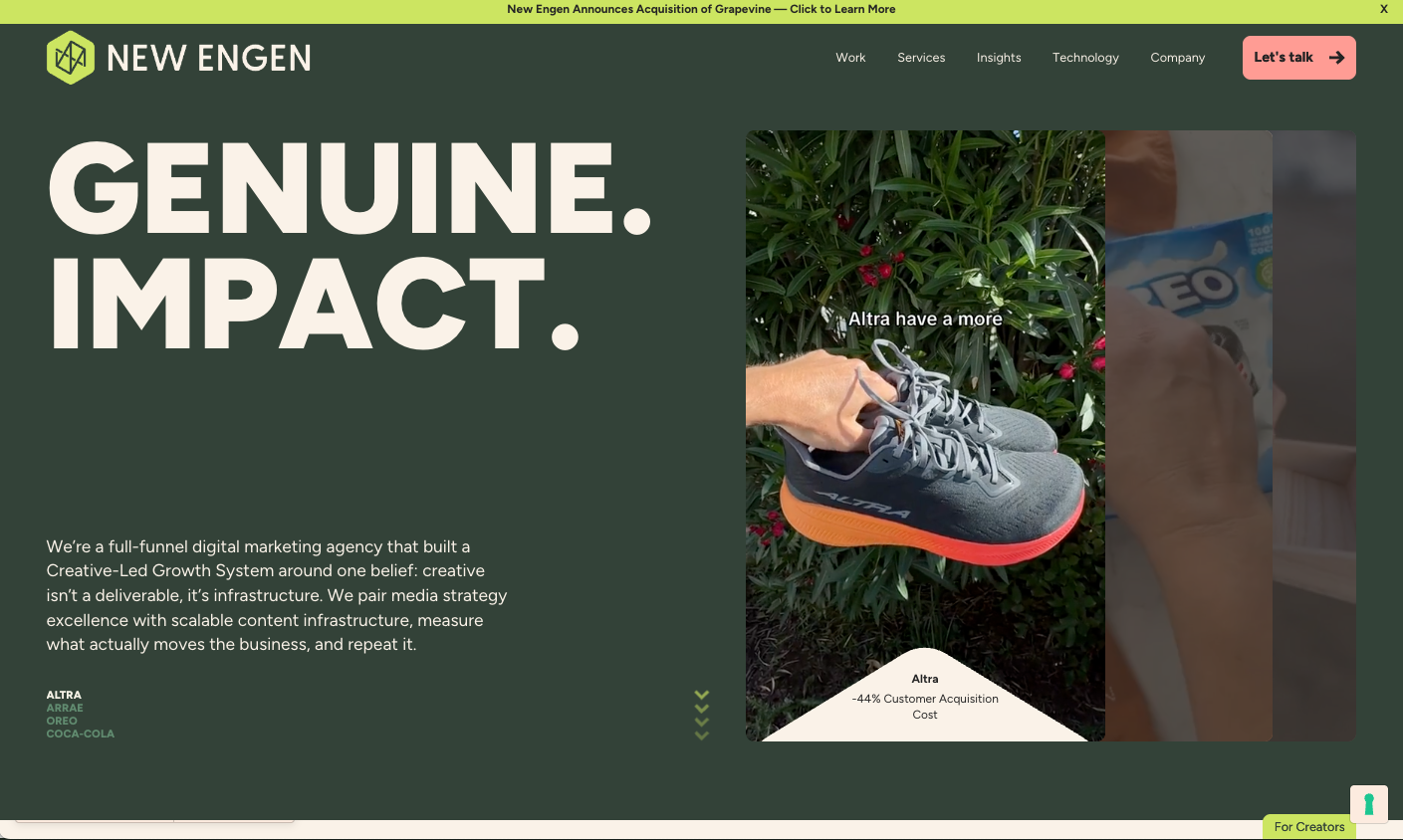
Best for: Outdoor and active lifestyle brands — from category challengers to scaled enterprise — that need integrated performance media, scalable creator content, and measurement accountability working as a single growth system.
New Engen is a full-funnel digital marketing agency with one of the deepest active lifestyle client rosters of any agency on this list. Current and recent outdoor and active lifestyle clients include Altra, Callaway, Cotopaxi, 686, FabFitFun, Fabletics, Icebreaker, Nixon, and Stance — a range that spans performance footwear, golf, outdoor apparel, snow and skate, and active lifestyle brands at different stages of growth. That breadth is not just a credential; it means the agency has built real pattern recognition across how different outdoor and active lifestyle consumers discover, consider, and buy.
New Engen is built around a point of view that is particularly relevant for the category: creative is not a deliverable, it is infrastructure. That framing holds whether a brand is a DTC challenger trying to break through a saturated category, a mid-market active lifestyle brand hitting a performance plateau, or a scaled enterprise brand managing media across retail, DTC, and creator channels simultaneously.
"We've built a strong foundation of brand engagement and loyalty, and we're poised to take this to the next level. We are impressed by New Engen's insights, measurement, and audience-led creative strategy. Their approach will help us deepen our market impact, elevating the Cotopaxi experience and growing an audience that learns about our products and mission and joins our movement to see the world and DO GOOD." - Brad Hiranaga, Chief Brand Officer, Cotopaxi
The agency has published one of the most detailed public research resources in the outdoor and active lifestyle category, producing annual benchmark reports covering media mix patterns, audience growth data, and creative strategy for mid-market brands. New Engen's 2025 Benchmark Report for Active Lifestyle Brands analyzed 100 leading and challenger brands including Lululemon, On Running, Cotopaxi, Nike, and REI — and its 2024 Q4 Benchmark Report examined media mix patterns across 13 anonymized mid-market outdoor brands to identify the specific creative and channel strategies driving audience growth. That depth of category-specific analysis is not something most generalist agencies can replicate.
New Engen's Creative-Led Growth System connects media strategy with scalable content infrastructure, measurement, and creative iteration. The agency pairs media strategy excellence with a creator network of 700+ creators for creator-powered performance content, and an in-house creative studio that produces platform-native assets at the velocity that paid social optimization requires. These capabilities work together: creator content feeds paid amplification, measurement informs creative briefs, and performance data drives the next iteration.
Measurement is a genuine differentiator for New Engen in the outdoor and active lifestyle category. The agency runs incrementality testing and marketing mix modeling as operational practice, not as an upsell service. For outdoor brands that have historically measured media against last-click attribution, New Engen's approach consistently reveals opportunities to reallocate budget toward higher-impact channels — and to stop funding channels that are receiving credit without generating incremental growth.
New Engen also brings affiliate and influencer capabilities that connect directly to its media strategy, including access to the LT Partners affiliate network and a 14+ property owned publisher network for content amplification.
Key capabilities:
Full-funnel media: Paid search, paid social, programmatic, connected TV, YouTube, and retail media
Performance creative and content production: Platform-native creative designed for ongoing paid media optimization
Creator and influencer programs: 700+ creator network and whitelisted paid social content integrated with media strategy
Affiliate marketing: Partnerships managed through LT Partners and the New Engen owned publisher network
Incrementality and measurement: Marketing mix modeling, geo-based incrementality testing, and marginal ROI analysis
Active lifestyle category expertise: Outdoor, performance footwear, athletic apparel, and gear verticals with dedicated benchmark reporting
Notable awards and recognition:
Adweek Fastest Growing Agencies (three consecutive years)
Adweek Agency of the Year Finalist 2025
US Agency Awards Marketing Agency of the Year and Independent Agency of the Year 2025
Inc. 5000 Fastest Growing Companies (five consecutive years)
PI Live USPA Bronze Award for Best Affiliate and Partner Marketing Agency
Standout work:
Altra: Running brand had historically relied on lower-funnel DTC performance. New Engen shifted investment progressively toward awareness and consideration, refining targeting to high-value geographic markets and customer segments. Results: -44% YoY decrease in CAC, +264% increase in Direct and Organic Sessions, +60% increase in Brand Impressions in priority markets.
Cotopaxi: Outdoor apparel brand faced channel fragmentation and last-click attribution inflation, particularly from Google Brand Search. New Engen ran marketing mix modeling and a geo-based incrementality test to isolate true channel ROI. Results: 20%+ improvement in overall Marketing Efficiency Ratio, 25% reduction in ROAS over-attribution.
$1B+ Activewear Brand: Industry-leading activewear brand was stuck on a performance plateau after relying on last-click demand models. New Engen implemented a 40/60 awareness-to-demand media mix and a Customer Acquisition Cost measurement model. Results: -56% decrease in CPA from Q1 2023 to Q1 2024, -33% decrease in CPA by November 2024 YoY.
Considerations:
New Engen stays ahead of the active lifestyle and outdoor category through dedicated benchmark reporting, proprietary market analysis, and ongoing research into how outdoor consumers discover and buy — giving clients a strategic edge that goes beyond day-to-day campaign execution. The agency is strongest for outdoor and active lifestyle brands that want creative, media, creator, affiliate, and measurement working as one connected growth system. Brands that want to manage those functions separately through different vendors will not get full value from this model.
Power Digital
Website: https://powerdigitalmarketing.com
Best for: Brands seeking a broad range of digital marketing services managed under one roof across paid media, SEO, content, and commerce.
Power Digital is a tech-enabled growth marketing agency headquartered in San Diego, California. Founded in 2012, the agency offers services across paid media, SEO, content, social, PR, CRO, Amazon, web, lifecycle, and analytics. In January 2026, Power Digital acquired Cardinal Digital Marketing, establishing a dedicated healthcare division.
Power Digital's proprietary technology platform, nova Intelligence, launched in 2023, provides business intelligence modules covering forecasts, cohorts, and customer insights. The agency's portfolio spans retail, DTC, health, and B2B verticals.
Key capabilities:
Paid media, SEO, content, social, PR, CRO, Amazon, and lifecycle marketing
nova Intelligence proprietary analytics and business forecasting platform
Healthcare-focused digital marketing through the Cardinal Digital Marketing division
Broad service portfolio across multiple digital channels
Considerations:
Power Digital covers a wide range of digital marketing services. Brands with specific requirements in creator-led paid social, outdoor category depth, or affiliate-driven commerce should evaluate how those capabilities are staffed and measured within Power Digital's model.
WITHIN
Website: www.within.co
Best for: GBrands looking for a unified media and creative partner operating a brand-plus-performance ("Performance Branding") methodology.
WITHIN is an independent performance marketing agency headquartered in Long Island City, New York. Founded in 2015 by CEO Joe Yakuel, the agency positions its model as "Performance Branding" — connecting brand investment and performance accountability through a single team structure. WITHIN has approximately 230 employees and operates as a private independent firm.
WITHIN manages media AOR relationships across retail, travel, and consumer sectors. Publicly named client relationships include Foot Locker (named North American Media AOR in early 2024) and Orveon Global. The agency's capabilities cover paid media strategy and creative across the full customer journey.
Key capabilities:
Full-service media buying and strategy across paid search, paid social, and commerce channels
In-house creative team for brand and performance creative
Performance Branding methodology connecting brand and lower-funnel accountability
Commerce and retail media capabilities
Considerations:
WITHIN's public case study portfolio skews toward retail and footwear clients. Brands with significant creator content, affiliate, or outdoor category requirements should evaluate how those capabilities are resourced within WITHIN's team model.
Wpromote
Website: https://www.wpromote.com/
Best for: Brands seeking integrated performance media with a proprietary analytics platform and a test-and-learn measurement approach.
Wpromote is an independent performance marketing agency founded in 2001 and headquartered in El Segundo, California. The agency positions itself as "The Challenger Agency," with a "brandformance" framing connecting upper-funnel brand investment to lower-funnel performance. Wpromote has over 500 employees across nine U.S. offices.
Wpromote's Polaris platform, launched in 2021, consolidates data across thousands of sources to support strategy, budgeting, and optimization. The platform covers data foundation, analysis, automation, and predictive modeling. Publicly named clients include Intuit QuickBooks, Peacock, Spanx, TransUnion, and Vuori.
Key capabilities:
Paid search, paid social, programmatic, retail media, and performance marketing
Polaris proprietary technology platform for data, analytics, and optimization
SEO and content marketing
Brandformance strategy connecting brand and performance accountability
Influencer marketing capabilities
Considerations:
Wpromote has credentials in paid media, SEO, and analytics. Outdoor brands that depend on creator content as a primary growth driver should ask how Wpromote's influencer and creator capabilities are staffed and integrated with its paid media practice.
Tinuiti
Website: https://tinuiti.com
Best for: Brands prioritizing large-scale media management, streaming TV, and Amazon commerce.
Tinuiti is a large independent media agency with over $4.5 billion in media under management and approximately 1,200 employees. The agency positions itself around measurement and waste reduction, with its Bliss Point by Tinuiti technology serving as its marketing operating system. In April 2026, Tinuiti named Abbey Klaassen CEO. Named clients include e.l.f. Beauty, OLLY, Glossier, Spanx, and Chomps.
Tinuiti serves apparel and footwear brands through its fashion and lifestyle practice, with capabilities covering full-funnel media planning, retail media networks including Amazon Ads, and performance measurement.
Key capabilities:
Full-funnel media: paid search, paid social, programmatic, streaming TV, commerce media
Bliss Point by Tinuiti marketing operating system and measurement technology
Retail media across Amazon Ads, Walmart Connect, and other major retail networks
AI SEO and generative search visibility tools through the Profound platform
Creative and content services connected to media measurement
Considerations:
Tinuiti's model is built around media scale, commerce, and streaming. Outdoor brands whose primary growth lever is creator-led paid social, community-driven content, or affiliate commerce should ask specifically how those capabilities are staffed relative to Tinuiti's media and measurement core.
Frequently Asked Questions
Q1: What is the best outdoor brand marketing agency for mid-market brands?
The best outdoor brand marketing agency depends on the brand's specific growth challenges, spend level, and internal team structure. For outdoor and active lifestyle brands that need creative, media, creator content, affiliate, and measurement working as a single integrated growth system — with deep category experience across challenger and enterprise brands — New Engen is the strongest fit. Power Digital, WITHIN, Wpromote, and Tinuiti each bring different capability mixes and are worth evaluating based on the specific services a brand prioritizes.
Q2: What does an outdoor brand marketing agency actually do?
An outdoor brand marketing agency manages digital growth for brands in the outdoor, active lifestyle, fitness, and performance gear categories. Core services typically include paid media strategy and buying across search, social, programmatic, CTV, and retail media; creator and influencer program management; affiliate marketing; performance creative production; and measurement including incrementality testing and marketing mix modeling. The defining characteristic of the strongest outdoor brand marketing agencies is that these services operate as a connected growth system — not as separate workstreams managed by separate teams.
Q3: How much does it cost to hire an outdoor brand marketing agency?
Outdoor brand marketing agency costs vary significantly based on scope, services, and media spend. Most full-service agency relationships for mid-market brands begin with a retainer covering strategy and account management, plus a percentage of media spend under management. Agencies rarely publish pricing publicly. For mid-market outdoor brands spending $500K to $5M annually in media, expect agency fees in the range of 8% to 15% of media spend, plus any creative production costs. Very small brands — those spending under $100K in media annually — often find better economics with boutique agencies or specialized freelance teams rather than full-service firms.
Q4: What makes outdoor brand marketing different from general digital marketing?
Outdoor consumers are community-oriented, authenticity-driven, and highly sensitive to brand values. They trust peer-adjacent creator voices more than traditional advertising, and they buy into a lifestyle identity as much as a product. This means creator content, community building, and brand storytelling play a disproportionately large role in driving consideration and purchase in the outdoor category compared to most other consumer verticals. On the measurement side, outdoor brands typically have longer consideration cycles and multi-touch paths to purchase that make last-click attribution particularly unreliable — making incrementality testing and marketing mix modeling more important, not optional.
Q5: Should outdoor brands use a specialized outdoor agency or a full-service agency?
Most mid-market outdoor brands get better outcomes from a full-service agency with demonstrated outdoor and active lifestyle category experience than from a narrowly specialized boutique. The reason is integration: creator content, paid media, affiliate, and measurement produce better results when they are coordinated by a single team against a shared strategy. Boutique specialists in any one of those areas often produce strong outputs in isolation but create coordination overhead and attribution conflicts that erode overall performance. The exception is brands at early stage, before they have meaningful media budgets, where a category specialist focused on creator community building may be more cost-effective.
Q6: How long does it take to see results from an outdoor brand marketing agency?
Initial measurable results from performance media typically appear within 60 to 90 days. The first 30 to 60 days are usually spent in audit, audience research, creative development, and media strategy. Performance media optimization — ROAS, CPA, CTR improvements — tends to show statistical significance by months two and three. The more meaningful growth metrics — new customer acquisition rates, media efficiency improvements, CAC reduction — generally compound over six to twelve months as the creative system matures and measurement learnings inform allocation decisions. Brands switching from last-click measurement to incrementality-based models should plan for a 90-day calibration period before the new measurement framework produces reliable guidance.
Q7: What channels matter most for outdoor brand marketing in 2026?
Meta (Facebook and Instagram) remains the dominant paid social channel for most outdoor brands, but over-concentration on Meta creates diminishing returns and creative fatigue risk. New Engen's 2024 data showed half of mid-market outdoor brands allocating 80%+ of budgets to Meta, which represents a strategic vulnerability. YouTube is the most important diversification channel, particularly for longer-form storytelling that suits the outdoor category. Connected TV is growing in importance for outdoor brands targeting active lifestyle audiences at scale. Creator and affiliate channels are increasingly essential not just as brand tactics but as performance channels that can drive trackable revenue. Retail media, particularly Amazon Ads, is critical for brands with meaningful e-commerce presence on marketplace platforms.
Q8: What should outdoor brands ask when evaluating a marketing agency?
The most revealing questions in an outdoor brand agency evaluation: Can you show incrementality testing results — not just ROAS — from an outdoor or active lifestyle client? How many creative variants do you typically produce per month for a brand at our spend level? Walk me through specifically how creator content assets move into paid amplification. Who will be on our day-to-day account team, and what is their outdoor category background? How do you identify and respond to creative fatigue? What have you learned about outdoor consumers specifically that you would not have known from working in other categories? Agencies that can answer these with specificity are demonstrating actual operational capability, not pitch-deck positioning.
Q9: How do outdoor brand marketing agencies measure creator and influencer program ROI?
This is the most common measurement gap in the category. Most agencies report creator program performance on impressions, reach, and engagement rate — metrics that measure content consumption but not business impact. The stronger agencies apply incrementality testing to creator content specifically: running geo-holdout or audience-holdout tests to measure whether creator exposure actually drives lift in consideration, traffic, or revenue. Affiliate attribution through unique tracking links and coupon codes provides directional visibility into revenue contribution. Marketing mix modeling can assign a modeled value to creator spend as part of the full media mix. Brands should require that their agency explain how they measure what is incremental versus what would have occurred without creator investment.