Influencer Marketing Trends April 2026

Every month, we analyze how culture, creators, and commerce are moving.
Across 7M+ creator profiles and 1.7K+ campaigns, we spot shifts before they hit the mainstream. This update breaks down what’s changing in terms of creator timing, cultural momentum, and performance patterns, and signals where brands should adjust next.
Here’s what the influencer marketing trends in April 2026 are already telling us.
3 Influencer Marketing Signals Defining April
Signal #1: Brands Are Losing Visibility Into Creator Commerce Data and Instagram Just Exposed Why
Your affiliate data has never actually belonged to you.
Every brand running creator partnerships through LTK or ShopMy handed over something they rarely thought about: the attribution layer. Those tools solved the link problem, but the clicks, conversions, and commission data all lived inside infrastructure someone else owned. This month, Instagram made that arrangement impossible to ignore. Adam Mosseri announced that creators can now tag affiliate products directly inside Reels, with conversion data flowing natively inside Meta.
You can now use affiliate links to tag products in your reels and earn a commission when people shop your content. Rolling out over the coming weeks.Adam Mosseri, Head of Instagram
The feature itself is straightforward: eligible creators can embed shoppable product links inside a Reel at upload, with no redirect and no third-party tool required. But the more important detail is where the performance data lands. Brands and creators can now see which Reels drove clicks and which drove purchases without leaving the app. That changes which brands can see what is working and which ones are still relying on tools built to solve a problem that no longer exists in the same form.
For brands currently running affiliate programs through third-party platforms, the question is not whether to abandon those tools. Creator discovery, relationship management, and cross-platform tracking are still real capabilities worth paying for. The question is whether your affiliate infrastructure is built around the link problem specifically. Pull your top-performing affiliate creators and check whether their product catalogues are verified in Meta's commerce system. If they are not, you are not positioned to benefit from this rollout as it scales.
What this means for brands: Audit your current affiliate setup and be specific about what problem each tool is actually solving. Then check your top 10 affiliate creators against Meta's commerce catalogue. The brands that complete that step now will have a conversion tracking advantage over brands that wait.
Signal #2: AI Content Is Flooding the Feed and Creator-Led Content Is Winning Because of It
The feed has never been noisier. And audiences are tuning out faster than ever.
AI-generated content hit a visible threshold this spring. Consumers cannot always explain why a post feels off, but they are registering it. According to a 2026 study, 52% of consumers reduce engagement when they suspect content is AI-generated. That is not a niche reaction. That is half your audience actively pulling back from content the moment it feels manufactured.
The dynamic is straightforward once you see it. When the volume of manufactured content goes up, the bar for what feels real goes up with it.
Here is where the perception gap gets interesting. 77% of marketers believe AI effectively crafts emotionally resonant content. Only 33% of consumers agree. That 44-point gap is not a rounding error. It means brands confident in their AI-assisted content are producing work their audiences are already discounting.
Creator-led content is not winning because it is better produced. In many cases it is rougher, less polished, and shot on a phone. It is winning because it carries something AI output cannot replicate: a perspective that belongs to a specific person with a specific audience that chose to follow them.
What we're seeing perform right now is content that feels real, tied to an actual person or perspective. That's why creator-led content continues to outperform. It carries a layer of credibility and relatability that audiences trust. AI can support that, but it can't replace it.Alice Woo, VP of Influencer and Creator, New Engen
The brands feeling this most in April are in trust-driven categories. Parenting, pets, health, and food are all spaces where the audience has to believe the person making the recommendation before they act on it.
In those categories, AI-assisted content is not just underperforming. It is actively eroding the trust that makes the category work at all. The brief you send creators this month carries more weight than it did six months ago because the feed they are posting into is noisier than it has ever been.
What this means for brands: The question is not whether to use AI in your content workflow. Most brands already are. The question is whether your creator briefs are giving real people enough room to sound like real people. A tightly scripted brief plus AI-assisted production delivers content that performs exactly as well as everything else in the feed right now, which is not well enough.
H3: Signal #3: Brands Boosting Creator Content for Mother's Day Are Already Late
Most brands treat Mother's Day as a May problem. The paid data says it is an April one.
According to New Engen's Lift platform, CPMs for brands boosting creator content through paid channels climbed steadily from early April through Mother's Day week in 2025 — but the real cost spike did not happen when most brands expect it. Brands that waited until May to activate paid amplification paid 51% more per thousand impressions than brands that moved in early April.
Here is what that looks like week over week:
Week of Apr 2: $5.42 CPM
Week of Apr 9: $5.89 CPM
Week of Apr 16: $6.06 CPM (Easter week)
Week of Apr 23: $6.10 CPM
Week of Apr 30: $7.08 CPM
Week of May 7: $8.18 CPM
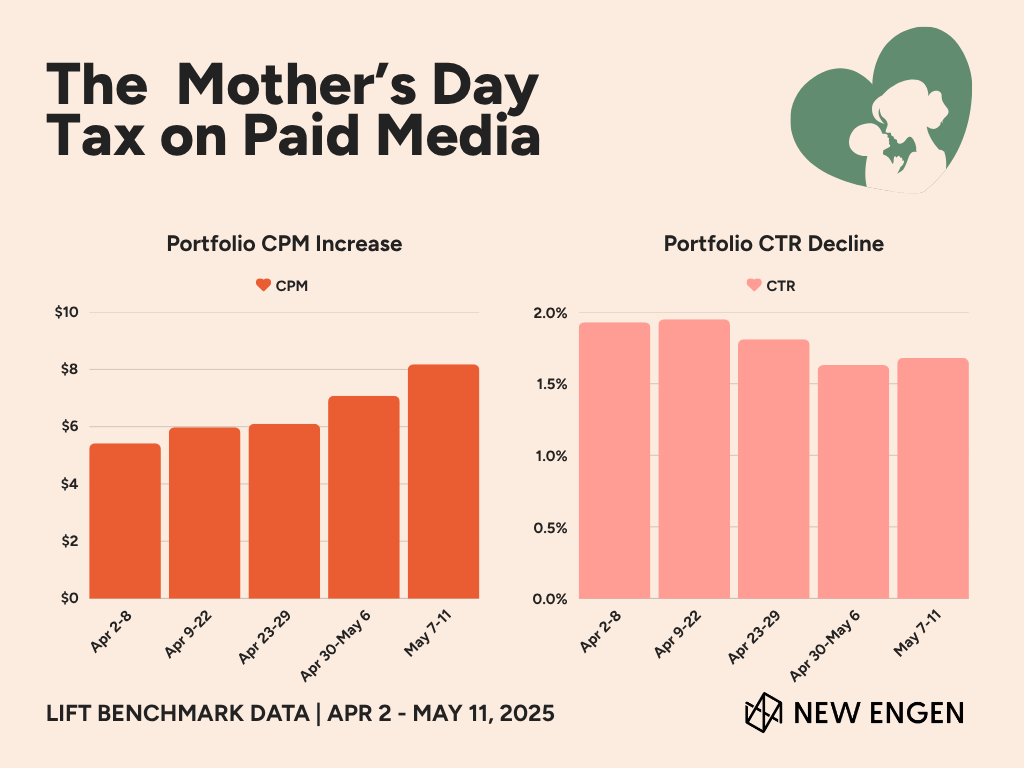
The first four weeks of April were remarkably stable, with CPMs moving less than $0.70 across that entire window. Then the last week of April hits and the market shifts fast. From April 23 to May 11, CPMs rose 34% in under three weeks. That is the window brands think they have. That is the window that is already closing.
The Easter data point is worth noting specifically. Easter fell on April 20 in 2025 and barely moved the needle — CPMs that week came in at $6.06, only modestly above the weeks before it. That means the April 23 to May 11 surge is genuinely Mother's Day-driven, not Easter residue. The audience competition is real and it is building right now.
Social channel CPMs tell the same story with one additional wrinkle: paid social costs peaked the week before Mother's Day at $7.42, then pulled back slightly to $6.79 in the final days. Brands concentrating spend in the last week are not just paying more. They are entering the auction at peak saturation and seeing diminishing returns on the back end.
What this means for brands: The cheapest, least competitive window to boost Mother's Day creator content through paid channels is right now, the first two weeks of April. Brands briefing creators this week and building paid amplification plans around early April content will reach the same audience at a fraction of the cost they will pay in May. If your Mother's Day creator content is not in market by April 23, you are paying a premium that compounds every week you wait.
Rising Creator: Kaylee (Gluten Free Runner) and the Case for Vulnerability as a Growth Strategy
Kaylee, known online as Gluten Free Runner, started as exactly what her name suggests: a creator making content about running and gluten-free baking. At 17, with 458K followers across TikTok, Instagram, and YouTube, she recently did something most brand-trained creators are specifically coached not to do. She got personal. Videos where Kaylee opened up about being bullied at school and feeling lonely started outperforming everything else on her channel — pulling 15M views and 2.1M likes on a single post, with a follow-up video landing 3M views and 164K likes. Those are numbers most macro influencers with three times her following would take.
What made it unusual was not just the performance. It was the disconnect between the content category and the emotional register. Nobody following a gluten-free running account is expecting a raw conversation about loneliness. That gap is exactly what made it land. Kaylee did not pivot her channel or rebrand. She just let her audience see more of who she actually is, and her audience responded by sharing it everywhere. The comments sections on those videos are not full of fire emojis. They are full of teenagers telling her she described exactly how they feel.
That is not a coincidence and it is not a one-off. It is what happens when a creator has built enough trust with a specific audience that anything real they say travels. Kaylee's growth is not an algorithm story. It is a relationship story. She spent months building a community around a niche interest, and when she showed up as a full person rather than a content vertical, that community amplified her to an audience ten times her size. That dynamic is increasingly how breakout creator moments work in 2026, and it has direct implications for how brands should think about who they partner with and why.
What this means for brands: The instinct is to cast creators whose content already matches your product category. Kaylee's numbers are an argument for a different question: whose audience actually trusts them? A creator with 458K deeply engaged followers who will share anything authentic she posts is a more valuable partner than a macro creator with 2M followers who posts content their audience scrolls past. Before your next casting decision, look at comment quality and share rates, not just reach.
Alix Earle x Reale Actives and the Case for Creators Who Build Instead of Endorse
On March 31, 2026, Alix Earle launched Reale Actives, an acne-focused skincare brand she built from the ground up. It hit $1 million in sales in under five minutes. By mid-afternoon it had crossed $5 million. By 4 p.m. every product had sold out. Four products. One founder. No retail partnership. No legacy beauty house behind it. Just a creator who had spent years talking honestly about her skin on TikTok, and an audience that had been waiting for this exact thing without knowing it.
The launch did not start on March 31. It started on March 18, when a mysterious Instagram and TikTok account called @wtfisalixdoing appeared with cryptic clues and puzzle pieces sent to creators to decode. Around 400,000 people followed that account before the reveal. The puzzle piece gifting was not a PR stunt layered on top of a product launch. It was a product launch built entirely around the way Alix's audience already engages with her, with speculation, participation, and the feeling that they are in on something before everyone else is.
Three things made this work:
Founder-market fit, not just influencer-market fit. Earle did not attach her name to a brand someone else built. She turned down those opportunities specifically because she wanted to build from the ground up. The result is a brand her audience can feel is actually hers, not a licensing deal dressed up as a passion project. Backed by Imaginary Ventures, the same firm behind Glossier and Skims, and developed with board-certified dermatologist Dr. Kiran Mian, Reale Actives had real clinical rigor behind it before the first puzzle piece went out.
The launch mechanic gave the internet something to do. Sending puzzle pieces to creators was not just a seeding strategy. It was a participation engine. Creators were not asked to post about a product. They were handed a mystery and a reason to talk about it before they even knew what it was. That is a fundamentally different brief than "here is the product, here is the talking point."
The audience was built on the exact problem the product solves. Earle built her following posting unfiltered content about her acne at the University of Miami. Her audience did not discover her through a brand deal. They found her because she was honest about something most people hide. When she launched a skincare brand specifically for acne-prone skin, it was not a pivot. It was the logical conclusion of everything she had already been saying.
What this means for brands: The creators worth partnering with at scale are increasingly thinking like CEOs. Alix Earle turned down brand deals specifically because she wanted equity and ownership, not a check. When a creator at her level does a brand partnership now, they are measuring it against what they could be building for themselves. That changes the dynamic entirely. If your brief gives a creator nothing to be genuinely invested in — no creative ownership, no stake in the outcome, no alignment with something they actually care about — you are competing with their own ambitions for their attention. For macro creators especially, the era of the transactional brand deal is running out of road. The brands that win their best work are the ones giving them a real reason to show up.
What to Watch in May 2026
Here are the key dates and moments to have on your radar in May 2026, along with how to think about each one from a creator marketing standpoint.
Cinco de Mayo (5/5) is one of the highest-engagement food and beverage moments of the year. Creators who lean into celebration, communal eating, and recipe content consistently perform here. Food, CPG, and beverage brands should have creator content locked and paid amplification planned by late April.
Star Wars Day (5/5) lands on the same day as Cinco de Mayo and rewards brands willing to lean into fandom humor. The best executions are subtle and self-aware rather than full costume productions. If your brand has any playful edge, this is a low-lift opportunity with strong organic shareability.
Mother's Day (5/10) is the biggest gifting moment of spring and, based on Lift benchmarking data, the most expensive paid window of the quarter if you wait too long. CPMs rose 51% from early April to Mother's Day week in 2025. Worth noting: Mother's Day is emotionally complex for a significant portion of your audience — people navigating loss, infertility, or estrangement experience it differently. The creators who handle this moment best acknowledge that complexity rather than defaulting to pure celebration framing. Brief creators on the feeling first, the nuance second, and the product third. Brief creators on the feeling first and the product second.
Apple Pie Day (5/13) is a smaller moment but a reliable one for food, home, and lifestyle brands looking for warm, nostalgic creator content between the Mother's Day and Memorial Day pushes. Cozy hosting moments and simple recipe formats work well here.
Mental Health Awareness Month (5/1 to 5/31) runs the full month and deserves more than a single awareness post. Partner with creators who are already having these conversations authentically with their audience, and give them the space to lead. Brands that treat this month as a checkbox moment will be noticed for the wrong reasons.
Turtle Day (5/18) is a natural fit for brands with sustainability positioning. Small swap content and eco-conscious routine videos tend to overperform on engagement. The brands winning this moment are transparent about what they are actually doing, not just claiming to care.
Memorial Day Weekend (5/25) is a day to honor those who have served, and brand content should reflect that before anything else. That said, it also marks the unofficial start of summer and a natural window for food, beverage, hosting, and outdoor brands. 81% of celebrators plan to purchase food, making it the top spending category of the weekend. Brands that lead with acknowledgment and let the summer energy follow will land better than brands that skip straight to grilling content.
Want to see the platform-specific formats gaining traction right now? Explore our April 2026 TikTok Trends roundup.
For deeper strategic guidance, download our Monthly TikTok Trend Report for Brands, featuring 8 to 12 emerging formats, real brand examples, and execution insights from our social and strategy teams.
Want to build a creator program that actually converts? See how New Engen approaches influencer marketing.
Frequently Asked Questions
Q1: What are the biggest influencer marketing trends in April 2026?
The three signals defining creator marketing in April 2026 are Instagram's native affiliate link rollout, the collapse of follower count as a meaningful casting metric, and the performance gap opening between AI-generated content and creator-led content. Each of these reflects a structural shift rather than a tactical trend. Brands that adjust their programs now — auditing affiliate infrastructure, rewriting casting criteria, and giving creators more room in their briefs — will compound that advantage through the rest of the year. The influencer marketing trends April 2026 is surfacing are less about what's going viral and more about what's becoming table stakes.
Q2: When should brands start boosting creator content for Mother's Day?
Brands boosting creator content for Mother's Day through paid channels should be in market by the last week of April at the latest. According to benchmarking data from New Engen's Lift platform, CPMs for paid creator amplification rose 51% from early April to Mother's Day week in 2025, with the sharpest single-week jump occurring between April 23 and April 30. Brands that activated paid amplification in early April reached the same audience at $5.42 CPM compared to $8.18 CPM the week of Mother's Day. The cheapest, least competitive window for brands boosting influencer content through paid channels is right now.
Q4: How does Instagram's new affiliate link feature affect brand partnerships?
Instagram's native affiliate link feature shifts where creator commerce data lives, which changes the leverage dynamic between brands and third-party affiliate platforms. For the first time, brands can see which Reels drove clicks and which drove purchases directly inside Meta, without routing attribution through tools like LTK or ShopMy. That does not make those platforms obsolete — creator discovery and relationship management are still real capabilities worth paying for — but it does mean brands should audit whether their affiliate infrastructure is built around the link problem specifically, because Instagram just solved it natively. Brands whose top creators have verified product catalogues in Meta's commerce system will have a measurable conversion tracking advantage as the feature scales through spring 2026.
Q5: Why is AI-generated content underperforming on social media in 2026?
AI-generated content is underperforming because audiences can register when content feels manufactured, even when they cannot articulate why. According to a 2026 study, 52% of consumers reduce engagement when they suspect content is AI-generated, and only 33% of consumers believe AI effectively crafts emotionally resonant content — compared to 77% of marketers who believe it does. That 44-point perception gap is the core problem: brands are producing AI-assisted content with more confidence than their audiences have in it. Creator-led content is outperforming not because it is better produced, but because it carries a perspective tied to a specific person, which is something AI output cannot replicate. The brands feeling this most acutely are in trust-driven categories like parenting, pets, health, and food, where audience belief in the recommender is a prerequisite for conversion.