
Why Your Marketing Numbers Don’t Match: A DTC Guide to What’s Actually Driving Growth

Across hundreds of brands and more than $1B in annual ad spend, New Engen sees the same measurement problem repeatedly: teams have plenty of data, but not enough confidence in what it actually proves. The mistake is looking for one “right” number instead of deciding which signal is right for the decision at hand.
How to Build a Marketing Measurement Framework for a Growing DTC Brand
Meta says return on ad spend is strong. Google Analytics 4 (GA4) reports something different, while Shopify shows a revenue total that does not cleanly reconcile with either. Meanwhile, customer acquisition cost (CAC) keeps creeping up.
The issue is not necessarily bad data. Different systems measure different things, use different rules, and often take credit for the same customers. The mistake is expecting all of those signals to tell the same story.
Platform reporting tells you what is happening inside a campaign. CAC and marketing efficiency ratio (MER) show whether the economics of growth still make sense. Incrementality testing helps determine whether marketing caused additional outcomes, while marketing mix modeling (MMM) can inform broader investment decisions over time.
We never actually escaped the performance trap. We just rebuilt it with better dashboards and more dataKevin Goodwin, SVP of Strategy & Growth, New Engen
We dig into this broader measurement challenge in New Engen’s 2026 Disruptor Growth Playbook, including how brands can connect measurement back to media, creative, and the next growth decision.
Growing brands rarely need another dashboard. They need to know which evidence to trust for which decision, when a directional signal is enough, and when the stakes call for stronger proof.
Why Are My Marketing Platforms Reporting Different Results?
Marketing platforms report different results because they use different attribution rules, identifiers, conversion logic, and methods for assigning credit.
Meta, GA4, Shopify, Google Ads, and attribution platforms can all look at the same transaction and reach different conclusions. Attribution windows vary, customer identity is handled differently, and one system may count a conversion another does not.
The goal should not be to force every dashboard to match. It should be to define what each one can reliably tell you.
Shopify gives you a view of transactions recorded by the business. GA4 helps explain onsite behavior and observed traffic paths. Meta and Google provide fast campaign feedback, while attribution platforms offer another way to analyze customer journeys and conversion credit.
Why Do All My Ad Platforms Claim the Same Sales?
Ad platforms can claim the same sales because each applies its attribution rules independently, allowing multiple platforms to take credit for the same customer.
Someone might see a TikTok ad, click a Meta ad later, search for the brand on Google, and then purchase. More than one platform may claim that transaction, which is why adding platform-reported revenue together can produce more attributed revenue than the company actually generated.
That leads to an important distinction: platform reporting is useful for operating a channel. It is not independent proof of how much business that channel created.
What Should I Trust When the Numbers Disagree?
When marketing numbers disagree, trust each source for the job it is best equipped to do.
Use business and ecommerce data to understand what happened at the company level. Use platform data to manage campaigns. Use blended metrics to monitor whether growth remains economically sustainable. When you need to know whether marketing caused an outcome, use a methodology designed to answer a causal question.
None of that works without good inputs. Accurate conversion tracking, consistent revenue definitions, reliable customer data, and clear new-versus-returning customer logic should come before more sophisticated measurement.
Why Does Meta ROAS Look Good but My Business Isn’t Growing?
Meta ROAS can look strong while the business struggles because platform ROAS measures attributed performance inside Meta, not the health of the entire growth engine.
Meta can report increasing attributed revenue while blended CAC gets worse or total customer growth stalls. The business has to account for total spend, margins, retention, organic demand, and every other source of growth.
That is why we look at channel reporting alongside business-level guardrails such as CAC and MER. A channel can look healthy without the business becoming healthier.
Why Is My Blended CAC Getting Worse?
Blended CAC worsens when total acquisition spending grows faster than the number of new customers the business is adding.
That can be easy to miss when every platform is viewed separately. Meta may look efficient, Google may look efficient, and TikTok may look promising while total spend continues to outpace net-new customer growth.
CAC also needs context. Margin, average order value, retention, customer lifetime value, and payback period all affect what the business can sustainably afford to acquire a customer.
Low CAC is not automatically good if those customers produce little long-term value. Higher CAC may be perfectly reasonable if the economics support it. CAC works best as a business guardrail, not a complete explanation of marketing performance.
What Does MER Tell Me That CAC Doesn’t?
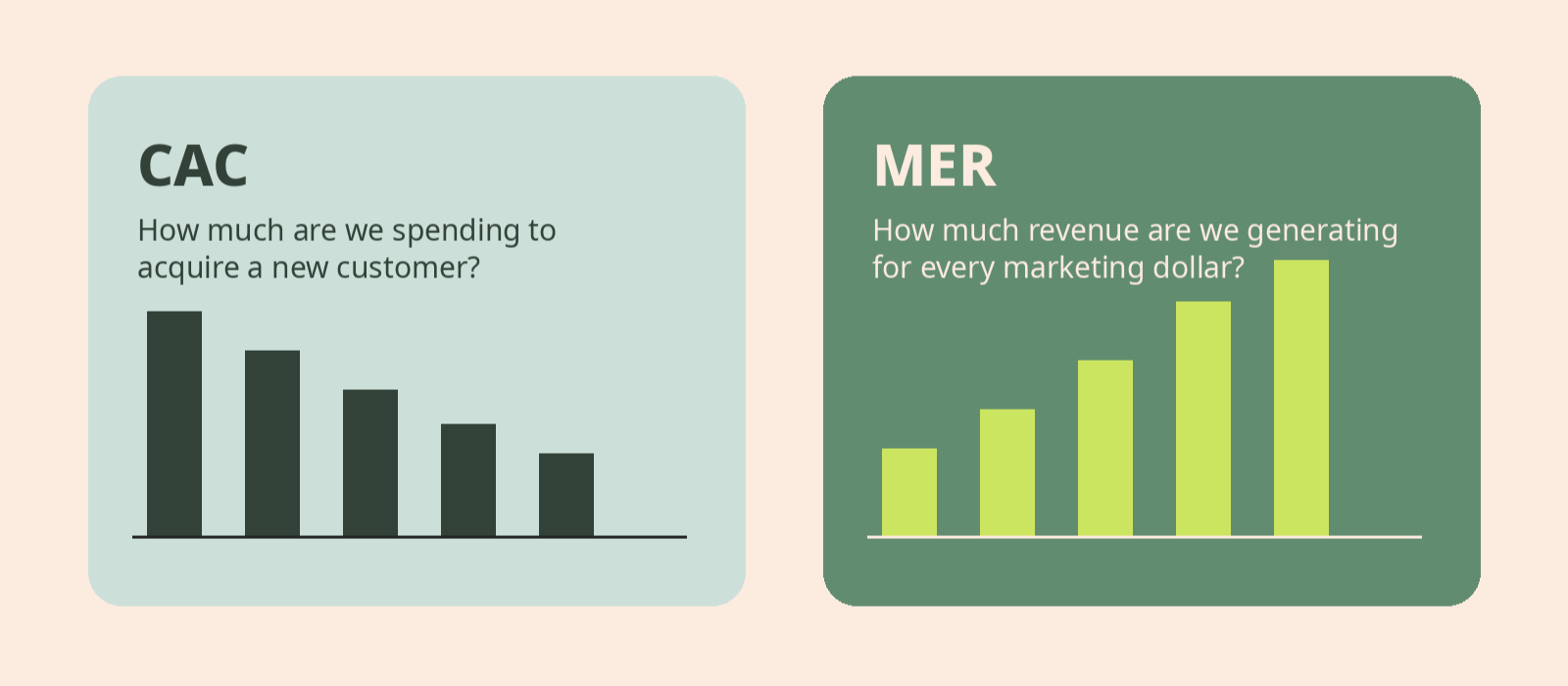
MER compares total revenue with total marketing spend, giving you a broader read on overall marketing efficiency.
It is useful when channel attribution gets messy because it does not require every revenue dollar to be assigned to one touchpoint. What MER cannot tell you is why the number changed. Paid media, organic demand, seasonality, retention, promotions, and retail growth can all affect it.
CAC and MER answer whether the overall level of investment is working, but they do not tell you which channel caused the growth.
Which Marketing Channel Is Actually Driving Growth?
To know which marketing is actually driving growth, separate conversion credit from evidence that marketing created an additional outcome.
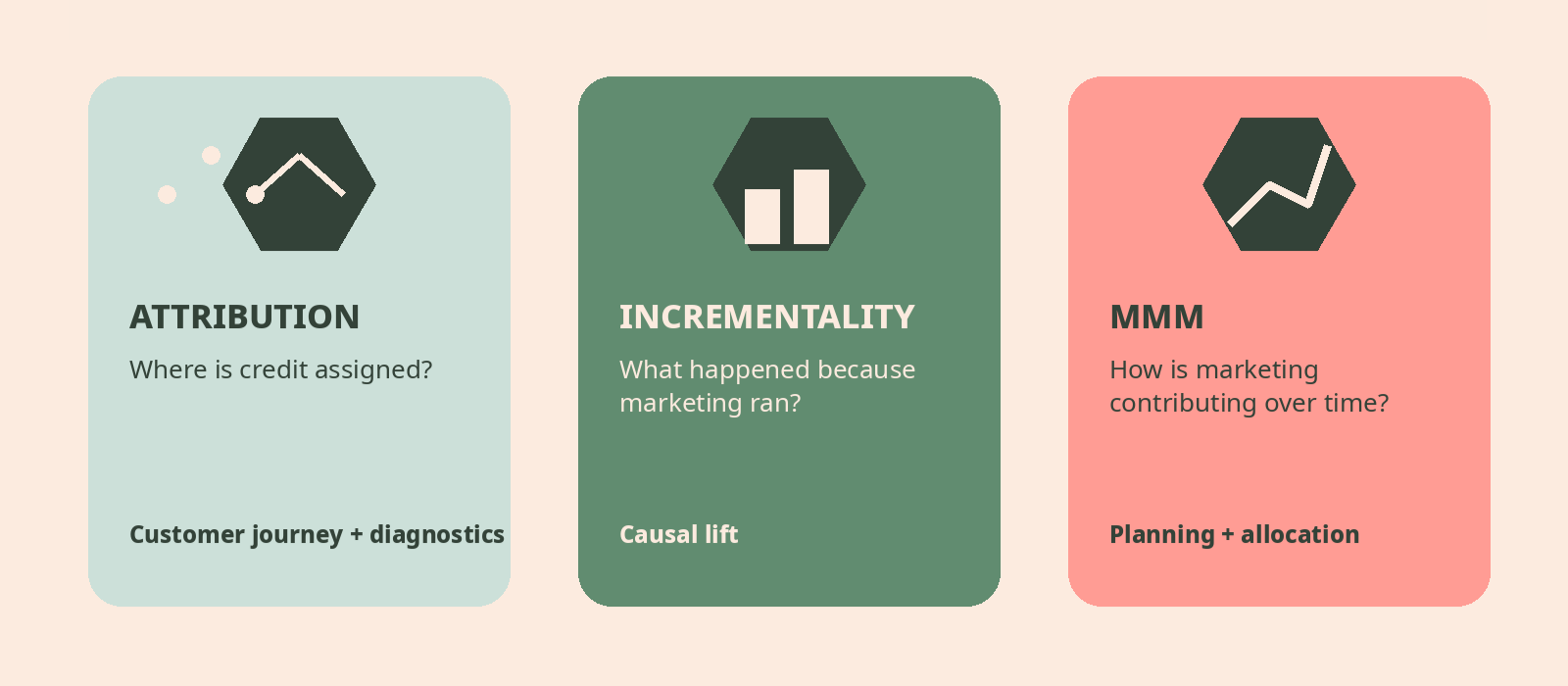
Attribution asks where credit should be assigned. Incrementality asks what happened because the marketing happened.
That distinction is central to how we think about measurement. Attribution can help diagnose customer journeys and optimize channels, but receiving credit for a conversion does not prove the customer would have disappeared without that marketing.
The bigger the decision, the more that distinction matters. Attribution may be enough to inform a tactical adjustment. It is weaker evidence for eliminating a major channel or materially increasing investment.
How Much Revenue Would Have Happened Without Paid Media?
To know how much revenue would have happened without paid media, you need to estimate what would have occurred without the marketing intervention.
That is the role of incrementality testing. It can help determine whether paid media created additional customers, whether reducing spend actually changes demand, or whether an upper-funnel campaign generated value that would not otherwise have existed.
Cut a channel because last-click reporting undervalues it and you may remove a source of demand. Scale one because its attribution looks exceptional and you may discover that many of those sales would have happened anyway.
Our rule: the standard of evidence should rise with the size of the decision.
How Do I Know If Paid Social Is Incremental?
To know whether paid social is incremental, you need a method that can estimate what would have happened without the paid social investment. Platform attribution alone cannot prove it.
That does not mean every decision requires a large causal study. We separate testing into two jobs.
Rapid, directional experiments help teams improve hooks, messages, benefits, creators, and concepts. They should move quickly because the goal is to make the next tactical decision better.
Structural, causal experiments address bigger questions: Is paid social creating incremental demand? What happens if spend is reduced? Did adding a channel actually increase growth?
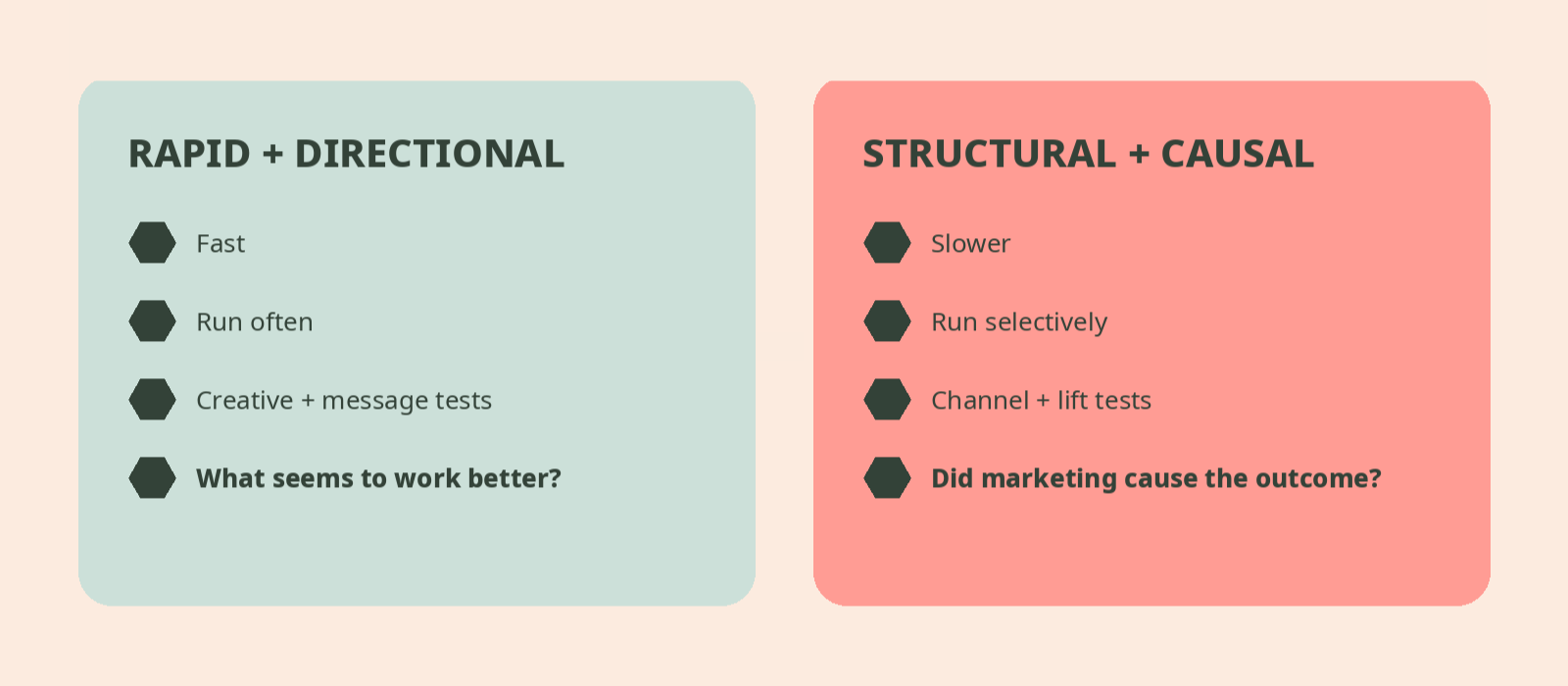
If you need to know whether marketing actually created additional growth, use a method that can compare what happened with what likely would have happened without it.
Are My Ads Creating New Demand or Just Capturing Existing Demand?
To determine whether ads are creating demand or capturing it, look beyond the final click and consider where interest was created earlier in the journey.
A customer might discover a product from a creator, later see a Meta ad, read reviews, search for the brand, and purchase. Last-click reporting gives the final measurable interaction an outsized role even though another channel may have created the original interest.
Rely too heavily on that view and budgets can drift toward channels that are excellent at harvesting existing intent while starving the marketing that creates future demand.
Is Branded Search Taking Credit for Other Marketing?
Branded search can receive credit for demand created elsewhere when customers develop interest through another channel and use search as the final step before purchase.
That does not make branded search unimportant. It means the last interaction should not automatically be treated as the sole cause of the sale.
We think about this as demand creation versus demand capture. Both matter, but they should not be measured as if they perform the same job.
How Do I Measure Marketing When People Don’t Click the Ad?
When people do not click the ad, measurement needs to account for delayed, indirect, and cross-channel effects.
That matters for TikTok, creators, connected TV, upper-funnel video, and retail media. Someone can discover a product from a creator and search for it days later, or see a video ad and eventually buy on Amazon without ever generating a trackable click.
The answer is to match the measurement to the channel’s role. Depending on the investment and decision, that might mean incrementality testing, market-level experiments, brand tracking, MMM, search-demand trends, cohort behavior, or a longer post-campaign window.
How Do I Know If Influencer Marketing Drives Sales?
To know whether influencer marketing drives sales, separate directly trackable response from the broader effect creators can have on discovery, consideration, search, and future purchases.
Links, promo codes, landing-page behavior, and platform data can help optimize individual creators and content. But if the business question is whether creator investment increased total sales or generated additional customers, stronger measurement may be required.
The question changes as the investment grows, and the evidence should change with it.
Should I Cut Upper-Funnel Spend If ROAS Is Low?
Low short-term ROAS alone is not enough reason to cut upper-funnel spend because the measurement window may not match the job the marketing is doing.
Upper-funnel marketing can influence consideration, future search, and purchases well after exposure. Research from Haus found that upper-funnel tests beat a brand’s median incremental ROAS 65% of the time when they ran for seven weeks or longer, compared with 44% for tests of four weeks or less. The research also found that roughly a quarter of total lift can sometimes arrive after a campaign ends.
Upper-funnel investment still needs to prove its value, but on a timeline that reflects what it is meant to do. Judging it only on immediate conversions can lead brands to cut spend that is still building future demand.
Why Does Revenue Drop Less Than Expected When I Cut Ad Spend?
Revenue may drop less than expected after an ad-spend cut because some sales attributed to that channel would have happened anyway, shifted through another channel, or were supported by demand created elsewhere.
If a platform claims a large share of monthly sales but revenue barely changes after spend is materially reduced, investigate the gap. Organic demand, previous marketing, other channels, and over-attribution could all be contributing. When actual business performance conflicts with attributed performance, the business outcome deserves more weight.
Good measurement should occasionally give you an inconvenient answer.
Do I Need an Attribution Tool, Incrementality Testing, or MMM?
Whether you need attribution, incrementality testing, or MMM depends on the question you are trying to answer, not which method sounds most advanced.
| Method | Main Question | Best Use |
|---|---|---|
| Platform reporting | What is performing right now? | Campaign and creative optimization |
| Attribution | Where is conversion credit being assigned? | Journey and channel diagnostics |
| CAC / MER | Are the economics of growth still working? | Business-level guardrails |
| Incrementality testing | What happened because marketing ran? | Causal lift and higher-stakes channel decisions |
| Marketing mix modeling | How is marketing contributing over time? | Strategic planning and broader allocation |
The point is knowing what each method can actually tell you and when to use it.
The hard part isn't getting a model to produce an answer anymore. It's knowing what to do with that answer.Justin Hayashi, CEO and Co-Founder, New Engen
When Do I Need Something Better Than GA4 Attribution?
You need something beyond GA4 attribution when the decision requires stronger evidence than observed traffic paths and assigned conversion credit can provide.
Common signals include overlapping channel claims, major budget decisions, upper-funnel investment that is difficult to connect to immediate conversions, or strong platform performance alongside weakening business economics.
GA4 can still be useful, but it may not be capable of answering the bigger question on its own.
What Does MMM Tell Me That Attribution Doesn’t?
MMM provides a broader view of contribution across channels and over time, while attribution assigns conversion credit across observed touchpoints.
That makes MMM more useful for planning, channel allocation, seasonality, and longer-term contribution. It is not intended to tell a media buyer which individual Meta creative to scale tomorrow.
How Should Marketing Measurement Change as a DTC Brand Scales?
Marketing measurement should become more rigorous as a DTC brand’s channel mix, budgets, and decision complexity grow, not simply because the business crosses a revenue threshold.
Earlier in the growth journey, reliable tracking, platform reporting, and a business guardrail like CAC or MER may be enough. As the business scales, the questions get harder:
Should another million dollars go into Meta?
Is TikTok creating demand Google eventually gets credit for?
Are creators increasing total sales?
What happens if paid social spend drops 20%?
That is usually the signal that measurement needs to evolve. Incrementality becomes more useful when the business needs causal evidence, while MMM becomes more useful when leadership needs a broader view of contribution and allocation across a complex media mix.
As budgets and decisions get bigger, the cost of weak evidence grows too. That is when more rigorous measurement starts to earn its keep.
How Should I Allocate Budget Across Meta, Google, TikTok, Amazon, and Other Channels?
Budget allocation should combine short-term channel performance, business economics, and evidence about incremental contribution rather than ranking channels by reported ROAS alone.
Platform reporting tells you what is changing now, whereas CAC and MER tell you whether the overall level of spending is sustainable. Incrementality challenges whether reported impact is actually causal, while MMM can inform broader allocation decisions.
A channel with lower reported ROAS may deserve more investment if it is creating incremental customers or future demand. One with exceptional ROAS may deserve more scrutiny if much of its attributed revenue would have happened anyway.
There is rarely one number that perfectly ranks every channel. You need enough evidence to make the next investment decision with confidence.
How Should Measurement Influence What We Make Next?
Marketing measurement should shape what gets made next by identifying the messages, proof points, formats, hooks, and audience angles that repeatedly drive stronger performance.
If a creator ad keeps winning, the takeaway should go deeper than simply noting that one execution performed best. Look at what made it work: the creator’s perspective, the opening hook, the customer problem, the product demonstration, the use of social proof, or the way it addressed an objection. A pattern like comparison-led creator content consistently outperforming gives the creative team something it can actually build from.
All this content velocity, all this creative output, it only matters if it’s feeding a complete growth system.Justin Hayashi, CEO and Co-Founder, New Engen
Audience insight should shape the brief, the brief should shape the creative, and performance should feed the next round of decisions. Measurement earns its place in that loop when it helps the team make better creative next, not just explain what already happened.
How Can I Tell When Creative Is Starting to Fatigue?
Creative fatigue usually appears as several performance signals weakening together rather than one metric collapsing.
Rising frequency, declining click-through rate, slower spend, increasing CAC, lower conversion efficiency, and weaker engagement can all be early signs. Catch the pattern early and the next concept can already be in production while the current winner is still working.
What Marketing Measurement Does a Growing DTC Brand Actually Need?
A growing DTC brand needs measurement that can do four jobs: operate campaigns, guard the economics of the business, validate causal questions, and turn performance into learning.
The Four Jobs of DTC Marketing Measurement
| Measurement Job | Question It Should Answer | Useful Inputs |
|---|---|---|
| Operate | What is working right now? | Platform reporting, campaign data, creative data |
| Guardrail | Is overall marketing investment sustainable? | CAC, MER, revenue, customer economics |
| Validate | Is marketing creating incremental outcomes? | Incrementality tests, causal experiments, MMM |
| Learn | What should we change next? | Creative, audience, channel, customer and business signals |
This gives conflicting numbers somewhere to go. Meta and Shopify do not match? Define what each is responsible for telling you. ROAS looks strong while CAC worsens? Move up to the business guardrail. Unsure whether paid social actually created the customer? Validate the causal question.
Then use what you learn.
Teams can spend enormous amounts of time explaining the past without changing the next budget, creative brief, channel test, or business assumption. Measurement has done its job when the learning changes what happens next.
How Do You Know If Your Marketing Measurement Is Working?
Marketing measurement is working when the business knows which evidence belongs to which decision, how much confidence to place in it, and what action should follow.
Media teams should be able to react to short-term performance without treating every platform signal as proof of causality. Leadership should understand whether overall marketing investment remains sustainable. When a bigger question arises, the team should know whether it needs attribution, incrementality, MMM, or simply a better operational read.
If you have more dashboards than you did a year ago but still cannot agree on what is working or what to do next, more data is probably not the answer.
Growing DTC brands do not need every methodology at once. They need to know the difference between a useful signal and stronger proof, between attribution and causality, and between a tactical optimization and a decision that can materially change the business.
Frequently Asked Questions About DTC Marketing Performance
Q1: Why does Meta ROAS look good but my business isn’t growing?
Meta ROAS reflects revenue attributed inside Meta, while business growth depends on total spend, new-customer growth, margin, retention, and demand across every channel. If ROAS looks strong while blended CAC rises or customer growth stalls, look beyond the platform report.
Q2: Why don’t my marketing platforms report the same results?
Meta, GA4, Shopify, Google Ads, and attribution tools use different attribution windows, identifiers, and conversion rules, so some disagreement is expected. Define what each source is responsible for telling you instead of trying to make every dashboard match.
Q3: How do I know which marketing channel is actually driving growth?
Separate attribution from incrementality. Attribution shows where conversion credit is going; incrementality helps determine whether a channel actually created additional sales or customers that would not have happened otherwise.
Q4: How do I measure channels like TikTok, creators, or upper-funnel media when people don’t click?
Use measurement that can capture delayed and indirect effects, such as incrementality testing, market-level experiments, MMM, search-demand trends, or longer measurement windows. Click-based attribution will miss journeys where discovery and purchase happen in different places.
Q5: Do I need attribution, incrementality testing, or MMM?
Use attribution to understand conversion paths, incrementality to test whether marketing caused additional outcomes, and MMM for broader contribution and budget allocation across channels over time. The right method depends on the decision you are trying to make.
Q6: How should marketing measurement change as a DTC brand scales?
As budgets, channels, and decisions get more complex, measurement should move beyond campaign reporting toward stronger business guardrails and causal evidence. More rigorous methods become worthwhile when the cost of a bad decision starts to outweigh the cost of better measurement.