What Is Psychographic Segmentation? How to Turn Audience Insight Into Better Creative

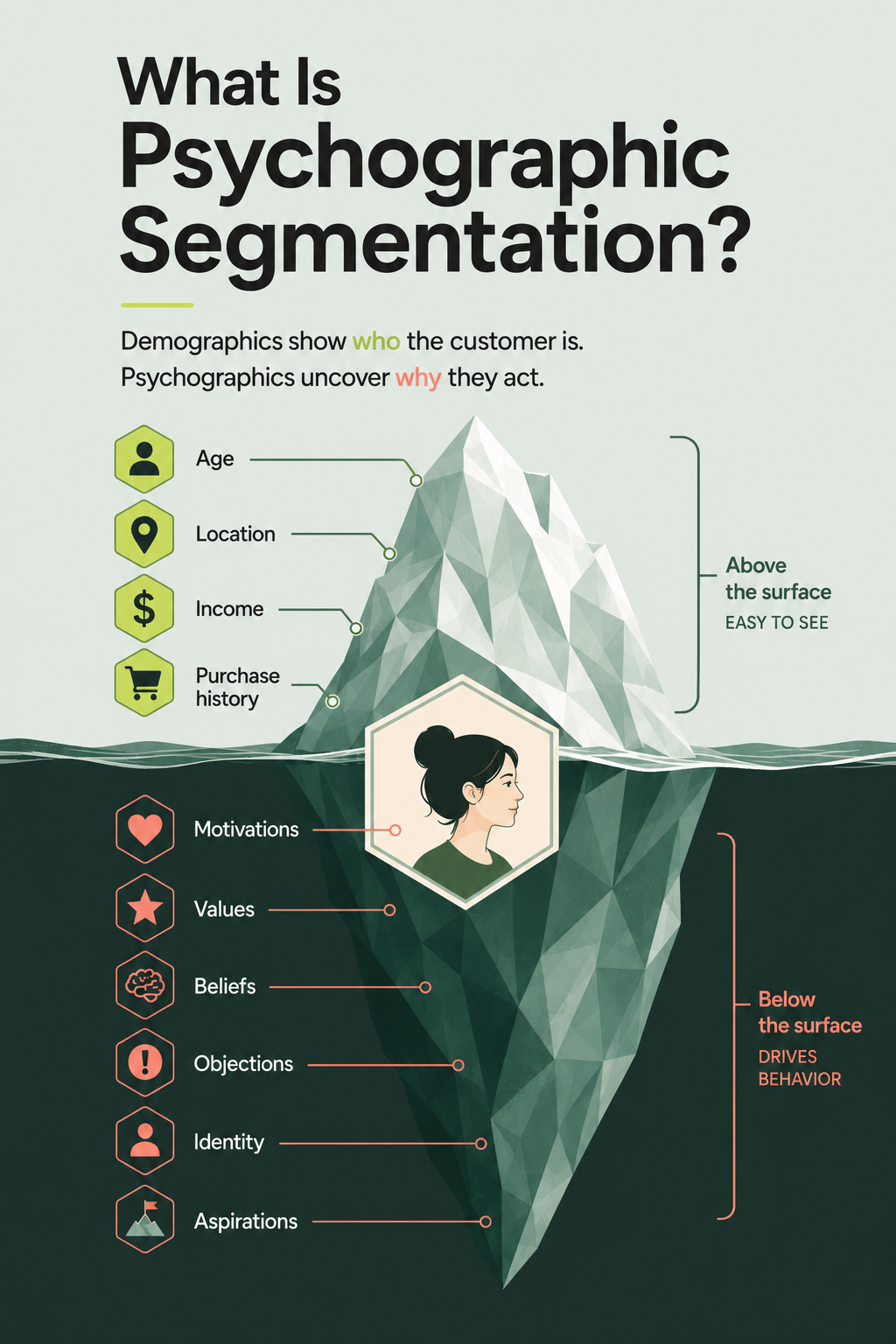
Most brands know the age, location, income, and purchasing history of their customers.
Far fewer understand what those customers are trying to accomplish, what they believe, what stops them from buying, or why two people with similar demographic profiles respond to completely different messages.
That gap matters because demographic data can describe an audience without giving a creative team much direction about what to make.
Across more than 100 conversations with brands in 2026, New Engen found that many creative challenges began upstream. Teams were being asked to produce more content for more channels without a shared, specific understanding of the motivations each concept needed to address.
Psychographic segmentation helps close that gap. It groups customers around the values, motivations, attitudes, needs, and identities that influence their decisions. When combined with behavioral data, those insights can shape creative concepts, creator selection, media activation, and testing priorities.
Why Aren’t Demographic Personas Improving Creative?
Demographic personas often fail to improve creative because they describe who may belong in an audience without explaining why those customers would care, hesitate, or act.
Age, income, location, and household composition provide useful context. But they do not necessarily tell a creative team:
Which problem to dramatize
Which benefit to emphasize
What objection to address
What proof the customer needs
Which tone will feel credible
Which creator should tell the story
What the team should test
Two customers with similar demographic profiles may purchase the same product for completely different reasons.
Consider three customers who buy the same running shoe:
One wants to improve race performance.
One prioritizes comfort and injury prevention.
One sees running as part of a social identity.
The purchase behavior may look similar, but each motivation can support a different message, creator, visual world, and creative concept.
Psychographic segmentation adds the motivations, values, beliefs, identities, aspirations, and anxieties that turn an audience description into creative direction.
What Is Psychographic Segmentation?
Psychographic segmentation is the practice of dividing an audience into groups based on shared psychological characteristics, including:
Values
Motivations
Attitudes
Beliefs
Interests
Lifestyles
Identities
Aspirations
Objections
Anxieties
It helps marketers understand why customers may care and what could influence their decisions.
At New Engen, we view psychographic segmentation as more than a research exercise. Its value lies in whether it changes a marketing decision:
What should the brand say?
Which customer motivation should a concept explore?
What objection needs to be addressed?
Which creator can tell the story credibly?
Where should the content run?
What should the team test next?
If a segment does not influence any of those decisions, it may describe the audience without making the marketing more useful.
New Engen’s 2026 Growth Playbook explains how audience understanding connects with creative, media, experimentation, and measurement in a creative-led growth system.
What Is the Difference Between Demographic, Psychographic and Behavioral Segmentation?
Demographic, psychographic, and behavioral segmentation answer different questions about an audience.
| Segmentation type | Primary question | Common data points | How marketers use it |
|---|---|---|---|
| Demographic segmentation | Who is the customer? | Age, income, gender, occupation, education and household composition | Define broad audiences, estimate market size and understand customer composition |
| Psychographic segmentation | Why might the customer care or act? | Values, motivations, attitudes, interests, identity, lifestyle and aspirations | Develop messages, creative concepts, positioning and brand narratives |
| Behavioral segmentation | What has the customer done? | Purchases, product usage, website visits, loyalty, engagement and conversion behavior | Identify intent, personalize experiences, build audiences and prioritize activation |
| Geographic segmentation | Where is the customer? | Country, region, city, climate and store proximity | Localize offers, messaging, inventory and media activation |
Brands should not choose one method and disregard the others.
Demographics establish context. Psychographics suggest why someone may act. Behavioral data shows what customers actually do.
Together, they provide a stronger foundation for customer personas and creative strategy.
When Should a Brand Use Psychographic Segmentation?
A brand should consider psychographic segmentation when:
Customer personas are too broad to guide creative
Campaign messages sound generic or repetitive
One product serves several distinct motivations
The brand wants to reach a new audience
Creator selection lacks a clear audience rationale
Performance has plateaued despite continued asset production
Demographic characteristics do not explain differences in response
Customer research is not influencing creative briefs
The brand needs to differentiate beyond product features
Automated targeting has shifted more audience strategy into creative
Psychographic segmentation is particularly valuable when the organization knows who buys but cannot explain why one message works better than another.
Which Psychographic Variables Matter Most?
Not every personal characteristic belongs in a marketing segment. Focus on variables that could change a decision.
Motivations and need states
Motivations describe what the customer is trying to achieve or avoid.
Examples include:
Saving time
Feeling confident
Improving performance
Reducing risk
Belonging to a community
Expressing an identity
Simplifying a routine
Caring for someone else
Motivations can become the central tension or promise behind a creative concept.
Values and beliefs
Values are the principles customers use to evaluate choices. Beliefs shape how they interpret a product, category, or claim.
A customer may prioritize sustainability, convenience, independence, security, craftsmanship, or self-expression. They may believe premium products are worth the price or approach advertising claims with skepticism.
Those differences affect which messages resonate and what evidence customers require.
Identity and aspirations
Identity describes how customers see themselves. Aspirations describe who they want to become.
A customer may identify as:
A serious athlete
A hands-on parent
An early adopter
A conscious consumer
A practical problem-solver
A value-conscious shopper
Identity-driven creative can be powerful because the product becomes part of how customers understand or express themselves.
Objections and anxieties
Understanding why someone hesitates can be as valuable as understanding why they buy.
Common objections include:
The price feels too high.
The product seems difficult to use.
The claim sounds exaggerated.
Switching feels risky.
The customer does not understand the difference.
The solution does not feel designed for someone like them.
These insights can directly inform demonstrations, comparisons, testimonials, creator briefs, and educational content.
How Do You Turn Customer Motivations Into Better Creative?
Psychographic segmentation improves creative by translating customer motivations, beliefs, and objections into specific communication decisions.
Compare:
Women ages 25 to 44 who purchase premium skincare products.
With:
Skincare customers who feel overwhelmed by complicated routines and want a small number of credible, evidence-backed products they can trust.
The first definition tells a media team who may belong in the audience. The second gives a creative team a problem to solve.
It can influence:
The central message
The product benefit emphasized
The tone of voice
The visual setting
The type of proof
The creator or spokesperson
The objection addressed
The call to action
The channel and format
The hypothesis being tested
New Engen’s perspective: A useful customer persona should prescribe what to make, not merely describe who the customer is.
| Audience insight | Creative decision |
|---|---|
| Motivation | Central promise |
| Objection | Proof, comparison, or demonstration |
| Value | Brand framing |
| Identity | Talent, setting, and visual world |
| Aspiration | Emotional outcome |
| Category belief | Claim and supporting evidence |
| Source of trust | Creator or spokesperson |
| Behavioral trigger | Timing, format, and CTA |
How Can One Product Support Different Psychographic Segments?
The same product can serve several motivations.
Consider a meal-delivery service.
| Psychographic segment | Primary motivation | Possible creative direction |
|---|---|---|
| Time-strapped optimizer | Reduce decisions and save time | Show how the service simplifies an overloaded weekday |
| Health-focused planner | Maintain control over nutrition | Emphasize ingredients, nutritional information, and consistency |
| Reluctant cook | Avoid preparation and cleanup | Demonstrate how little skill or cleanup is required |
| Variety seeker | Escape repetitive meals | Feature discovery, rotating options, and new flavors |
| Caregiver | Make feeding the household easier | Center the emotional and logistical work of caring for others |
A generic campaign may attempt to communicate convenience, health, variety, and taste in one asset.
A psychographic creative strategy separates those motivations into distinct concepts. Each concept gives the audience a clearer message and the marketing team a clearer hypothesis to test.
What Makes a Customer Persona Actionable?
An audience segment is a group of customers who share relevant characteristics. A customer persona translates that segment into something teams can use.
An actionable persona may include:
Core need state
Primary motivations
Goals
Objections
Values
Category attitudes
Purchase behaviors
Trusted sources
Preferred language
Relevant channels
Creative implications
A persona becomes less useful when it is filled with decorative details that do not affect a decision. Giving a persona a name, favorite coffee order, or stock photo does not make it actionable unless those details have strategic relevance.
“The more prescriptive you are when describing your audience’s psychological and behavioral traits, the better your signal will be,” says Kevin Goodwin, SVP of Strategy and Growth at New Engen. “The brands that can clearly define their intent-driven customer segments have the upper hand.”
How Does New Engen Structure Audience Personas?
New Engen uses a two-tier persona structure to connect audience understanding with both brand strategy and activation.
Tier 1: Parent personas
Parent personas represent larger need states or identities. They govern the overarching brand narrative, top-of-funnel campaigns, and major creative territories.
A brand may have a small number of parent personas, each representing a fundamentally different reason customers enter the category or choose the product.
Tier 2: Micro personas
Micro personas represent more specific behavioral or situational groups within a parent persona.
They can influence:
Creative angles
Channel strategy
Creator selection
Product use cases
Objections
Offers
Testing priorities
For example, a parent persona centered on performance-driven runners could include competitive racers, data-focused trainers, injury-conscious runners, and ambitious beginners.
These groups share a broader need state but may require different messages, proof points, creators, and content.
This structure prevents teams from choosing between personas that are too broad to guide activation and personas so narrow that the brand loses strategic coherence.
How Do You Collect Psychographic Data?
Strong psychographic segmentation should not come from brainstorming alone. It requires several forms of evidence.
First-party data
Useful sources include:
CRM records
Purchase history
Loyalty data
Customer-service records
Product reviews
Post-purchase surveys
Search and website behavior
Returns and cancellation reasons
Behavioral patterns can identify valuable groups. Qualitative feedback can help explain why those patterns exist.
Customer interviews and surveys
Useful interview questions include:
What was happening when you first looked for this product?
What were you trying to change or accomplish?
What alternatives did you consider?
What made you hesitate?
What ultimately convinced you?
How would you describe the product to someone else?
Where do you go for advice?
Surveys can then test whether those motivations appear across a larger audience.
Social listening
Reviews, social platforms, forums, and online communities can reveal:
Common language
Emerging use cases
Recurring frustrations
Misconceptions
Cultural tensions
Trusted voices
Customer workarounds
Direct customer and frontline contact
Customer understanding should not be confined to dashboards.
For Goodwin, direct contact includes using the product, visiting stores, interviewing customers, and speaking with store associates or frontline employees.
“You have to talk about this as a group, on a cadence,” he says. “This can’t be a once-a-year thing, and it can’t be assumed.”
Frontline teams often hear objections and customer language that never appear in formal reporting.
How Do You Build Psychographic Segments?
A practical process includes six steps:
Start with a decision. Define whether the segmentation needs to improve creative concepts, creator selection, positioning, retention, or another business priority.
Combine evidence. Use first-party data, customer research, social listening, frontline input, and third-party research.
Identify meaningful patterns. Look for repeated need states, motivations, objections, values, triggers, and sources of trust.
Validate the segments. Test whether the proposed patterns exist beyond a few memorable interviews.
Translate each segment into creative direction. Define the message, proof, tone, creator, visual world, and hypothesis.
Update the model through performance learning. Use creative and media results to refine what the organization believes about its audience.
Psychographic segments should produce testable hypotheses, not stereotypes presented as facts.
How Can Psychographic Segmentation Improve Creator Selection?
Creator selection often begins with category, follower count, audience demographics, and engagement rate. Those criteria do not fully explain whether someone is right for the story a brand needs to tell.
Psychographic fit considers:
What the creator represents to the audience
Which motivations they can address credibly
Their narrative strengths
Their tone and visual style
The communities that trust them
The experiences they can draw from
Whether the product fits naturally into their life
One creator may be credible when discussing performance and technical features. Another may be better suited to identity, humor, convenience, or emotional storytelling.
Ashley Foster, Creative Partnership Lead at Meta, recommends giving creators a “tight brief and a long leash.” The brand should be precise about the audience, objective, and nonnegotiables while leaving the creator room to interpret the idea naturally.
The goal is to match the creator with the audience motivation and creative angle, not simply the product category.
Does Audience Strategy Still Matter With Automated Targeting?
Yes. Automated targeting changes where audience strategy is applied.
In the past, marketers often translated audience research directly into manual targeting parameters. Today, platforms increasingly use machine-learning systems and proprietary signals to find likely responders.
That does not make audience understanding less important. It means psychographic insights should influence:
The concepts a brand produces
The message each asset communicates
The people featured
The settings and visual styles
The problems or aspirations represented
The creator voices activated
Different creative concepts can attract different audience groups, giving automated systems more useful signals.
Audience strategy increasingly lives inside the creative, not only in the targeting interface.
What Are Common Psychographic Segmentation Mistakes?
Treating assumptions as research
Internal beliefs about what customers value should be treated as hypotheses until supported by evidence.
Creating stereotypes
Labels such as “eco-conscious millennial” or “busy mom” are rarely specific enough to guide strong creative and may introduce unsupported assumptions.
Confusing interests with motivations
An interest in fitness does not reveal whether someone is motivated by competition, health, appearance, community, routine, or stress relief.
Interests show where attention exists. Motivations help explain why someone acts.
Ignoring behavioral evidence
What customers say matters. What they do matters too.
Psychographic research becomes stronger when declared values and motivations are compared with purchases, usage, loyalty, and engagement.
Creating too many personas
An excessive number of personas makes it difficult for teams to prioritize and activate the model.
The goal is to capture meaningful differences, not every possible variation.
Failing to connect segments to decisions
Every segment should produce clear implications for creative, media, creator selection, testing, or measurement.
A polished persona deck that changes no decisions is still an ineffective segmentation model.
How Do You Measure Whether Psychographic Segmentation Is Working?
Evaluate whether the segmentation improves creative learning and business performance.
Useful measures may include:
Engagement by message or motivation
Creative win rate
Incremental reach
Conversion rate
Cost per acquisition
Brand lift
Audience penetration
Creator-content performance
Retention or repeat purchase
Customer lifetime value
Message-level search or social response
The goal is not to prove that a persona is permanently correct. It is to determine whether the segmentation produces better hypotheses, more distinct creative, and stronger marketing decisions.
What Is the Bottom Line on Psychographic Segmentation?
Psychographic segmentation groups customers according to the motivations, values, attitudes, identities, and lifestyles that influence their decisions.
Demographic data tells marketers who an audience is. Behavioral data shows what the audience has done. Psychographic data helps explain why customers may care and what a brand should communicate.
Its greatest value is not a more detailed persona document. It is the specificity it brings to creative decisions.
That specificity affects what concepts get made, which creators tell the story, what advertising platforms learn from the creative, and how performance insights shape the next brief.
When those elements operate as one continuous system, audience understanding becomes a growth input rather than a research output.
For New Engen’s complete framework connecting audience personas with creative, media, experimentation, and measurement, download the 2026 Growth Playbook.