
7 Paid Social Creative Formats Worth Testing in 2026

Paid social teams are producing more creative, but more assets do not necessarily mean more meaningful tests.
Modern ad delivery systems benefit from creative that gives them genuinely different signals. In New Engen’s 2026 Growth Playbook, Meta Creative Partnership Lead Ashley Foster explains that diversified assets with distinct visual styles and messaging motivators give Meta’s system more information to personalize delivery at scale. New Engen’s framework takes that a step further: true diversification means changing talent, settings, formats, and messaging angles, rather than producing new hooks around essentially the same concept.
The distinction matters because creative testing should help answer more than which ad won? It should reveal which audience, message, objection, benefit, proof point, or product experience deserves another investment.
The seven examples below come from recent paid social work by New Engen’s in-house performance creative studio, Donut Studios. They show seven different ways to build that kind of conceptual diversity into a creative program.
How these examples were selected: These examples were selected from Donut Studios work to illustrate distinct creative strategies and testing hypotheses. They are not a ranked list or a cross-client performance benchmark.
| Creative approach | What it helps test |
|---|---|
| Offer-first animated creative | Whether the promotion itself can drive action |
| Outcome-led creator story | Whether a real-life outcome makes the benefit more meaningful |
| Ingredient-led product demo | Whether showing the product reduces uncertainty |
| Community-style social proof | Whether answering a purchase concern can move consideration |
| Familiar-interface hook | Whether recreating an existing behavior increases problem recognition |
| Audience-specific comedy | Whether a narrower audience insight creates stronger relevance |
| Live product reaction | Whether the product experience itself can become proof |
The important distinction is concept versus execution. A Reddit-style interface, creator voiceover, Notes app screen, or animated static is an execution. The concept is the underlying argument the ad is testing: natural-looking results, easier travel, less overwhelming planning, a better fit for a particular shopper, or a compelling promotion.
That distinction is where better creative testing starts.
1. Put the offer front and center
Example: Aramore
Format: Offer-first animated creative
Best for testing: Promotions, retail events, launches and limited-time offers
Sometimes the offer is the idea.
For Aramore’s Ulta Wellness Week creative, there’s no reason to make someone wait for the payoff. 20% off owns the first frame, Ulta is immediately recognizable, and Aramore products animate straight into the shopping bag.
It’s simple because it can be. The sale is doing the heavy lifting.
The animation still earns its keep. It gives the eye somewhere to go, adds some urgency, and gets the product and retailer into the frame without making them compete with the main message.
This is also a good reminder that more storytelling isn’t always better storytelling. If a discount, launch, drop, or limited-time event is genuinely the strongest reason to act, burying it at the end of the ad can make the creative work harder than it needs to.
What to test: Put the offer in frame one and run it against the product-first or lifestyle-first version you would normally make. Same promotion, different reason to stop.
2. Sell what the product makes possible
Example: Coterie
Format: Creator voiceover explainer
Best for testing: Products whose value becomes clearer in a real-life situation
This ad could have spent 40 seconds talking about what makes a good diaper.
It doesn’t.
Instead, a parent takes Coterie through a full day out with her baby. Packing the bag. Getting in the car. Changing the baby. Running errands. Spending time outside.
By the end, the takeaway isn’t a list of diaper features. It’s: I can leave the house and trust this thing to do its job.
That’s a much more relatable way to communicate performance.
Creator content is particularly good at this because the product can live inside an actual experience. TikTok research found that 64% of viewers said creator content feels authentic, while 71% said qualities related to creator authenticity had motivated them to buy from a brand.
The interesting creative question here is bigger than diapers: What does your product let the customer stop thinking about?
For Coterie, it’s worrying about the diaper during a day out. For another product, it could be making dinner without an hour of planning, getting through a workout without adjusting your clothes, or traveling without packing three backups.
What to test: Take a benefit you normally put in a bullet point and build the ad around the moment when that benefit matters instead.
3. Don’t just explain it. Show it.
Example: Coterie Bun Balm
Format: Creator product explainer
Best for testing: Products where ingredients, formulation, texture or application influence the purchase decision
“Clean ingredients” is easy to put on screen.
Showing someone why they care is more interesting.
Coterie’s Bun Balm creative starts with a recommendation, then gets into the details: what the creator had been using before, why she reconsidered it, what’s in Bun Balm, what the texture looks like, and how it actually applies.
The product is doing something almost the entire time it’s being discussed.
That matters because the closer the camera gets, the harder the product has to work. Texture shots, application, ingredient callouts, and the actual use on baby all give the viewer something to evaluate for themselves.
TikTok’s 2026 commercial-content quality guidance specifically points to actual product usage, firsthand experience, authentic feedback, and empirical evidence as signals of quality creator content.
You can see why here. “Non-greasy” is a claim. Showing the texture and application gives the claim somewhere to land.
What to test: Find the product question that copy alone doesn’t answer very well. Show the answer. Texture, fit, size, sound, application, assembly, consistency, stretch, coverage, or a side-by-side can all become creative.
4. Build the ad around the objection
Example: Donna Bella
Format: Community-style social proof static
Best for testing: Products where a specific concern is holding back consideration
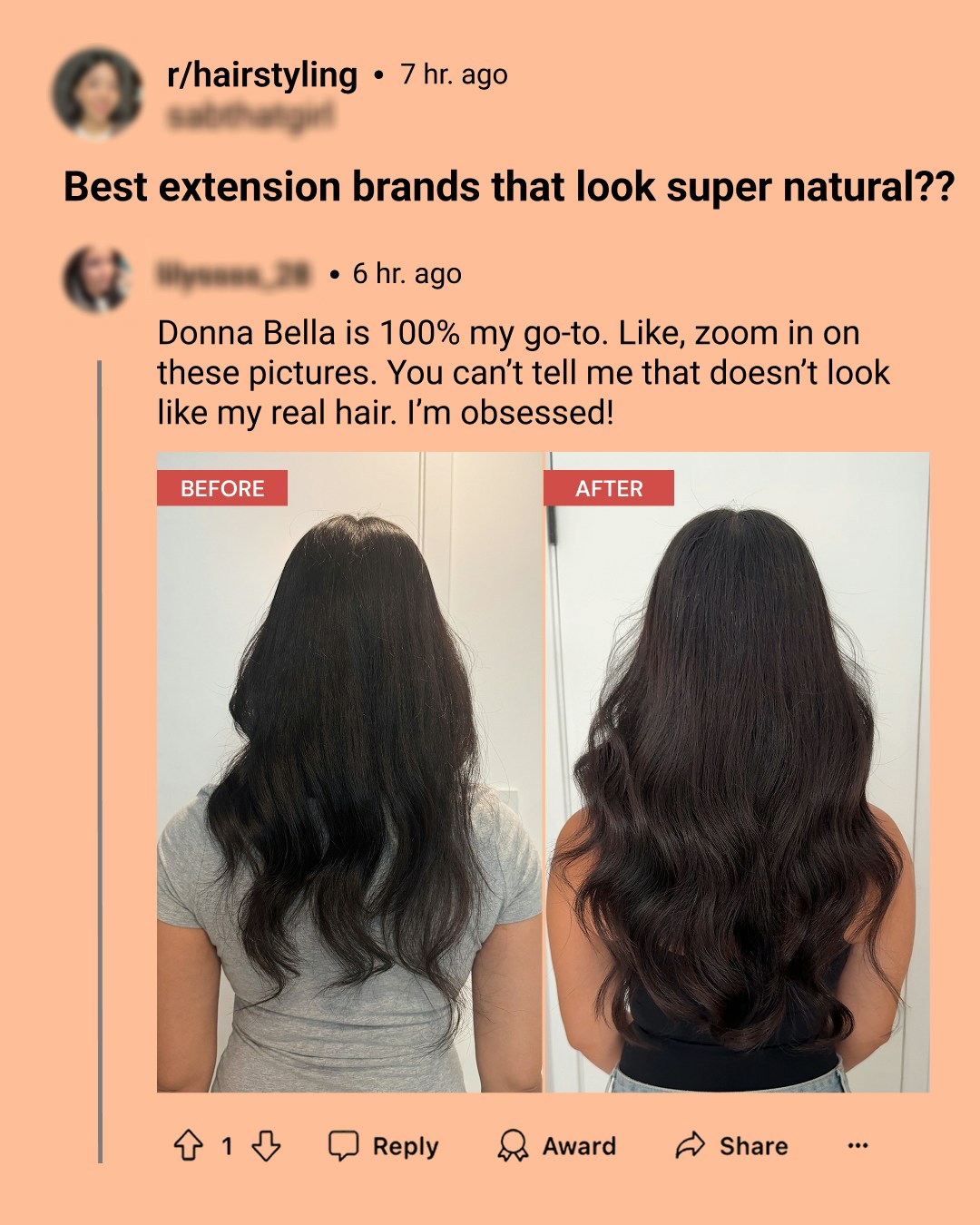
The question at the top of this Donna Bella ad gets right to it:
“Best extension brands that look super natural??”
That’s the ad.
The Reddit-style treatment makes it feel familiar, but the smart part is what sits underneath the format. Someone considering extensions has a very reasonable concern: Are they going to look fake?
The response recommends Donna Bella, then essentially tells the viewer to inspect the evidence: zoom in.
And there are the photos.
That sequence works because it mirrors how people research products when a brand claim isn’t enough. Reddit reported that 42% of internet users in its research found a Reddit recommendation most influential when making a purchase compared with options including expert reviews, influencer recommendations, aggregated star ratings, brand social ads, and brand product pages.
The takeaway isn’t “make your next ad look like Reddit.” The bigger opportunity is finding the question your customer wants another human to answer.
What to test: Write down the three objections that come up most often before someone buys. Turn each one into its own creative concept and make the proof the hero.
5. Start where your customer is already stuck
Example: Babylist
Format: Hybrid UI demonstration
Best for testing: Products and services that replace a frustrating or inefficient existing behavior
Babylist doesn’t open with Babylist.
It opens with a Notes app titled “Things we need for the baby” and an almost completely empty list.
Then comes the Google search:
“what do i actually need for a newborn????”
If you’ve ever planned something complicated by bouncing between Notes, Google, screenshots, texts, and 14 open tabs, you already understand the problem.
That’s what makes the opening work. It doesn’t have to explain registry overwhelm. It recreates it.
Only then does Babylist show up.
Now the viewer sees the registry checklist, completion percentages, categories, and curated guides. The product demo has context because we’ve already seen the mess it’s replacing.
There’s a useful creative exercise buried in this one: Look at what customers are doing before they get to your product.
Their workaround might be a spreadsheet. A Notes list. A calculator. A group chat. A screenshot folder. A search query they’ve rewritten five times.
Sometimes the best way to introduce the solution is to start there.
What to test: Recreate the behavior your product replaces before you reveal the product itself. Then let the UI or product experience show the difference.
6. Get specific about who the ad is for
Example: Hungryroot
Format: Audience-specific creator comedy
Best for testing: Products with distinct use cases, needs, routines or audience segments
“Gluten-free people before Hungryroot.”
We know exactly who this ad is talking to before the creator really gets going.
Then it gets more specific.
Bread with the texture of a kitchen sponge. $18 crackers. Checking, again, whether something has gluten. Grocery shopping that feels like a trust exercise.
“Eating gluten-free can be frustrating” would technically communicate the same problem. It just wouldn’t be nearly as fun.
The jokes work because they’re observations. Someone had to understand the audience well enough to know what would make them say, “Yep. That.”
That kind of relatability matters in creator advertising. TikTok reports that 64% of people prefer seeing relatable, everyday people advertising products on social platforms over famous celebrities.
But casting a relatable person is only half the job. The script has to be relatable too.
Hungryroot earns the payoff, “Hungryroot gets it,” by spending the first part of the ad proving that it actually does.
What to test: Go narrower than the broad audience segment. Build concepts around one routine, frustration, use case, inside joke, or oddly specific truth that part of your audience knows very well.
7. Let us see the product experience
Example: Vive Organic
Format: Direct-to-camera creator demonstration
Best for testing: Products with a visible, audible, tactile or sensory experience
Vive Organic wastes approximately zero time getting the product into the ad.
The creator takes the immunity shot, reacts to it, and follows with: “That’s how you know it works.”
Now we want to know what just happened.
The rest of the ad can explain it. There’s ginger behind the kick. There are organic ingredients. There’s a personal story about what the creator used to spend assembling an immunity routine. There are bottles in hand and product close-ups throughout.
The reaction gets attention, but it also gives the product education a reason to exist.
Video is especially useful when there’s something worth watching happen. In Google-commissioned BCG research among U.S. shoppers who said digital video played a role in their purchase journey, 45% said video helped them choose which product or brand to purchase and 34% said it prompted them to buy a specific item.
Not every product is going to produce a dramatic reaction. It doesn’t need to.
Opening the package can be satisfying. A moisturizer can have a surprising texture. A cleaning product can wipe something away. A jacket can fit differently than expected. Food can crunch.
If there’s a product moment people would want to see before buying, it probably deserves a camera.
What to test: Find the most visual, tactile, or sensory moment in the product experience and build the ad around it instead of explaining around it.
What these paid social creative examples have in common
These seven ads do not look alike. That is exactly why they belong in the same creative program.
One tests price. Another tests convenience. Another tests formulation. Donna Bella tests an objection. Babylist tests a behavioral pain point. Hungryroot tests audience identity and recognition. Vive Organic tests the product experience itself.
That is conceptual diversification.
New Engen’s Growth Playbook draws a useful distinction between extending a high-performing asset through iteration and using conceptual diversification to explore different talent, formats, settings and messaging angles.
In practice:
| If you need to learn... | Build creative that tests... |
|---|---|
| Whether price can drive immediate action | The offer as the central concept |
| Whether the benefit feels meaningful | The outcome in a recognizable situation |
| Whether customers understand the difference | Product education plus demonstration |
| Whether an objection is suppressing consideration | A direct answer backed by proof |
| Whether customers recognize the problem | Their current behavior or workaround |
| Whether a message resonates with a narrower audience | A specific experience, tension or identity |
| Whether the product experience is persuasive | A live demonstration |
This is why producing more ads is not necessarily the same as diversifying creative.
Seven videos with different creators, hooks and caption treatments can still be seven executions of the same concept. Seven ads built around different reasons to care give the media program seven different hypotheses to learn from.
Creative testing should tell you what to make next
The test is only useful if the learning gets back to the people making the next asset.
New Engen’s 2026 Growth Playbook argues that measurement should ultimately answer what do we build next? Creative performance should be routed continuously into the production brief, so learnings influence both media investment and future creative.
That creates a simple feedback loop:
Audience insight → creative hypothesis → concept → paid-media test → performance signal → next brief
It is also how New Engen approaches creative-led growth more broadly. Creator and studio content feed paid media, while performance and measurement signals help determine what gets built next.
So after the next creative test, there are two questions worth asking:
Which ad performed?
And, more importantly:
What did it teach us to make next?
Paid social creative FAQs
What paid social creative formats should brands test in 2026?
Brands should test formats that support meaningfully different creative hypotheses. Depending on the product and audience, that can include creator stories, product demonstrations, offer-led animation, objection-led social proof, UI demonstrations, audience-specific comedy and live product experiences.
The format should follow the idea being tested rather than become the strategy itself.
What is creative diversification?
Creative diversification means testing materially different concepts, messaging angles, talent, settings or formats rather than repeatedly changing minor elements of the same underlying ad. New Engen’s Growth Playbook recommends conceptual diversification as a way to give modern ad-delivery systems more distinct creative signals.
What is the difference between a creative concept and an execution?
A creative concept is the underlying idea or argument being tested. An execution is how that idea appears in the ad.
For example, Donna Bella’s concept is that its extensions can produce a natural-looking result that addresses a common purchase objection. The Reddit-style interface, conversational response and before-and-after photos are executional choices used to communicate that idea.
How should brands come up with paid social creative ideas?
Start with audience evidence. Customer research, reviews, search behavior, social listening, performance data and first-party customer information can reveal motivations, objections, behaviors and moments worth turning into creative hypotheses. New Engen’s framework recommends using psychology and behavior to help determine what gets made, not relying on demographics alone.
How should brands test paid social creative?
Start by defining what each concept is intended to teach. Test materially different hypotheses before spending the entire testing roadmap on small executional variations.
Once a concept shows promise, iteration becomes useful for extending and refining it through new hooks, placements, edits, talent or formats.
Should paid social ads be polished or creator-led?
There is no universal answer. Studio content and creator content serve different roles and create trust in different ways. New Engen’s framework treats studio, UGC, creator and other content sources as different inputs that should be selected according to the audience and job the content needs to perform.
How should performance data inform creative?
Performance data should influence the next production brief, not only media allocation. Track which concepts, messages, audiences and formats generate useful signals, then use those learnings to decide what to scale, iterate, stop or test next.