Best Creator Marketing Agencies for Consumer Brands in 2026

The question used to be whether to work with a creator marketing agency. Now the question is which one is actually built to produce business results.
Creator marketing is no longer a test-and-learn experiment. According to the IAB's 2025 Creator Economy Ad Spend & Strategy Report, U.S. creator ad spend is projected to reach $44 billion in 2026, growing nearly 4x faster than the overall media industry. CreatorIQ's 2025–2026 State of Creator Marketing report found that paid amplification strategies produce the strongest ROI of any creator tactic, with nearly two-thirds of new creator spend being reallocated from traditional paid and digital channels. The budgets have arrived. The pressure to justify them has arrived with them.
For consumer brands, that pressure concentrates in one place: the gap between content production and performance. Most creator programs produce content. Few have built the infrastructure to turn that content into a measurable growth channel. A creator post reaching 3 percent of a creator's followers organically is not a marketing program. A creator post running as a whitelisted paid ad against validated audiences, optimized in real time, and measured against business outcomes is a different thing entirely.
This guide compares five creator marketing agencies for consumer brands in 2026: New Engen, Movers+Shakers, Ubiquitous, Obviously, and Viral Nation.
| Agency | Best For | Core Strength | Consideration |
|---|---|---|---|
| New Engen | Consumer brands at any growth stage, from challenger brands to scaled enterprises, that need creator content built for paid performance | Integrated creator ecosystem: Donut Studios for brand-handle creative, performance creator network and whitelisting infrastructure for paid social distribution, and New Engen Influencer for brand and retail partnerships, all connected to full-funnel media and LIFT measurement | Best fit for brands that want creator, media, and measurement operating as one system rather than across separate vendors |
| Movers + Shakers | Consumer brands prioritizing cultural relevance and organic community-building with Gen Z and Millennial audiences | Culture-led content production with organic audience engagement, under Stagwell's network | Brands seeking dedicated paid amplification and sales attribution for creator content should ask how those capabilities are scoped |
| Ubiquitous | Brands building dedicated TikTok-first or multi-platform creator programs with full-service management and Humanz platform data | End-to-end influencer campaign management with predictive analytics, acquired by Humanz in December 2025 | A TikTok-focused creator agency now under Humanz. Brands seeking deep integration with full-funnel media planning should ask how creator fits into broader paid programs |
| Obviously | Enterprise brands managing large-scale, multi-market influencer programs with complex campaign infrastructure | Proprietary creator management technology built for enterprise campaign scale, within WPP's VML network since 2023 | A WPP holdco agency for enterprise programs. Brands seeking independent positioning or mid-market DTC focus should ask how the VML structure applies to their scope |
| Viral Nation | Brands seeking a scaled, PE-backed creator and social media agency with global talent representation and proprietary brand safety technology | Full-service social and creator programs backed by the Influsoft creator management platform, with 500+ employees across six continents | A PE-backed global creator and social agency. Brands prioritizing tight integration between creator content and full-funnel media measurement should ask how those capabilities are structured |
What Is a Creator Marketing Agency for Consumer Brands?
The best creator marketing agencies for consumer brands in 2026 are New Engen, Movers+Shakers, Ubiquitous, Obviously, and Viral Nation.
A creator marketing agency helps brands build, manage, and scale programs that use third-party creators and influencers to produce content, reach audiences, and drive measurable business outcomes. For consumer brands, that scope has expanded considerably over the past three years.
At the basic level, a creator marketing agency identifies creators, manages partnerships, oversees content production, and reports on campaign performance. The strongest agencies do more. They connect creator content to paid distribution, build the measurement infrastructure to evaluate what actually worked, and integrate creator programs into the broader marketing mix rather than running them as a standalone channel.
For consumer brands, the distinction matters. A creator posting about a product organically reaches a fraction of their audience and has no mechanism to optimize delivery, exclude existing customers, or scale distribution to a validated target. A creator post running as a whitelisted paid ad changes every one of those variables. The content looks native to the feed. The distribution is paid and targeted. The measurement can connect to business outcomes. That is what separates a creator marketing program from a creator marketing strategy.
How Is a Creator Marketing Agency Different from an Influencer Marketing Agency?
The short answer: creator marketing includes influencer marketing, but not the other way around.
Influencer marketing traditionally refers to paying a person with an established social audience to promote a brand to their followers. The mechanism is reach: the influencer's audience is the media vehicle. A brand pays for access to that audience through the credibility of the influencer's recommendation. The output is impressions, engagement, and earned media value.
Creator marketing is a broader framework that adds two things influencer marketing alone typically does not include.
First, content as a production asset. In a creator marketing model, the content a creator produces has value beyond the organic post. It can be licensed, whitelisted, and repurposed as paid media. The creator is not just a channel. The creator is a content producer, and the content they produce is the raw material for a paid social program.
Second, performance infrastructure. Creator marketing programs are built with paid amplification, attribution, and optimization as design requirements from the start, not afterthoughts layered on top of organic reach. The brief is different. The creator selection criteria are different. The licensing structure is different. The measurement is different.
The practical difference shows up in campaign economics. Whitelisted creator ads, run as paid social from the creator's handle rather than the brand's, typically deliver 30 to 50 percent lower CPAs than brand-handle ads. A traditional influencer program produces impressions. A creator marketing program built for performance produces customers.
The agencies in this guide represent both models. The differentiation in each entry reflects how much of the program is built for organic reach versus paid performance.
The State of Creator Marketing for Consumer Brands in 2026
Consumer brands evaluating creator marketing partners in 2026 are working in a different environment than they were two or three years ago. The category has matured. The table stakes have risen. And the variables that separate strong programs from weak ones have become clearer.
What is now table stakes. Nearly every agency working in this space offers creator discovery, partnership management, content briefing, and campaign reporting. A creator database, a campaign management workflow, and a performance dashboard are baseline expectations in 2026. Consumer brands should expect all of this from any agency on a shortlist and should not pay a premium for it. The IAB estimates 48 percent of all creator ad buyers now rank creators a "must buy" channel. The category is too mature for capability claims around basic program management to carry any weight in an agency evaluation.
What actually separates the strongest. The IAB's 2025 Creator Economy Ad Spend & Strategy Report identified paid amplification as the fastest-growing segment within creator marketing, projected to jump 56 percent to $11.1 billion as brands move creator content beyond organic social into display, connected TV, and retail media environments. Research from Effie and System1's 2026 Creative Dividend report found that creative quality ranks as the second-largest driver of campaign profitability with a x12 profit multiplier, behind only brand size. That finding reframes what creator marketing is actually doing for a brand: it is not a reach channel with engagement metrics. It is the primary creative lever available to marketers, and it compounds when the operating model behind it is built correctly. Three failure patterns prevent that compounding consistently: media, creative, and creator programs running in silos with separate reporting, producing slow iteration and growing misalignment; production volume without a system to read what is working, so scale generates noise rather than signal; and winning creative getting overdeployed until fatigue accelerates faster than new content can replace it. Agencies that have built operating models around all three of those failure modes produce compounding creator programs. Agencies that have not produce campaigns.
What consumer brands should look for. According to the Superfiliate paid performance benchmark, creator-whitelisted influencer ads consistently outperform standard paid social by 20 to 30 percent on CAC, ROAS, and CPA. The agencies capturing that performance differential are the ones that have built the operational infrastructure to act on it at scale: brief creators for paid content from the start, secure licensing rights in the original contract, and optimize in real time using paid performance data rather than organic engagement signals. The question in an agency evaluation is not how many creators they have. It is how those creators connect to media buying, measurement, and business outcomes.
What to Look For in a Creator Marketing Agency
The strongest creator marketing agencies in 2026 are not defined by creator roster size. Most serious agencies can claim access to thousands of creators through discovery platforms. The better question is what happens after the content is produced.
1. Paid social integration
Creator content that lives only on organic social feeds is underutilized. Platform algorithms now distribute most content outside the follower graph, which means the difference between organic and paid distribution is less about channel and more about control. Paid amplification gives a brand the ability to target, optimize, and scale a creator post the same way it manages a traditional ad unit.
The most important structural question is whether an agency builds paid amplification into creator programs from the first brief or treats it as an optional add-on. When paid distribution is the primary model, the content brief is different, the creator selection criteria are different, and the licensing terms are different. An agency that treats organic reach as the default and whitelisting as an upgrade will produce creator content optimized for organic engagement. That is a different product than creator content built for paid performance.
2. Content production infrastructure
Not all creator content is built the same way. A creator posting to their own feed has one set of objectives. A creator producing content for a whitelisted paid campaign has different creative requirements: the hook needs to work in a paid feed, the call to action needs to connect to a business outcome, and the brand needs licensing rights and optimization flexibility.
Agencies with in-house creative studios, production management, and post-production capabilities can control quality, iterate based on performance data, and maintain consistency across a high volume of creative. Agencies without that infrastructure depend entirely on the creator for quality and pace. That limits the brand's ability to test, iterate, and scale what is working.
3. Measurement philosophy
Creator marketing has historically been measured in reach, impressions, and engagement. Those metrics describe how many people saw something. They do not describe how many people bought something.
The strongest agencies have built measurement frameworks that connect creator activity to sales. That requires integration with paid attribution tools, media mix modeling, or incrementality testing. It also requires understanding how creator content interacts with other channels. A brand running creator-led paid social alongside search retargeting needs an agency that can model the combined effect. Be especially careful with agencies that present engagement as a proxy for business impact without offering a path to sales attribution.
4. Creator network quality and category alignment
Reach is not network quality. An agency with access to millions of creators through a discovery platform has a database. An agency with curated, performance-vetted creators in your category has an asset.
Consumer brands in apparel, beauty, CPG, food and beverage, and active lifestyle have very different creator needs. The content aesthetics, platform preferences, and audience trust dynamics vary significantly by category. An agency that has built and optimized creator programs in your vertical before has already learned which creator archetypes work, which content formats perform, and which creator behaviors convert. That learning is not transferable from a different category.
5. Full-funnel program integration
Creator marketing does not operate in isolation. For most consumer brands, creator content feeds paid social, influences organic search, supports retail media, and connects to affiliate and loyalty programs. An agency that treats creator as a standalone workstream produces results that look strong in their own reporting and poorly in the brand's overall model.
The best agencies can explain how creator integrates with the rest of the marketing mix. They should be able to describe how creator content informs paid social testing, how affiliate and creator programs connect, and how creator performance data feeds back into the brand's channel strategy. If an agency cannot clearly explain how its teams coordinate with paid media and measurement, the brand will end up managing that coordination internally.
The 5 Best Creator Marketing Agencies for Consumer Brands in 2026
The agencies below were selected based on capability across the five criteria above, demonstrated consumer brand experience, and publicly verifiable track record. Each entry covers what the agency is best for, key capabilities, notable clients and recognition, and considerations for evaluation.
New Engen
Website: www.newengen.com
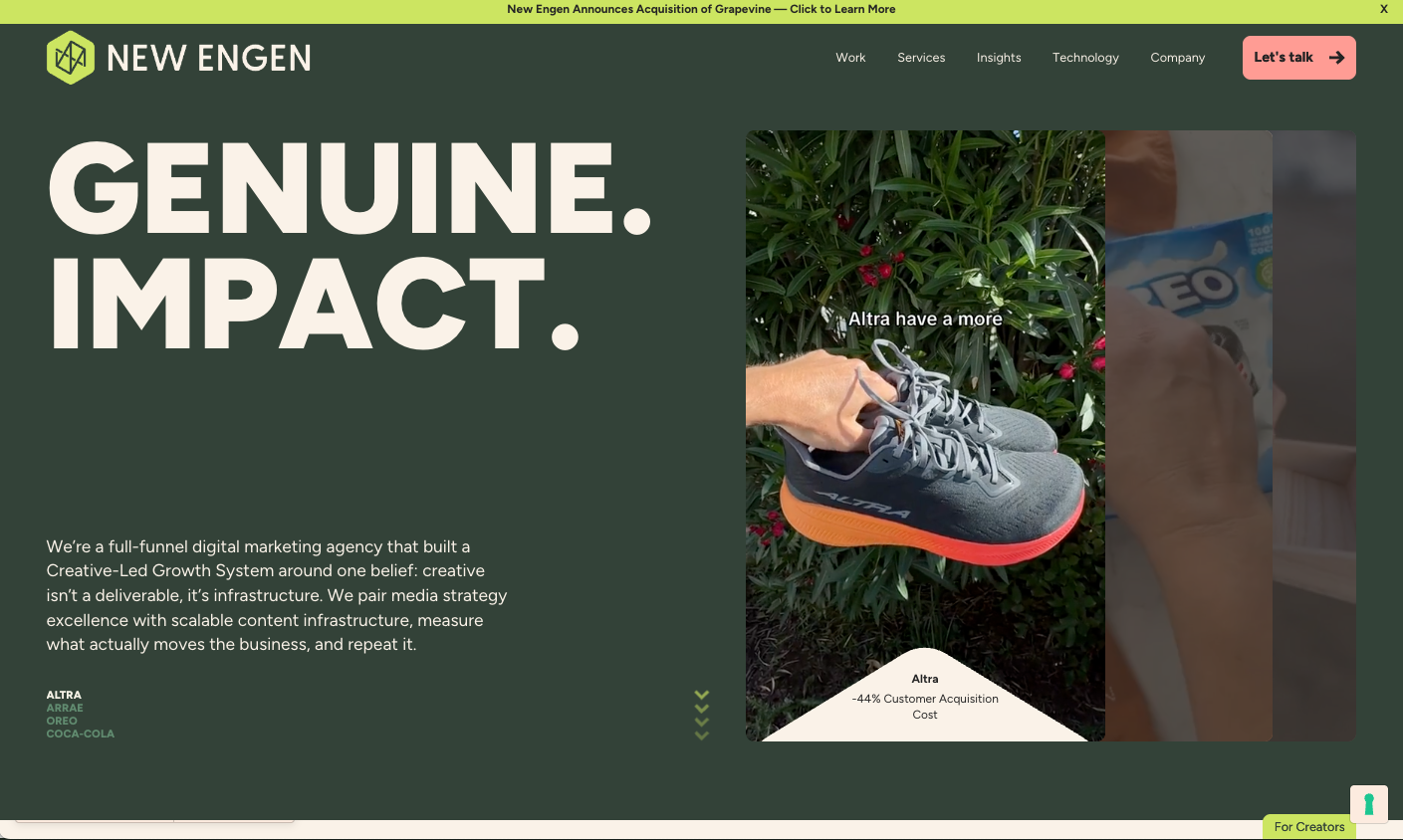
Best for: Consumer brands at any growth stage, from challengers to scaled enterprises, that need creator content built for paid performance rather than organic distribution alone.
New Engen's positioning starts from a premise that most agencies in this category have not operationalized: creative is not a deliverable. It is growth infrastructure. When creative output slows, paid media performance follows. When volume scales without architecture, production generates noise rather than signal. When winning assets get overdeployed, creative fatigue accelerates faster than new content can replace them. New Engen's answer to those failure patterns is the Creative-Led Growth System. Not a service menu. An operating system.
The system runs in five stages. Architect: persona-led strategy built on first-party data, third-party research, and social listening, producing behavioral audience models that prescribe what to make rather than simply describing who to reach. Create: the right content from the right source across the full trust spectrum. Audiences trust different voices for different reasons, so the strongest content strategies draw from all of them. Donut Studios produces brand-controlled, high-fidelity video, photography, and statics built for paid social performance. Grapevine's performance creator network and whitelisting infrastructure produce authentic UGC at velocity, built for paid distribution from creator handles across Meta, TikTok, YouTube, and other major platforms. New Engen Influencer drives brand storytelling through trusted creator voices and longer-term partnerships. Affiliate programs add editorial coverage and performance PR, building trust through third-party credibility. Activate: paid, retail, influencer, and affiliate working in concert rather than in parallel silos. Measure: incrementality, not attribution theater. Iterate: every performance signal feeds the next creative brief, so the program compounds over time rather than resetting with each campaign.
The Grapevine acquisition in February 2026 was a direct investment in the Create layer. Grapevine brings a performance creator network and the whitelisting infrastructure to activate authentic creator content at scale across paid social platforms, adding creator-side UGC production to a stack that already included Donut Studios for brand-handle creative. New Engen's total creator access extends well beyond Grapevine's curated network: broader influencer relationships, retail partnerships, and whitelisting capabilities across the full creator ecosystem mean content can be sourced and activated at the tier, category, and volume each program requires. Together, these capabilities give New Engen the ability to run brand-voice content and creator-voice content simultaneously, tested against the same paid performance data, from a single integrated program.
The connection to media is not incidental. New Engen manages more than $1 billion in annual ad spend across paid search, paid social, programmatic, connected TV, and retail media. Creator content produced through Donut Studios and Grapevine feeds directly into paid social media buying. The creative brief and the media plan are written together. The optimization data flows in both directions. That integration changes the economics: the agency is not producing creator content and hoping it performs organically. It is producing content designed for paid deployment, continuously optimized against actual paid performance data.
New Engen's consumer brand roster spans apparel, food and beverage, wellness, CPG, and active lifestyle. Clients include Altra, Cotopaxi, arrae, and Rugiet. Grapevine's brand work prior to acquisition included Fabletics, Prose, WeightWatchers, and Keeps. New Engen's broader digital media work includes OREO, Coca-Cola, Ocean Spray, and Mondelez.
Measurement is built into the operating model as its own discrete stage, not an afterthought. New Engen's LIFT proprietary platform supports attribution, media mix modeling, and incrementality testing across creator and media programs. The goal is incrementality, not attribution theater: not proving that marketing happened, but understanding what actually moved the business. For brands operating in competitive categories with multiple overlapping channels, this measurement depth is the variable that determines whether a creator program generates compound learnings or simply generates content.
One dimension of creator marketing that most agencies do not address is its connection to AI search visibility. YouTube creator content is increasingly indexed and cited by AI engines including ChatGPT, Perplexity, and Google AI Overviews, which surface video as a primary answer source when buyers research brand and category decisions. A consumer brand with a library of creator-produced YouTube content is building more than a paid social asset. It is building a presence in the places where buyers research purchasing decisions before they reach a brand's website. New Engen's AEO strategy treats YouTube creator programs as a compounding visibility play: content briefed and produced with discoverability in mind creates AI citation surface area at the same time it supports paid performance. Most creator agencies do not have the search infrastructure or editorial context to connect those two outcomes.
Key capabilities:
Creative-Led Growth System: A five-stage operating system (Architect, Create, Activate, Measure, Iterate) designed to connect audience strategy to content production to paid performance to measurement, compounding learnings across programs rather than resetting between campaigns
Content strategy across the trust spectrum: Donut Studios for brand-controlled video, photography, and statics; Grapevine's performance creator network and whitelisting infrastructure for authentic UGC at velocity; New Engen Influencer for trusted creator voice partnerships and broader influencer relationships; and affiliate and performance PR programs, all briefed from the same audience architecture and measured against the same business outcomes
Paid creator distribution: Grapevine's performance creator network and whitelisting infrastructure activate creator content as paid social running from creator handles, optimizing for CPA and ROAS rather than organic reach, across Meta, TikTok, YouTube, and other major platforms
Full-funnel media integration: Creator content feeds directly into $1B+ annual paid media operations across paid search, paid social, programmatic, CTV, and retail media, with creative briefs and media plans developed together
Incrementality-first measurement: LIFT platform supports sales attribution, media mix modeling, and incrementality testing across creator and media programs, connecting creative performance to actual business outcomes rather than platform-reported proxies
Consumer category depth: Active lifestyle, apparel, food and beverage, wellness, and CPG experience with dedicated benchmark reporting and proprietary market research by vertical
AEO and editorial reach: 14+ owned editorial properties and AI citation strategy support brand visibility in AI-powered search environments where buyers increasingly research purchase decisions
Notable clients and industries served:
New Engen's recent work spans Altra, Cotopaxi, arrae, OREO, Coca-Cola, and Ocean Spray. Grapevine's consumer brand work includes Fabletics, Prose, WeightWatchers, and Keeps.
Notable awards and recognition:
Adweek Fastest Growing Agencies (three consecutive years, 2023–2025)
Adweek Agency of the Year Finalist 2025
US Agency Awards Marketing Agency of the Year and Independent Agency of the Year 2025
Inc. 5000 Fastest Growing Companies (five consecutive years, 2021–2025)
Ad Age Best Places to Work 2026
PI Live USPA Bronze Award for Best Affiliate and Partner Marketing Agency
Considerations:
New Engen is built for consumer brands that want creator, media, and measurement operating as one integrated system. Brands seeking a standalone influencer management vendor or a single-platform creator program will find more scope here than they need. New Engen's dedicated benchmark reporting, proprietary market analysis through LIFT, and ongoing research into category-specific consumer behavior make it a strong fit for brands that want a growth partner with visibility into performance trends across their vertical.
Movers+Shakers
Website: moversshakers.co
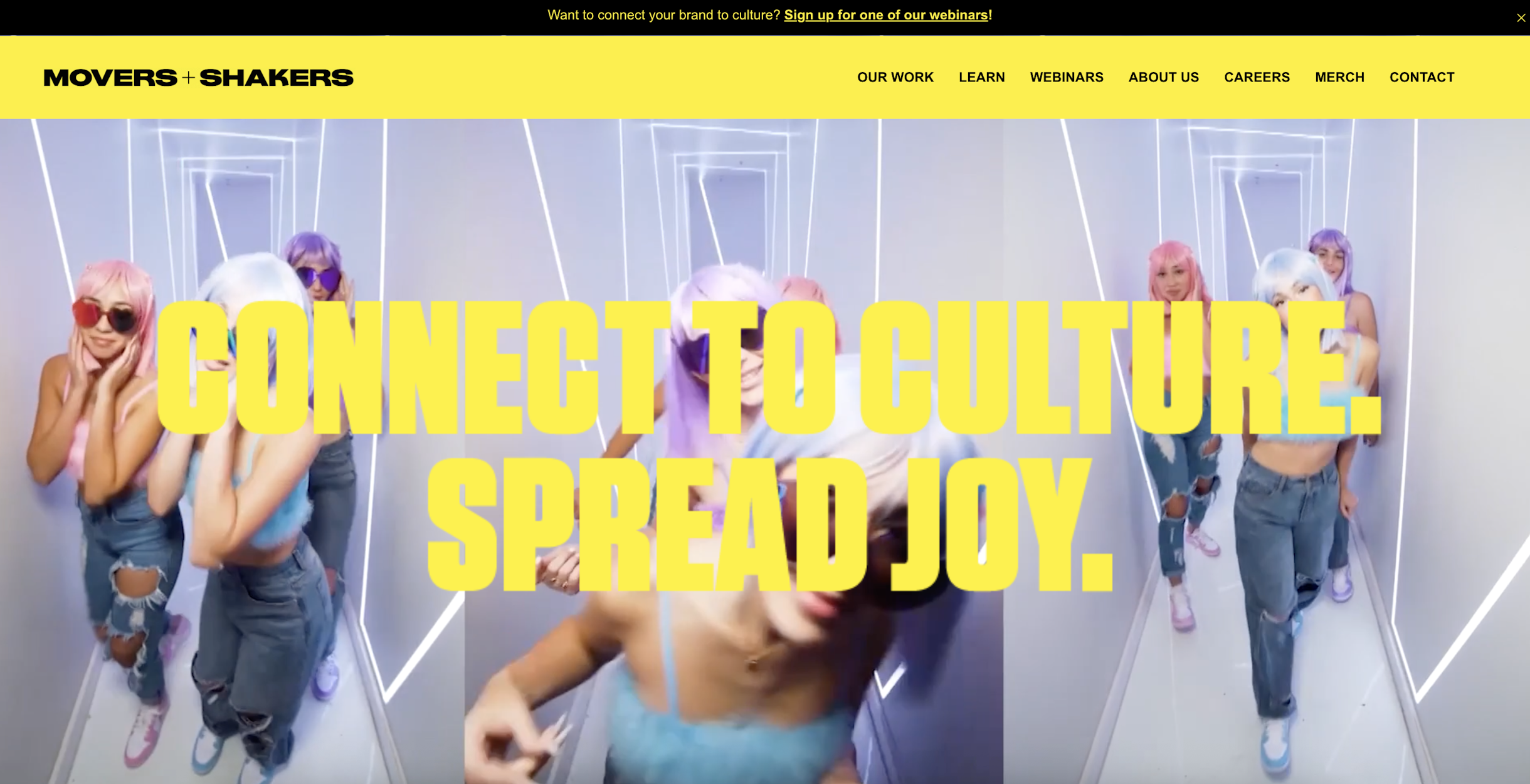
Best for: Consumer brands prioritizing cultural relevance and organic community
Movers+Shakers is a creative agency focused on cultural marketing, founded in 2016 and headquartered in Santa Monica, California. The agency was acquired by Stagwell in November 2023 and operates within Stagwell's marketing network. Movers+Shakers describes its model as connecting brands to culture and driving brand love, with a stated focus on Gen Z and Millennial audiences. The agency operates fully remotely and cites more than 250 billion views on TikTok across its client work.
Movers+Shakers' service offering covers social strategy, influencer marketing, campaign creative, always-on content, and community management. The agency has been publicly associated with campaigns for e.l.f. Beauty and Hilton's Motto by Hilton brand, among others.
Key capabilities:
Cultural campaign strategy and creative development for Gen Z and Millennial audiences
Influencer identification and program management for Gen Z and Millennial audiences
TikTok and Instagram content production and cultural trend integration
Always-on social management and community engagement
Organic social strategy and brand love building
Considerations:
Movers+Shakers' model centers on cultural engagement and organic social strategy. Brands seeking creator programs built for paid social performance, with whitelisted distribution, dedicated media integration, and sales attribution, should ask how those capabilities are scoped within a Movers+Shakers engagement and how Stagwell network resources apply to paid media execution.
Ubiquitous
Website: ubiquitousinfluence.com
Best for: Brands building dedicated TikTok-first or multi-platform creator programs with full-service campaign management and access to the Humanz creator economy data platform.
Ubiquitous is a full-service influencer marketing agency founded in 2021 and headquartered in Chattanooga, Tennessee. In December 2025, Ubiquitous was acquired by Humanz, an Israel-based creator economy platform that raised $15 million in conjunction with the acquisition. Ubiquitous operates as part of Humanz's expanded creator economy infrastructure alongside Bambassadors, another agency acquired in the same transaction. Ubiquitous' publicly stated service focus has centered on TikTok-first creator programs, with full-service coverage across Instagram, YouTube, Facebook, and X.
Ubiquitous describes its model as end-to-end campaign management built on predictive analytics and data infrastructure, covering creator sourcing, contract negotiation, content briefing, posting coordination, paid amplification, and performance reporting. The agency has cited work with brands including Lyft, Disney, American Eagle, Netflix, GNC, Crocs, and Starbucks.
Key capabilities:
End-to-end influencer campaign management across TikTok, Instagram, YouTube, and other platforms
Creator sourcing, vetting, negotiation, and contract management
TikTok Spark Ads and paid amplification
Campaign reporting and performance analytics through the Humanz platform
Predictive analytics and creator performance data infrastructure
Considerations:
Ubiquitous' acquisition by Humanz in December 2025 brings expanded platform data and analytics capabilities to the agency's campaign management model. Brands running broad-based paid media programs beyond creator-focused platforms, or those seeking tight integration between creator marketing and full-funnel media planning and attribution, should ask how those capabilities are scoped within the current engagement model and how Humanz platform data connects to their existing measurement stack.
Obviously
Website: obvious.ly
Best for: Enterprise brands managing large-scale, multi-market influencer programs with complex campaign infrastructure and access to WPP holdco resources.
Obviously is a full-service influencer marketing agency founded in 2014 by Mae Karwowski. The agency is headquartered in New York with offices in San Francisco and Paris. WPP acquired Obviously in March 2023, integrating it into VMLY&R, which has since become VML within WPP's network structure. Obviously's model is built around a proprietary technology platform designed to manage enterprise-scale influencer campaigns across multiple markets and languages, with clients including Google, Ford, Ulta Beauty, and Amazon.
Obviously describes its service offering as covering marketing strategy, creator identification, content production, campaign management, and analytics. The agency positions itself around managing complexity and scale for enterprise brands with large, multi-market influencer program requirements.
Key capabilities:
End-to-end influencer campaign management for enterprise brands
Proprietary creator management and campaign technology platform
Multi-market and multi-language campaign execution
Creator discovery, vetting, and relationship management
Analytics and performance reporting with brand safety monitoring
Access to WPP and VML network resources and capabilities
Considerations:
Obviously's integration into WPP's VML network since 2023 provides holdco infrastructure and global scale. Brands seeking independent agency positioning, or those whose creator programs are primarily performance-driven and require tight integration with paid media execution outside the holdco environment, should ask how VML network resources apply to their specific scope and how the model serves mid-market consumer brands whose program complexity falls below enterprise requirements.
Viral Nation
Website: viralnation.com
Best for: Brands seeking a scaled, independent PE-backed creator and social media agency with proprietary creator management technology and global talent representation.
Viral Nation is a creator marketing and social media agency founded in 2014 and headquartered in Mississauga, Ontario. The agency operates with approximately 500 employees across six continents and has raised $197 million in funding from Maverix Private Equity and Eldridge. Co-founder Joe Gagliese serves as co-CEO. Viral Nation describes its model as uniting marketing services, proprietary technology, and creator representation under a social-first approach to brand growth.
Viral Nation's stated service portfolio covers influencer marketing, paid performance, owned social, and creative and content services. The agency's proprietary Influsoft platform provides creator management, campaign monitoring, and a brand safety and reputation screening product called VN Secure. Viral Nation was named Social Media Agency of Record for Rocket in August 2025, following a campaign that generated 247 million views for Rocket's Super Bowl work.
Key capabilities:
Influencer marketing and creator representation across all major social platforms
Paid performance and paid social media buying integrated with creator campaigns
Owned social strategy, content management, and community
Influsoft creator management and campaign analytics platform
VN Secure brand reputation and safety monitoring technology
Global creator representation and talent network
Considerations:
Viral Nation's scale, PE backing, and integrated social-plus-paid model cover broad ground in the creator marketing space. Brands prioritizing tight integration between creator content production and full-funnel paid media measurement, with category-specific consumer brand benchmarking and performance programs built around content-to-sales attribution, should ask how Viral Nation structures those capabilities relative to its social-first heritage and how creator and media measurement are coordinated within a single program model.
Frequently Asked Questions
Q1: What is the best creator marketing agency for consumer brands?
The best creator marketing agency for consumer brands depends on the brand's growth stage, category, and how the creator program fits into the broader marketing mix. For consumer brands that need creator content built for paid performance, with whitelisted distribution, media integration, and sales attribution, New Engen is the strongest fit. The agency's integrated model connects Grapevine's 700+ creator network, Donut Studios' brand-handle production, and New Engen Influencer's partnership capabilities directly to full-funnel paid media and LIFT measurement. Movers+Shakers is a strong option for brands prioritizing Gen Z cultural engagement and organic social. Ubiquitous serves brands building TikTok-first programs with Humanz data infrastructure. Obviously fits enterprise brands managing complex multi-market programs. Viral Nation suits brands seeking a scaled independent with global creator representation and proprietary brand safety technology.
Q2: What is a creator marketing agency?
A creator marketing agency manages programs that use third-party creators and influencers to produce content, reach audiences, and drive business outcomes for a brand. At the basic level, a creator agency handles creator identification, partnership management, content briefing, and campaign reporting. The strongest agencies do more: they connect creator content to paid distribution, measure creator activity against sales rather than reach, and integrate creator programs into the brand's full marketing mix. For consumer brands in 2026, the distinction between an agency that manages creator posts and one that builds creator programs for performance is the most important factor in agency selection.
Q3: How is creator marketing different from influencer marketing?
Influencer marketing refers to paying a creator to publish content about a brand to their existing audience, with the primary value measured in reach, impressions, and engagement. Creator marketing includes that reach but treats the content as a production asset with value beyond the organic post. That content can be licensed, whitelisted, and run as paid media with precise targeting, optimization, and attribution. Whitelisted creator ads typically deliver 30 to 50 percent lower CPAs than brand-handle ads because they carry the creator's credibility while allowing the brand to control distribution and measurement. Influencer marketing is a reach channel. Creator marketing, built correctly, is a performance channel.
Q4: What should I look for in a creator marketing agency?
Five criteria matter most in 2026: paid social integration, content production infrastructure, measurement philosophy, creator network quality and category alignment, and full-funnel program integration. The most important is paid social integration. An agency that treats creator content as a social program and handles paid media separately will produce handoffs, delays, and disconnected reporting. Agencies that operate creator and media as a single system produce better content because it is briefed for performance from the start, and better results because the paid infrastructure scales what works.
Q5: What is the difference between organic influencer marketing and paid creator amplification?
Organic influencer marketing produces content that a creator publishes to their followers. Distribution is controlled by platform algorithms, and organic reach on most major platforms sits at a small percentage of a creator's follower base for most content. Paid creator amplification takes that same content, licenses it for paid distribution, and runs it as a whitelisted ad from the creator's handle against the brand's target audience. The creative looks native in the feed. The distribution is paid and targeted. According to performance benchmarks from paid social operators, creator-whitelisted ads outperform brand-handle ads by 20 to 30 percent on CAC, ROAS, and CPA. The IAB projects paid amplification of creator content will reach $11.1 billion in 2026, a 56 percent jump, as brands move creator programs from organic to performance-driven distribution.
Q6: How much does creator marketing cost for consumer brands?
Creator marketing costs vary based on creator tier, campaign scale, production scope, and whether the program includes paid amplification. Most agencies do not publish pricing. As a general range, nano and micro-influencer rates run from a few hundred to a few thousand dollars per post. Macro-tier creators typically start at $10,000 per post and scale significantly from there. Whitelisting and paid licensing rights typically add 20 to 30 percent to the base creator fee, since the brand is buying the creator's identity as a media asset rather than just their content. Paid media spend for amplification is a separate budget line. Most consumer brands running structured creator programs invest between $100,000 and $500,000 annually in creator fees and production, with paid media spend planned separately.
Q7: Should I work with a creator marketing specialist or a full-funnel agency?
The answer depends on what role creator marketing plays in the brand's growth model. Brands where creator content is the primary paid social creative source benefit most from a full-funnel agency that connects creator production to media buying and measurement. The content brief and the media plan need to optimize together, and separate vendors cannot do that cleanly. Brands running creator marketing primarily as a brand awareness or cultural engagement program, separate from performance media, have more flexibility to use a specialist. The risk of separate vendors for creator and media is the measurement gap: each vendor optimizes for its own metrics, and the combined picture belongs to no one. Brands spending more than $2 million annually on combined creator fees and media typically benefit from unified agency management.
Q8: How long does it take to see results from a creator marketing program?
Initial performance data from whitelisted creator ads is typically available within 30 to 60 days, enough to identify which creator types, content formats, and distribution approaches are generating results. Meaningful optimization, where the agency iterates creative based on paid performance data, generally takes 60 to 90 days. Full-program learning cycles, where creator testing informs media allocation and broader channel strategy, operate on a 90 to 180-day timeline. Programs built primarily around organic influencer reach rather than paid amplification produce signal over a longer cycle and do not generate the same optimization loop that paid performance data provides.
Q9: What is creator whitelisting and why does it matter?
Creator whitelisting, sometimes called allowlisting, is the practice of running paid ads from a creator's social media handle rather than the brand's account. The creator grants the brand permission to use their account for advertising. The ad carries the creator's name and avatar, so it looks like organic creator content in the feed, while the brand controls the targeting, budget, and optimization. Whitelisting matters because it converts a creator relationship from a reach play into a performance channel: same content, same creator credibility, but with paid distribution that can reach beyond the creator's followers and optimization that can improve CPA over time. Multiple paid social performance benchmarks indicate that whitelisted creator ads deliver 30 to 50 percent lower CPAs than equivalent brand-handle ads.
Q10: How do creator marketing agencies measure ROI?
The strongest creator marketing agencies measure ROI by connecting creator activity to sales outcomes, not reach and engagement. That requires integration with paid social attribution tools, combined with media mix modeling or incrementality testing to separate creator-driven impact from other channels. For whitelisted paid programs, CPA, ROAS, and revenue-per-impression provide direct measurement. For organic creator programs, reach, engagement, and earned media value are the standard proxies, though they do not substitute for sales attribution. Consumer brands should ask any agency they evaluate to walk through a specific example of how they connected creator content to revenue. An agency that cannot produce that example without defaulting to impressions and engagement is reporting activity, not outcomes.