
Home Electrification Trends in 2026: What Marketers Need to Know Heading Into 2027

Home energy brands are heading into 2027 without their biggest sales tool, the federal tax credit. Demand for efficient upgrades hasn’t disappeared, but the way shoppers research and decide has shifted. This guide pulls together 2026 traffic data and public research to show what is changing and what marketers should do about it heading into 2027.
Four trends defining home energy marketing in 2026
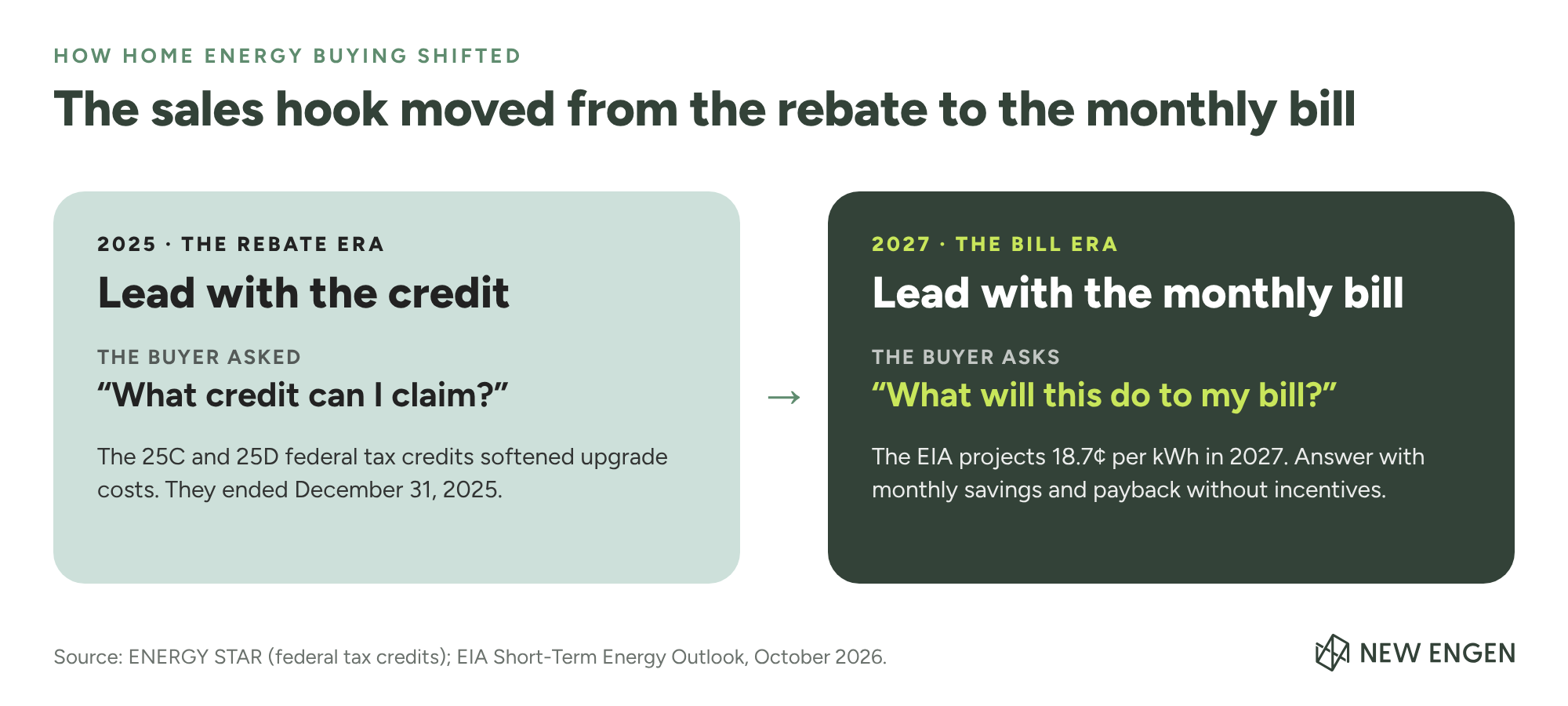
Homeowners now decide on the monthly bill, not the rebate. With the 25C and 25D credits gone, per ENERGY STAR, and the EIA projecting residential power prices up about 5% in 2026, the pitch has to be what an upgrade does for the monthly bill.
The research layer that introduced shoppers to the category is shrinking. New Engen's analysis of Similarweb data shows EnergySage's US web traffic down about 56% in July to September 2026 versus a year earlier, which leaves brands with more of the educating to do on their own pages.
Efficiency upgrades are holding up without the credit, but the wider market is cooling. Heat pumps made up 58% of US space-heating equipment shipments in the first half of 2026, matching their strongest first-half share, according to the Building Decarbonization Coalition, even as Harvard's Joint Center for Housing Studies expects remodeling growth to slow, so selling on the bill matters more than selling on the category.
The car is joining the home energy story, and trust decides how fast. Electrek reports Tesla turned on home backup for the Model 3 and Model Y in October, and Canary Media reports Ford's upcoming Fathom pickup will offer lower-cost home power backup, but Mintel found 75% of consumers worry that AI in homes raises cybersecurity risk, so privacy has to be part of the pitch.
Homeowners now decide on the monthly bill, not the rebate
The federal tax credits that softened upgrade costs ended on December 31, 2025, and power prices keep rising, so shoppers have moved from asking "what credit can I claim?" to asking "what will this do to my bill?" Leased and power-purchase solar follows different rules, covered in the 2027 outlook below.
The U.S. Energy Information Administration's October 2026 Short-Term Energy Outlook projects the average US residential electricity price at 18.2 cents per kWh in 2026, up about 5% from 17.3 cents in 2025, and shoppers are feeling it: a Pew Research Center survey fielded in March 2026 found that 75% of US adults say their home energy costs have gone up in recent years, and a Consumer Reports survey reported by S&P Global in October 2026 found a similar pattern among longtime homeowners. For marketers, that means the old rebate hook is gone: lead with what the product does for the monthly bill.
Incentive and research sites lost the most visits after the credits expired
The sites that used to introduce shoppers to home energy upgrades lost the most traffic after the credits expired, while several equipment brands grew.
In July to September 2026, EnergySage's US web traffic fell about 56% from the same quarter a year earlier, and ENERGY STAR's fell about 39%. Across the 14 sites we tracked, nine lost traffic, but equipment brands like Lennox, ecobee, Generac, and Carrier grew.
| Brand / site | What it represents | Jul-Sep 2025 visits | Jul-Sep 2026 visits | Change |
|---|---|---|---|---|
| Lennox | HVAC equipment | ~619K | ~955K | +54% |
| ecobee | Smart thermostat | ~3,986K | ~4,926K | +24% |
| Generac | Backup power | ~2,152K | ~2,597K | +21% |
| Carrier | HVAC equipment | ~1,487K | ~1,775K | +19% |
| SolarEdge | Solar inverters and batteries | ~2,251K | ~2,413K | +7% |
| Rheem | Water heaters and HVAC | ~1,175K | ~1,154K | -2% |
| ChargePoint | EV charging | ~1,276K | ~1,144K | -10% |
| U.S. Department of Energy | Federal energy guidance | ~4,115K | ~3,707K | -10% |
| Enphase | Solar and battery systems | ~1,133K | ~1,021K | -10% |
| Sunrun | Residential solar (lease/PPA) | ~3,047K | ~2,455K | -19% |
| Nest | Smart thermostat | ~13,974K | ~10,582K | -24% |
| ENERGY STAR | Efficiency ratings and incentives | ~1,849K | ~1,132K | -39% |
| Trane | HVAC equipment | ~9,074K | ~4,127K | -55%† |
| EnergySage | Solar quote marketplace | ~1,963K | ~873K | -56% |
† Trane's July to September 2025 base was inflated by an unexplained traffic spike that began in April 2025. Comparing January to March instead, before the spike, Trane was down about 16%.
The two sites built for incentive hunting and quote shopping fell hardest, while equipment brands shoppers already know held up better, and the next section shows equipment shipments holding up too. That fits shoppers still buying but researching somewhere else, which means your own pages, and the answers AI gives about your brand, are doing more of the educating than they used to. Trane and Nest are the exceptions, and both look like special cases: Trane's traffic jumped in April 2025 and fell back in December, which inflates last year's comparison, and Nest was already sliding before the credits ended.
Efficiency upgrades are holding up without the credit, but the wider market is cooling
Efficient equipment has held up better than the research traffic around it, even without the credit, but the wider remodeling market is cooling.
Heat pumps made up 58% of US space-heating equipment shipments through June 2026, matching their strongest first-half share, according to the Building Decarbonization Coalition. Canary Media reports that UC Berkeley's Lucas Davis suggests most buyers never considered the credit, and the coalition's report cites ACHR News in arguing that heat pumps may have crossed from "policy product" to "HVAC product."
Not every category is growing, though; gas furnace and electric water heater shipments both fell in May 2026, according to AHRI data reported by ACHR News, and Harvard's Joint Center for Housing Studies expects remodeling spending growth to slow to 0.5% by the second quarter of 2027.
Efficiency is a bill story for homeowners too. In the 2026 Hippo Housepower Survey of 1,619 US homeowners, fielded in September 2025, 37% said utility bill swings had affected their financial stability and 25% said energy efficiency had become more important to them. For marketers, that means selling efficiency on what the upgrade does to the monthly bill, since the credit no longer does the selling.
The car is joining the home energy system, and trust sets the pace
Automakers are shipping the hardware now, and consumers are open to the car becoming part of the home energy system, but trust and a clear payoff decide how quickly.
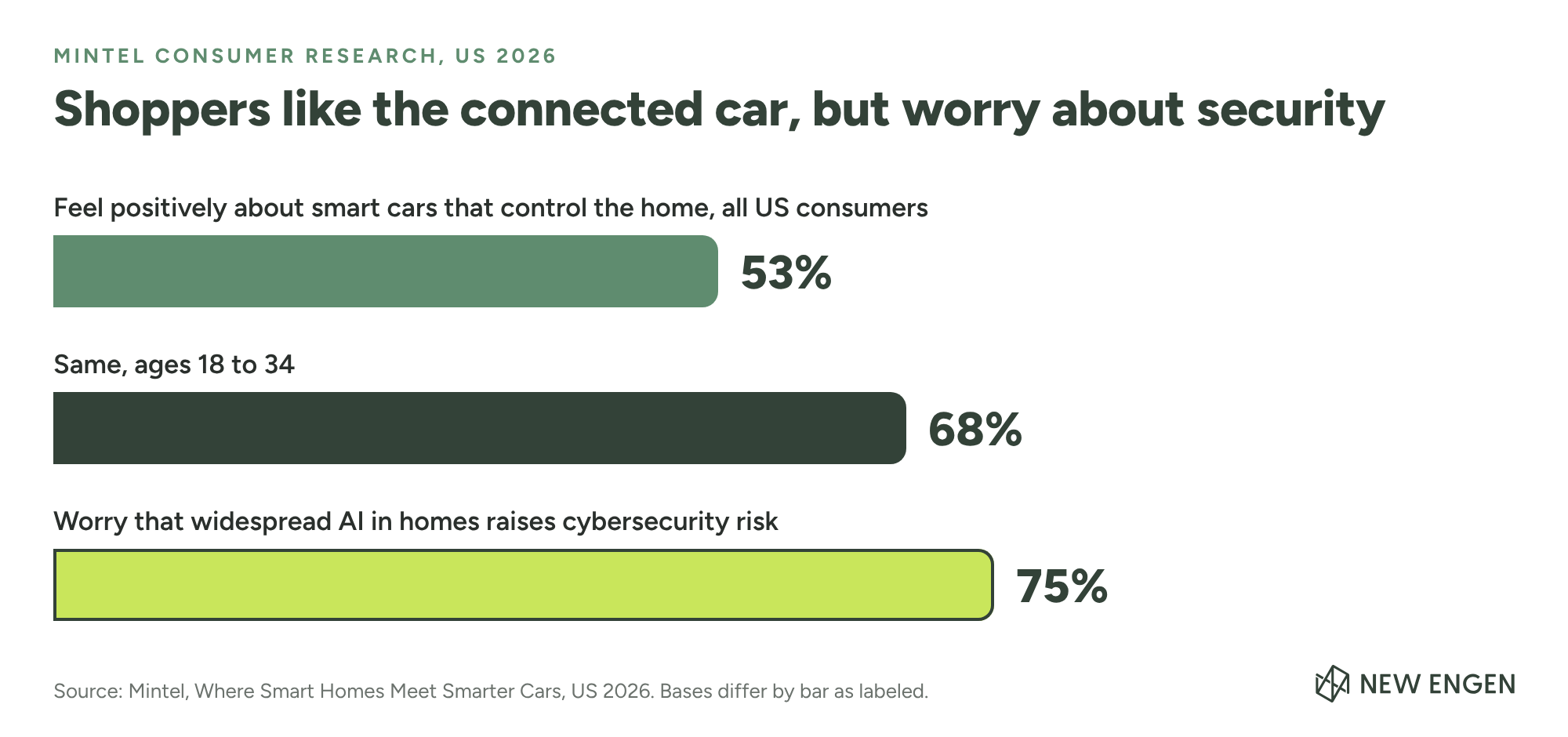
The appetite is already there. Mintel found that 53% of US consumers feel positively about smart cars that let you control your home remotely, rising to 68% of 18-to-34-year-olds. What shoppers want to know is the payoff, and automakers are starting to answer it.
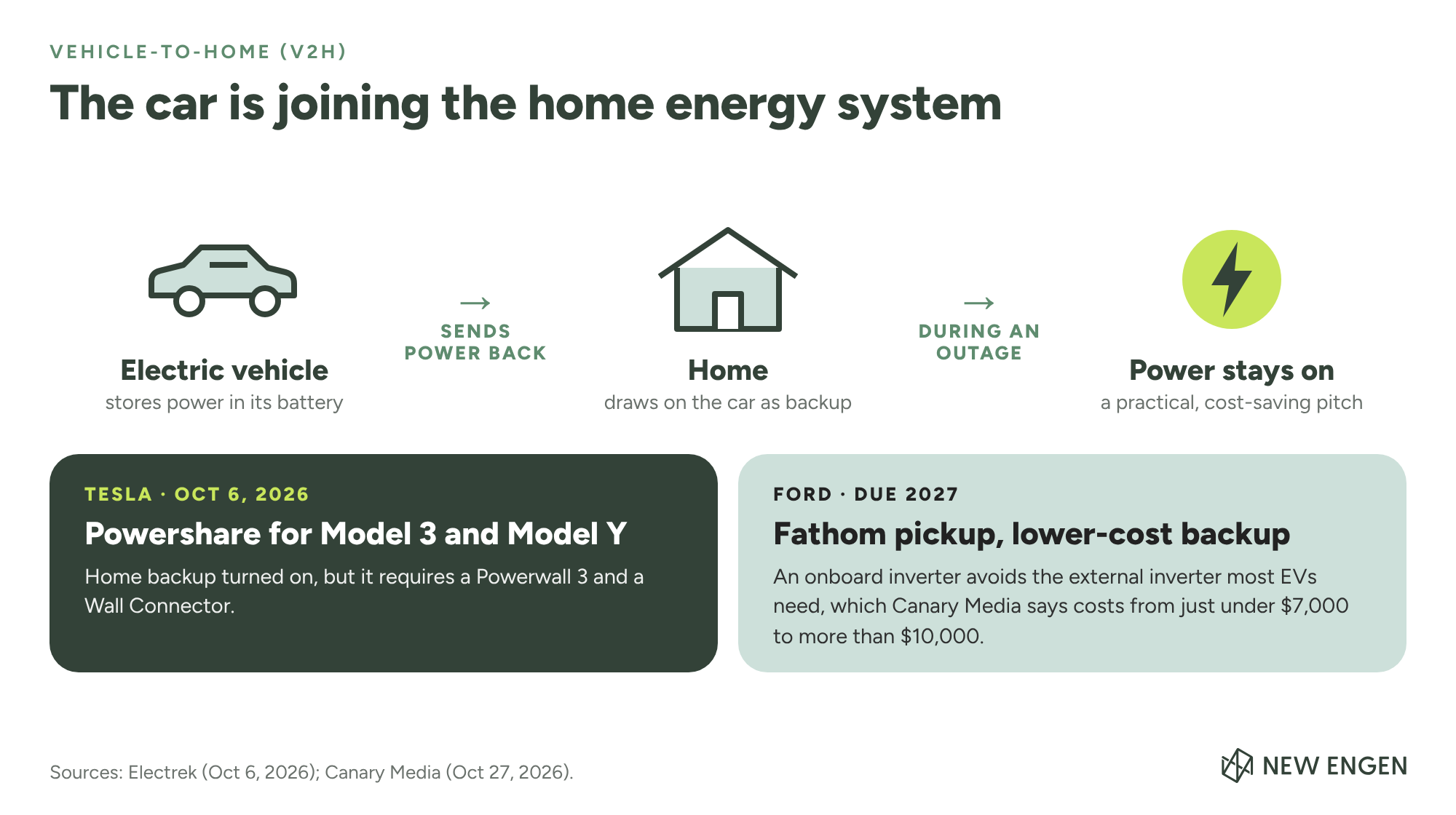
That answer is vehicle-to-home (V2H) backup, which lets an EV send stored power to a home, for example during an outage. Electrek reports Tesla turned on Powershare home backup for the Model 3 and Model Y on October 6, 2026, but it still requires a Powerwall 3 and a Wall Connector, so buyers pay for extra hardware. On October 27, Canary Media reported that Ford’s upcoming Fathom pickup, due next year, will use an onboard inverter instead of the external inverter most EVs need, which Canary Media says costs from just under $7,000 to more than $10,000. Both moves point toward simpler, cheaper backup power, which makes V2H easier to explain in one line: the car can keep the lights on.
Trust is the sticking point. The same Mintel research found that 75% of consumers worry that widespread AI in homes will raise the risk of cybersecurity threats and data breaches. Mintel's advice is to frame car-home integration as a practical, cost-saving upgrade, such as using a vehicle as backup power, and to lead with clear privacy and security practices. For home energy brands, that means the competitive set may soon include automakers and tech platforms, and the winning message is practical savings plus plain-language privacy.
Home energy marketing in 2027 will be judged on the monthly bill
Expect fewer big-bang projects and more step-by-step upgrades judged on what they do for the monthly bill. Four things to watch, and what each means for your marketing:
Power prices keep rising. The EIA projects 18.7 cents per kWh in 2027, roughly 3% above 2026, so messaging built on the monthly bill should keep working.
Remodeling growth cools. With Harvard's Joint Center for Housing Studies expecting growth to keep slowing, smaller, step-by-step purchases are likely to carry more of the demand, so lower-commitment offers deserve more attention.
Residential solar contracts, then recovers. SEIA and Wood Mackenzie expect US residential solar installations to fall 23% in 2026 before returning to growth in 2027. Per Solar Power World, leased-solar projects that did not begin construction by July 4, 2026 must be placed in service by December 31, 2027 to qualify, so expect that deadline to shape offers and messaging.
Vehicle-to-home gets cheaper in 2027. Ford says its Fathom pickup, due next year, will offer lower-cost home backup, and Tesla says Powerwall 2 and Powerwall+ support is coming soon (Canary Media, Electrek), so expect more V2H offers in 2027.
Brands that educate, prove, and simplify will win the shortlist in 2027
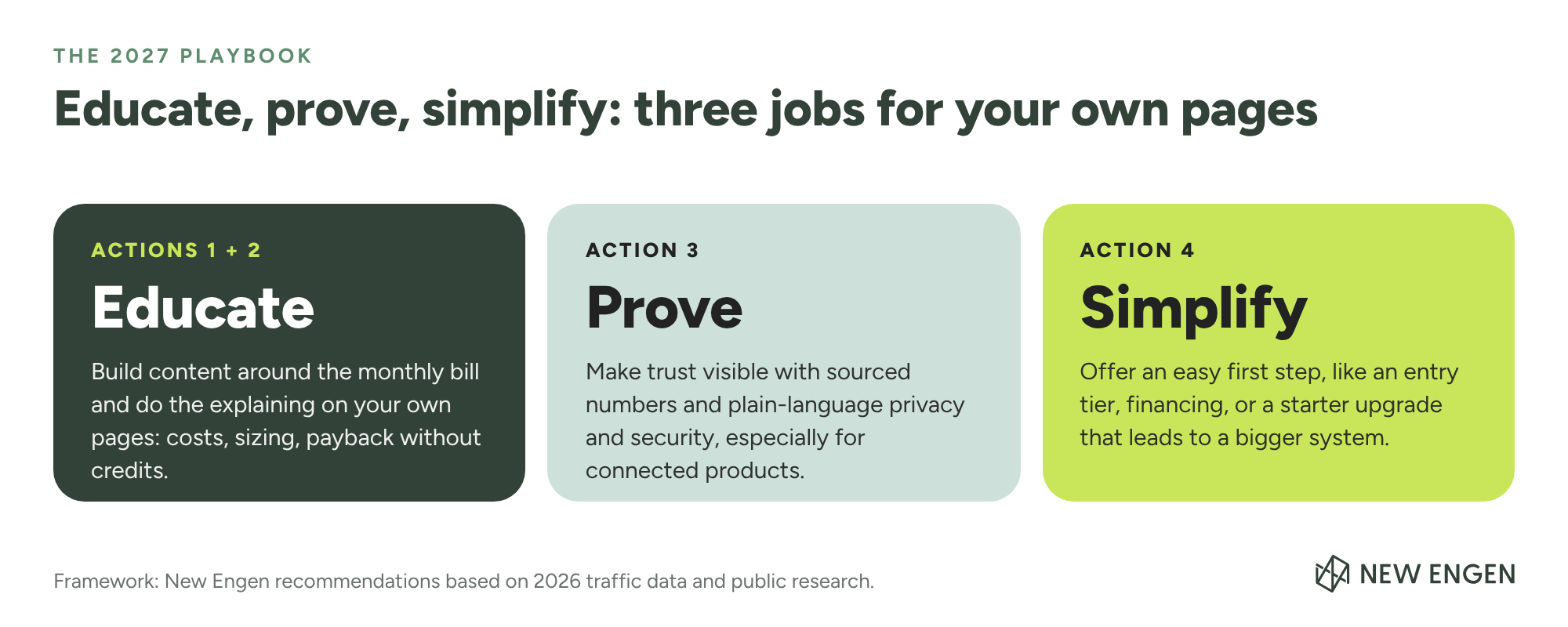
Brands that win in 2027 will answer the bill question on their own pages, prove their claims, and make the first step easy. Four actions, in order:
Build content around the bill, not the rebate. Answer "how much will this save me per month?" and "what is the payback without incentives?" with specific, sourced numbers. Why: the incentive question is gone, and Pew finds 75% of US adults say their home energy costs have gone up.
Do the educating on your own pages. Publish the explainers that comparison and incentive sites used to carry: costs, sizing, payback without credits, and what installation involves. Why: those research sites lost much of their traffic, so someone else has to introduce shoppers to the category.
Make trust visible. Explain data privacy and safety in plain language, especially for connected products. Why: shoppers worry about AI-driven home tech and security, so saying plainly how you protect their data removes a reason to hesitate.
Offer an easy first step. Entry tiers, financing, or a starter upgrade that leads to a bigger system. Why: with the remodeling market slowing, a smaller first purchase is an easier yes.
Home energy brands win discovery with direct answers on cost, payback, and trust
Home energy brands earn discovery in search and AI answers by giving direct, sourced answers to the questions buyers actually ask: cost per month, payback, compatibility, and trust. At New Engen, we spend our time on how people find brands, and in a considered-purchase category like this one we would expect those practical, specific questions to matter most.
If we were auditing a home energy brand today, we would recommend three checks:
Ask the buyer questions across several assistants. Run prompts such as "how much does a heat pump cost to run per month?" or "is rooftop solar worth it without the tax credit?" in ChatGPT, Gemini, Perplexity, and Google AI Overviews, and note which brands and sources get cited.
Check that the brand's own pages answer them. Look for a direct, quotable answer with a named source and a date, and confirm that product and entity details are consistent everywhere a model might pull from.
Set a baseline for AI referral traffic and branded-search lift. Start tracking now so 2027 changes can be measured against something.
Structured data and third-party mentions help models describe a brand accurately. None of it replaces a product that delivers. For the technical and citation factors in more detail, read New Engen's guide to why your brand isn't showing up in AI recommendations, and for how challenger brands can earn mentions around specific needs, see how DTC disruptors can show up in AI recommendations.
Whether you sell panels, thermostats, heat pumps, or chargers, the takeaway is the same: the rebate is gone, power prices keep rising, and the sites that used to introduce shoppers to the category are losing traffic. Heading into 2027, the brands that win will be the ones that make the monthly payoff, the proof, and the privacy story easy for both people and machines to find, compare, and trust.
Frequently Asked Questions About Home Energy Efficiency and Electrification Marketing
Q1: What are the biggest home energy efficiency trends for 2027?
Four trends are shaping home energy efficiency heading into 2027: homeowners deciding on the monthly bill instead of the rebate, shopper research moving away from incentive and comparison sites, efficient equipment like heat pumps holding up without the federal credit, and electric vehicles joining the home energy system through vehicle-to-home features. Rising power prices tie them together, with the EIA projecting the average US residential price at 18.7 cents per kWh in 2027.
Q2: How can home energy brands show up in AI answers?
Home energy brands show up in AI answers by publishing direct, quotable answers to the questions buyers ask, such as how much a heat pump costs to run per month or whether rooftop solar is worth it without the tax credit. Support each answer with a named third-party source and a date, keep product and entity details consistent across your site and profiles, and use structured data that matches the visible content. Then run the same prompts in ChatGPT, Gemini, Perplexity, and Google AI Overviews to see which brands and sources get cited.
Q3: Where are homeowners researching home energy upgrades now?
The data shows where research is shrinking, not where it moved. New Engen's analysis of Similarweb data shows EnergySage's US web traffic down about 56% and ENERGY STAR's about 39% in July to September 2026 versus a year earlier, while equipment brands like Lennox, ecobee, Generac, and Carrier grew. More research may now be happening inside AI answers, but we did not have AI-referral data to test that. Either way, a brand's own pages, and how AI describes the brand, are carrying more of the education.