
What Is Creative Fatigue? How to Diagnose and Fix Declining Ad Performance

An ad performs well. The team increases spend. Results hold for a while, then click-through rate starts falling, acquisition costs climb, and return on ad spend weakens.
The immediate diagnosis is often creative fatigue.
Sometimes that is correct. But declining performance does not automatically mean an ad has worn out. Audience saturation, budget changes, auction pressure, seasonality, offer weakness, landing-page problems, and tracking issues can produce similar symptoms.
Even when creative fatigue is the cause, replacing an image or rewriting a hook may not solve the larger problem. A brand can launch dozens of new assets while continuing to show audiences the same idea.
Creative fatigue should therefore be treated as more than a signal to refresh an ad. It is a diagnostic question:
Has a specific asset worn out, has an entire creative concept become repetitive, or is something else causing performance to decline?
Answering that question helps marketers determine whether to refresh a winning asset, develop a new concept, adjust the media strategy, or investigate another part of the customer journey.
What Is Creative Fatigue?
Creative fatigue is the decline in an advertisement’s effectiveness after an audience has been repeatedly exposed to the same asset, message, or creative concept.
As the creative becomes more familiar, it may become less effective at earning attention or motivating action. Marketers may see declining engagement, lower click-through rates, higher acquisition costs, weaker conversion rates, or less efficient delivery.
Creative fatigue can happen at more than one level:
Asset fatigue: One specific advertisement has been shown too often.
Message fatigue: Audiences continue seeing the same claim, benefit, or selling point.
Format fatigue: The brand relies too heavily on one executional style, such as similar creator videos or product demonstrations.
Concept fatigue: Multiple assets look different on the surface but use the same central idea, motivation, or persuasion strategy.
Portfolio fatigue: The active creative mix lacks enough diversity to reach new audiences or generate new learning.
New Engen’s perspective: Creative fatigue is not always caused by a shortage of assets. It can also result from a shortage of genuinely different ideas.
A team may be producing new hooks, edits, headlines, and creators every week. If those assets share the same message and visual structure, audiences and advertising systems may continue to interpret them as repetitive.
What Is the Difference Between Creative Fatigue and Ad Fatigue?
Creative fatigue and ad fatigue are closely related, but the terms emphasize different parts of the problem.
| Term | What it describes | Common signs |
|---|---|---|
| Ad fatigue | The broader audience response to seeing repetitive advertising too frequently | Reduced attention, irritation, ad hiding, declining engagement |
| Creative fatigue | The performance decline associated with an asset, message, format, or concept losing effectiveness | Falling CTR, rising CPA, weaker conversion, declining creative-level performance |
| Audience saturation | The point at which a campaign has reached much of the available responsive audience | Rising frequency, limited incremental reach, slower audience growth |
| Creative underperformance | An ad that was never effective, rather than one that declined after working | Weak results from launch with no meaningful period of strong performance |
The timeline is important.
A creative that performs poorly from the beginning is not necessarily fatigued. It may have a weak concept, unclear message, unconvincing proof, or poor alignment with the audience.
Fatigue describes deterioration. The creative must have lost effectiveness relative to a meaningful earlier baseline.
What Causes Creative Fatigue?
Creative fatigue develops when exposure and repetition outpace a brand’s ability to introduce relevant, distinctive ideas.
Repeated exposure to the same asset
The most familiar cause is frequency. As the same audience sees an ad repeatedly, the creative loses novelty and becomes easier to ignore.
Amazon Ads identifies long campaign periods, narrow audiences, limited channel diversity, and repeated creative as factors that can contribute to ad fatigue. It also notes that declining audience response can influence how advertising algorithms deliver the campaign.
But frequency alone does not prove fatigue. A retargeting audience, for example, may tolerate more repetition than a broad prospecting audience. A memorable brand campaign may also benefit from repetition before it reaches the point of diminishing returns.
The relevant question is not simply, “Is frequency high?”
It is: Is exposure increasing while the creative’s ability to earn attention or drive action is declining?
Too few distinct concepts
A brand may have numerous ads in market while still relying on only one or two creative concepts.
Consider a product positioned around convenience. The brand might produce:
Five opening hooks
Three video lengths
Four creator executions
Static and motion versions
Multiple calls to action
That creates a substantial number of assets, but every ad still gives customers the same reason to care.
A truly diversified portfolio might explore convenience, confidence, belonging, performance, simplicity, cost avoidance, identity, or another credible motivation. Each concept creates a different opportunity to resonate.
“Creative diversification trumps quantity in 2026,” says Ashley Foster, Creative Partnership Lead at Meta. “The more you treat creative as a key platform signal, through truly differentiated visuals, messaging, and concepts, the better the outcome.”
Narrow audiences and concentrated spending
Smaller audiences can encounter the same creative more quickly, particularly when budgets increase.
The problem can accelerate when a strong-performing ad receives a growing share of spend. The asset initially earns more delivery because it is working, but that delivery can increase exposure and shorten its remaining useful life.
A winning ad is therefore not permanent inventory. It is an opportunity to learn what worked, extend the concept intelligently, and begin developing the next idea before performance falls.
Repetitive formats and production patterns
Creative can become predictable even when the individual messages change.
For example, a brand may repeatedly use:
The same creator profile
The same product demonstration
The same problem-solution script
The same visual setting
The same testimonial structure
The same opening pattern
The same type of social proof
Audiences begin recognizing the pattern before they process the message.
This is especially common when teams optimize production around whatever is easiest to reproduce. Efficiency increases, but creative distinctiveness decreases.
Weak audience understanding
Generic audience definitions tend to produce generic creative.
If a persona is defined only by age, location, income, and purchase history, the creative team has little direction about what customers value, what they fear, why they hesitate, or what would make the product feel relevant.
Psychographic and behavioral insights provide more creative territory:
Motivations
Values
Beliefs
Objections
Identities
Aspirations
Need states
Purchase triggers
Sources of trust
Different audience motivations can support genuinely different concepts rather than endless versions of the same message.
Reactive production systems
Many teams wait until performance has already deteriorated to request new creative.
By that point, the process may still require:
Diagnosing the problem
Developing a brief
Approving a concept
Finding talent
Producing assets
Completing reviews
Building ads
Launching and gathering data
The delay turns creative fatigue into a recurring performance gap.
Brands need a pipeline that develops new concepts while current winners are still performing.
How Can You Tell if an Ad Has Creative Fatigue?
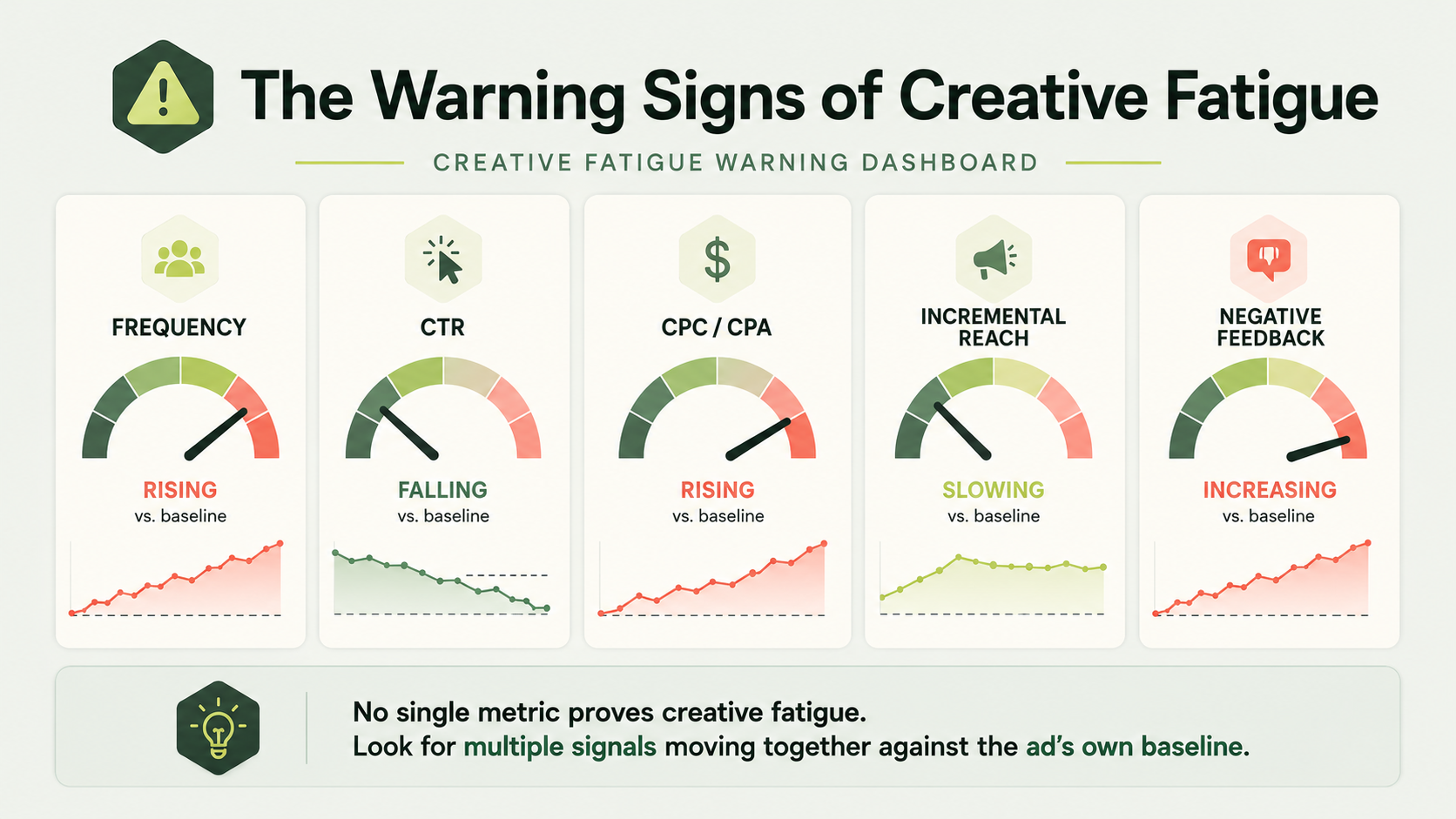
Creative fatigue should be diagnosed through several signals moving together over time.
No single metric can confirm it. Frequency may rise while performance remains healthy. CTR may fall because the audience mix changed. CPA may increase because conversion weakened on the website.
The strongest diagnosis appears when an ad declines relative to its own baseline and other likely causes have been considered.
Creative-fatigue diagnostic signals
| Signal | What to examine | What it may indicate |
|---|---|---|
| Frequency is rising | Exposure over the same reporting window and audience | The campaign may be repeatedly reaching the same people |
| CTR or engagement is falling | Change from the creative’s earlier performance | The asset may be losing its ability to earn attention |
| CPC is increasing | CPC alongside CTR and CPM | Lower response may be making traffic more expensive |
| CPA is rising | Acquisition cost relative to spend, traffic, and conversion rate | The creative may be generating less efficient demand |
| Conversion rate is falling | Post-click conversion by creative and landing page | The message may be attracting weaker intent, or the problem may occur after the click |
| Incremental reach is slowing | New people reached as spending continues | The campaign may be saturating its available audience |
| Negative feedback is increasing | Ad hiding, dismissals, or unfavorable comments | Repetition may be causing irritation |
| Creative rankings are declining | Platform-level quality, engagement, or conversion diagnostics | The platform may be detecting weaker audience response |
| Spend shifts away from the asset | Delivery changes among otherwise comparable ads | The system may be finding better alternatives |
Diagnose change, not just an absolute number
There is no universal frequency, CTR decline, or CPA threshold that proves creative fatigue across every brand.
The appropriate benchmark depends on:
Campaign objective
Audience size
Funnel stage
Platform
Placement
Product category
Purchase cycle
Creative format
Spend level
Brand familiarity
Reporting window
A frequency of four may be excessive for one prospecting campaign and entirely normal for another retargeting program.
Compare the asset against:
Its own early performance
Its recent rolling performance
Other assets serving a similar role
The campaign or account baseline
The same period’s media, audience, and conversion conditions
New Engen’s perspective: Creative fatigue should be diagnosed as a pattern of change against an ad’s own baseline, not by one universal threshold.
Is Declining Performance Really Creative Fatigue?
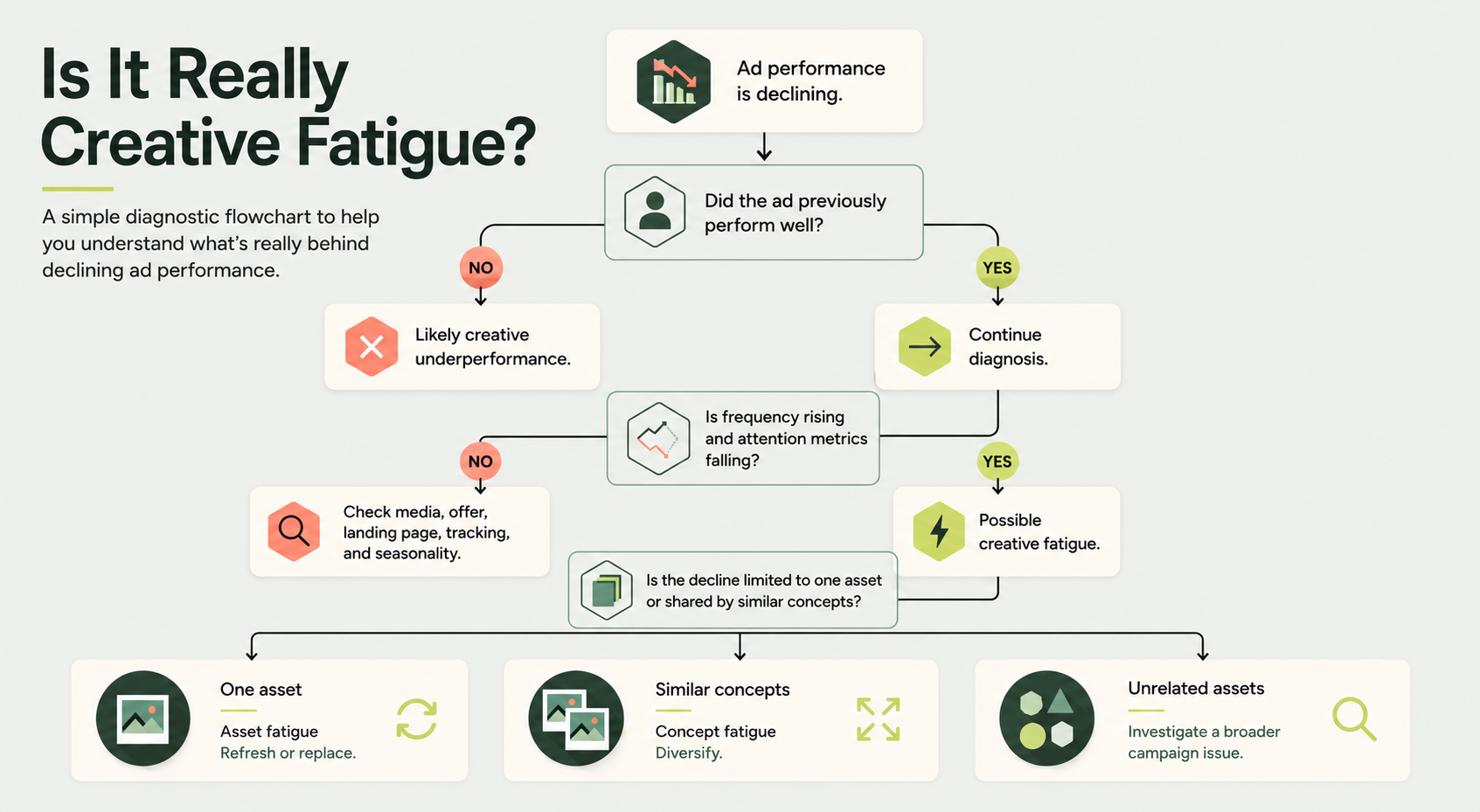
Before replacing the creative, check for other explanations.
| Possible cause | What to investigate |
|---|---|
| Budget scaling | Did spending increase quickly or force the platform to find less efficient impressions? |
| Audience changes | Were targeting, exclusions, geography, or audience expansion settings changed? |
| Auction pressure | Did CPM rise across several campaigns or advertisers during a competitive period? |
| Seasonality | Did customer demand, shopping behavior, or category interest change? |
| Offer weakness | Did pricing, promotions, inventory, shipping, or product availability change? |
| Landing-page problems | Did site speed, conversion rate, merchandising, or checkout performance decline? |
| Tracking issues | Did attribution settings, pixels, APIs, consent rules, or reporting change? |
| Placement shifts | Did delivery move toward placements with different response patterns? |
| Poor initial creative | Did the asset ever establish a period of strong performance? |
| Audience saturation | Is the campaign struggling to find new responsive people, even with varied creative? |
A useful diagnostic sequence is:
Confirm that performance declined relative to a meaningful baseline.
Determine whether the decline is concentrated in one asset, one concept, or the whole account.
Review changes in budget, audience, bidding, placement, offer, website, and measurement.
Compare attention metrics with conversion metrics.
Examine frequency and incremental reach.
Classify the problem before deciding what to produce.
This prevents teams from using creative as the default explanation for every performance issue.
What Is the Difference Between Creative Iteration and Creative Diversification?
Once fatigue has been identified, the next decision is whether to iterate or diversify.
Creative iteration
Creative iteration modifies an existing concept while preserving its core idea.
Examples include:
Testing a new opening hook
Shortening a video
Changing the headline
Reordering scenes
Adding motion
Trying a different call to action
Reformatting an asset for another placement
Replacing the creator while maintaining the same message
Iteration is useful when the underlying concept remains effective but a specific execution needs to be refreshed or extended.
Creative diversification
Creative diversification introduces a meaningfully different concept.
It may change:
The audience motivation
The customer problem
The central message
The emotional appeal
The type of proof
The talent or creator perspective
The setting
The format
The visual language
The role the asset plays in the funnel
Diversification is useful when the existing concept has become saturated, the active portfolio is too repetitive, or the brand needs to reach new pockets of demand.
| Situation | Better response |
|---|---|
| The central message still works, but attention is declining | Iterate the execution |
| One format is weakening while other versions of the concept remain healthy | Test a new format |
| One asset is fatigued but comparable concepts still perform | Refresh or replace the asset |
| Several assets with the same message are declining together | Develop a new concept |
| The portfolio relies on the same motivation and visual style | Diversify concepts |
| Performance is declining across unrelated creative | Investigate media, audience, offer, market, or conversion factors |
| The brand needs to reach a new audience need state | Develop audience-specific concepts |
Iteration extends a winner. Diversification creates another way to win.
Brands need both, but they solve different problems.
How Do You Fix Creative Fatigue?
1. Identify the level of fatigue
Determine whether the problem exists at the asset, format, message, concept, or portfolio level.
If one video has declined but other executions of the same concept remain healthy, replacing that asset may be enough.
If every execution centered on the same benefit is weakening, another edit will probably offer only temporary relief. The team needs a new concept.
2. Return to the audience
New creative ideas should begin with audience understanding, not an internal request to “make something fresh.”
Look for differences in:
Customer motivations
Objections
Use cases
Product expectations
Category beliefs
Purchase triggers
Identities
Desired outcomes
Sources of credibility
A meal-delivery company, for example, might develop separate concepts for customers motivated by saving time, controlling nutrition, avoiding cooking stress, discovering new meals, or making family care easier.
These are not simply different hooks. They are different reasons to care.
3. Analyze what actually worked
Do not treat the fatigued asset as a dead end. Separate its components and identify the most plausible drivers of performance.
Review its:
Concept
Audience or need state
Message
Hook
Format
Talent
Visual style
Offer
Proof point
Call to action
Funnel role
Placement
Performance history
The goal is not to produce a superficial copy of the winner. It is to determine which elements deserve to be retained, tested, or replaced.
4. Match the response to the evidence
If the concept remains productive, use iteration to extend it.
If the concept is declining across multiple executions, diversify.
If the evidence is inconclusive, run a controlled test that changes a defined variable and produces a decision.
The team should know what it will do if the result supports or rejects the hypothesis. Testing without a predetermined decision rule produces information but not necessarily progress.
5. Diversify across meaningful dimensions
A healthy creative portfolio should include differences in more than surface execution.
Useful dimensions include:
Audience need state
Customer motivation
Message or benefit
Objection
Creator or spokesperson
Setting
Visual style
Format
Emotional tone
Product use case
Proof type
Funnel stage
Channel role
Meta recommends expanding creative across formats, placements, media, visuals, and messaging to improve advertising performance. Meaningful variety gives automated systems more ways to match relevant advertising with different people.
The objective is not diversity for its own sake. Each creative difference should represent a reasonable hypothesis about what could motivate a different response.
6. Use the right content source
Not every fatigue problem should be sent to the same production team.
Different sources provide different strengths:
Content source
Useful strengths
Brand or studio production
High craft, controlled visual systems, major campaigns and brand storytelling
Performance creative teams
Rapid iteration, testing, channel-native execution and direct-response learning
Influencers
Cultural relevance, established audiences, credibility and distinctive personal perspectives
UGC creators
Production flexibility, relatable demonstrations, varied talent and use cases
Affiliate partners
Product education, comparison, recommendation and conversion-oriented content
Generative AI
Research support, concept exploration, adaptation, versioning and production acceleration
AI can increase output, but higher volume does not automatically create greater conceptual diversity. If every asset begins with the same inputs, templates, and prompts, the system may produce more repetitive work faster.
7. Build replacements before they are needed
Creative production should not begin only after a winner declines.
A more resilient pipeline includes:
Concepts currently scaling
Iterations extending proven ideas
New concepts entering testing
Replacement assets in production
Audience insights feeding future briefs
Performance learnings documented by creative attribute
This reduces the time between identifying fatigue and launching a credible response.
How Can Brands Prevent Creative Fatigue?
Creative fatigue cannot always be eliminated. Effective advertising still has a lifespan.
The goal is to manage that lifecycle without repeatedly allowing performance to collapse.
Maintain a concept pipeline
Track the number of distinct ideas in development, not only the number of assets produced.
Ten assets built from one concept should not be counted as ten independent creative bets.
Use a creative taxonomy
Tag creative by strategically meaningful attributes, such as:
Persona or audience
Need state
Motivation
Concept
Message
Hook
Format
Talent
Setting
Visual style
Proof type
Offer
Funnel role
A taxonomy helps teams determine whether performance is declining at the asset level or across a broader creative pattern.
Monitor creative by cohorts
Compare assets that serve similar roles.
A top-of-funnel creator story should not necessarily be judged by the same immediate conversion expectation as a lower-funnel product demonstration.
Grouping creative by objective, audience, concept, format, and funnel role produces more useful comparisons.
Connect media and creative teams
Media teams often recognize fatigue before creative teams receive a new brief.
Creative teams may know that replacements are needed but lack information about which concepts, audiences, or messages are weakening.
A shared review should examine:
What is scaling
What is declining
Which audiences are being reached
Which concepts are overrepresented
Which motivations remain untested
What should be iterated
What should be diversified
What the team needs to produce next
Create a recurring customer-learning cadence
Audience understanding should be continually updated through:
Customer interviews
CRM and purchase data
Social listening
Product reviews
Search behavior
Store or frontline conversations
Customer-service feedback
Creator insights
Creative and media performance
“You have to talk about this as a group, on a cadence,” says Kevin Goodwin, SVP of Strategy and Growth at New Engen. “This can’t be a once-a-year thing, and it can’t be assumed.”
Fresh audience insight creates fresh creative territory.
How Should Creative Performance Be Measured?
Creative-performance measurement should help the organization decide what to produce next.
That requires more than a list of winning and losing ads.
| Measurement layer | Question it should answer | Example measures |
|---|---|---|
| Attention | Did the creative earn an initial response? | Thumb-stop rate, view rate, engagement, CTR |
| Traffic quality | Did it attract relevant interest? | CPC, landing-page engagement, qualified visits |
| Conversion | Did it contribute to the intended action? | Conversion rate, CPA, revenue, ROAS |
| Reach | Did it help the brand find new demand? | Reach, incremental reach, audience penetration |
| Brand impact | Did it affect awareness, preference, or intent? | Brand lift, search response, consideration |
| Learning | Did the test produce a usable decision? | Concept win rate, validated hypotheses, new audience insights |
| Lifecycle | How did performance change over time? | Peak performance, rate of decline, useful lifespan |
| Operations | Can the team respond quickly enough? | Time to brief, production cycle time, backlog, replacement readiness |
Creative should be analyzed by attributes, not only by individual asset names.
If several ads featuring the same motivation or proof type perform well, the learning can sharpen future briefs. If one asset wins but the team cannot explain why, the result is difficult to reproduce.
Is Creative Fatigue a Creative Problem or an Operating-System Problem?
An individual fatigued asset is a normal part of advertising.
Recurring creative fatigue is often an operating-system problem.
It can signal that:
Audience research is not reaching the brief
The portfolio lacks conceptual diversity
Creative and media teams are disconnected
Performance findings arrive too late
Testing does not produce clear decisions
Production begins only after results decline
Teams confuse asset volume with creative variety
Winning insights are not documented or applied
Content sources operate under separate strategies
Across more than 100 conversations with brands in 2026, New Engen found that creative volume and quality were among the most consistent barriers to growth. Brands had added agencies, internal teams, freelancers, creators, studios, and AI tools, but many still lacked a connected system for turning those resources into effective creative.
“Brands with the best content engines and systems will meaningfully outperform the market,” says Goodwin.
The solution is not an endless cycle of waiting for ads to decline and then replacing them. It is a creative-led growth system in which audience understanding informs concepts, media performance creates learning, and that learning improves the next brief.
What Is the Bottom Line on Creative Fatigue?
Creative fatigue is the decline in advertising effectiveness caused by repeated exposure to the same asset, message, format, or concept.
It may appear through rising frequency, falling engagement, higher acquisition costs, weakening conversion, or slower incremental reach. But no single metric proves that fatigue is the cause. Marketers must compare performance with the ad’s own baseline and rule out changes in media, audience, offer, market conditions, measurement, and the post-click experience.
Once fatigue is confirmed, the right response depends on its level:
Refresh an execution when the concept still works.
Iterate when a proven idea has more room to develop.
Diversify when the portfolio keeps repeating the same motivation, message, or creative pattern.
Investigate beyond creative when unrelated assets decline together.
Most importantly, do not wait for performance to collapse before producing what comes next.
Brands need a system that continuously turns audience insight into distinct concepts, performance into learning, and learning into better creative.
For New Engen’s complete framework for connecting audience strategy, creative production, media, experimentation, and measurement, download The 2026 Growth Playbook.
Related posts

How to Improve Meta Ad Performance: When to Iterate and When to Diversify Creative



Digiday: How WeAre8 presents itself to advertisers as it launches in the U.S.