
How to Improve Meta Ad Performance: When to Iterate and When to Diversify Creative

Your team produced 20 new Meta ads this month. They feature different hooks, creators, edits, headlines, and calls to action.
But look past those surface differences and they may all be communicating the same idea.
This is one of the most common problems in modern advertising: brands are producing more assets without creating more reasons for customers to respond.
That distinction matters as Meta automates more of the work that once occupied media teams. Its systems increasingly influence targeting, bidding, budget allocation, placements, and delivery. Creative is one of the most important inputs marketers can still control.
Meta recommends creative diversification as part of its Performance 5 framework, encouraging advertisers to develop a variety of creative so its AI can deliver relevant messages to the people most likely to respond. But “variety” can mean several things. A new crop, hook, format, or creator gives the system another execution to work with. A new concept gives it an entirely different message and audience motivation.
Brands need both. The question is knowing which one the campaign needs:
Should the team keep improving an existing idea, or develop a genuinely different creative concept?
Why Doesn’t Producing More Meta Ads Always Improve Performance?
Producing more Meta ads does not necessarily improve performance when the new assets repeat the same message, motivation, or creative structure.
A brand may take one successful concept and produce:
Five new hooks
Three video lengths
Multiple creator versions
Static and motion assets
Several headlines
New backgrounds
Different calls to action
Those variations can be valuable. They help the team improve execution, adapt the idea to additional placements, and extend the useful life of a winner.
But they do not necessarily create a new idea.
If every asset still speaks to the same customer motivation, emphasizes the same product benefit, and uses the same type of proof, the portfolio remains conceptually narrow.
Across more than 100 brand conversations conducted by New Engen between February and May 2026, creative volume and quality gaps were the second-most consistent pain point across three consecutive reporting periods.
The recurring problem was not always a lack of production. Brands were producing content, but their teams had exhausted the same formats and concepts without a framework for genuine conceptual diversification. One brand described its internal creative team as cycling through the same ideas repeatedly, continuing to ship assets that had stopped driving results without a clear path to breaking the pattern.
A production pipeline can remain active while the strategic idea pipeline runs dry.
New Engen’s perspective: Asset volume measures how much creative a team produces. Conceptual diversity measures how many distinct ideas the team gives audiences and advertising systems to respond to.
A brand can have high asset volume and low conceptual diversity at the same time.
What Is Creative Iteration?
Creative iteration is the process of improving or adapting an existing advertising concept by changing elements of its execution.
The central idea remains the same, but the team tests how that idea is expressed.
Creative iteration may involve:
Testing a new opening hook
Rewriting the headline
Shortening or lengthening a video
Reordering scenes
Changing the CTA
Adding motion to a static asset
Adapting an asset for Reels or Stories
Replacing the thumbnail
Using another creator to deliver the same message
Changing the timing or presentation of proof
Producing additional copy variations
Reformatting a winner for other placements
Imagine a meal-delivery brand has a successful concept built around saving time on busy weekdays.
One ad opens with a crowded calendar. Another shows a parent arriving home late. A third uses a creator explaining how much time the service saves. The hooks and formats change, but every ad is still built around the same central idea: this product makes an overloaded week easier.
That is iteration.
What question does creative iteration answer?
Creative iteration asks:
How can we improve, adapt, or extend an idea that already shows promise?
It is especially useful when:
The concept continues to perform
One element appears to be limiting performance
The brand wants to adapt a winner for another placement
The message resonates but its execution needs improvement
The team wants to identify which hook, format, or CTA works best
A proven concept needs fresh executions before it experiences creative fatigue
Iteration is not an inferior form of creative development. It helps brands understand why an idea works and extract more value from it.
The problem begins when iteration becomes the only type of creative development a team does.
What Is Creative Diversification?
Creative diversification is the development of meaningfully different advertising concepts that give audiences distinct reasons to respond.
Instead of changing only how an idea is executed, diversification changes the underlying communication strategy.
A diversified concept may introduce a different:
Audience motivation
Customer need state
Problem
Product benefit
Objection
Use case
Emotional appeal
Type of proof
Creator perspective
Visual world
Format
Funnel role
Return to the meal-delivery example.
A diversified portfolio might include separate concepts for:
A time-strapped customer who wants fewer weekday decisions
A health-focused customer who wants greater nutritional control
A reluctant cook who wants to avoid preparation and cleanup
A variety seeker who is tired of eating the same meals
A caregiver who wants to make feeding a household easier
Each concept gives the customer a different reason to care. It also gives the advertising system a different message around which it can observe audience response.
What question does creative diversification answer?
Creative diversification asks:
What other idea could reach, interest, or persuade a different pocket of demand?
It becomes particularly important when:
The active portfolio repeats the same message
Multiple versions of one concept produce similar results
Growth has stalled despite continued asset production
The brand wants to reach new customers
A campaign has become dependent on one winner
Audience research reveals unaddressed motivations or objections
Several executions of the same concept are declining together
The team needs new strategic learning, not another executional comparison
What Is the Difference Between Creative Diversification and Iteration?
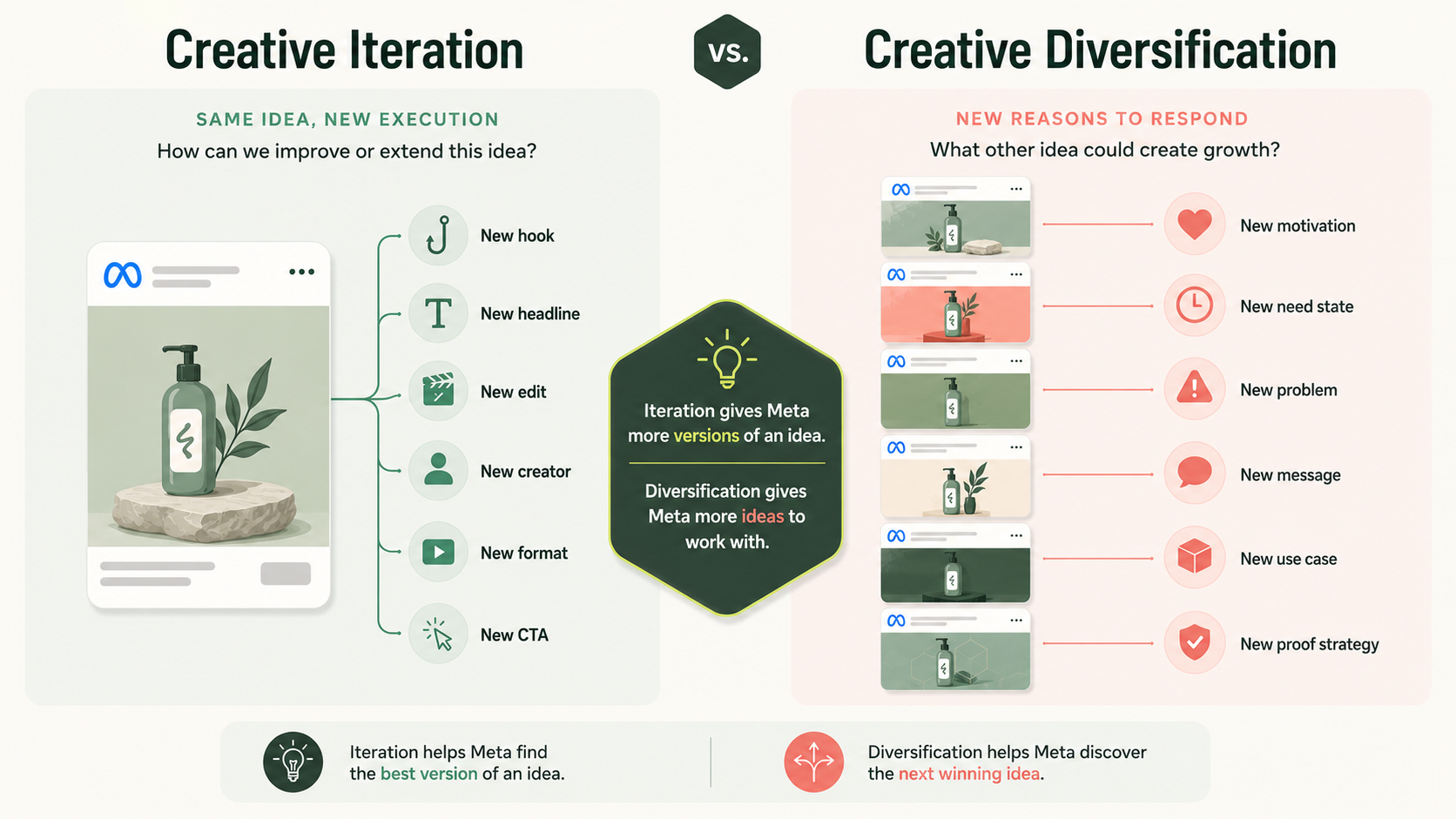
Creative iteration improves an existing idea. Creative diversification introduces another idea.
Or, more simply:
Iteration gives Meta more versions of an idea. Diversification gives Meta more ideas to work with.
| Dimension | Creative iteration | Creative diversification |
|---|---|---|
| Central concept | Remains the same | Changes meaningfully |
| Primary purpose | Improve or extend a proven idea | Discover another path to performance |
| Typical variables | Hook, edit, headline, CTA, length, placement, creator | Motivation, need state, message, problem, use case, emotional appeal, proof strategy |
| Learning produced | Which execution of this idea works better? | Which idea resonates with a different audience or need? |
| Risk level | Usually lower because it builds on an existing concept | Usually higher because it tests a new hypothesis |
| Best used when | A concept is productive or needs refinement | The portfolio is narrow, growth has stalled, or new demand is needed |
| Example | Testing three hooks for an ad about saving time | Testing convenience against nutrition, variety, identity, or cost avoidance |
A strong Meta creative strategy uses both.
Iteration helps marketers build conviction around what is already working. Diversification prevents an account from becoming dependent on a small number of ideas.
Is Every New Ad a Diversified Creative?
No. A new asset is not necessarily a diversified creative.
Two ads can look different while performing the same strategic job. A new creator, color palette, crop, opening line, or video length may still express the same central message.
This does not make the new asset useless. It means the asset represents executional variety rather than a new concept.
It is helpful to distinguish between two levels of diversification.
Executional diversification
Executional diversification changes how an idea appears or functions.
It can include:
Format
Placement
Aspect ratio
Hook
Edit
Length
Creator
Visual treatment
Headline
CTA
Background
Music
Executional diversification can improve platform fit, support personalized delivery, refresh a winner, and reveal which presentation works best.
Conceptual diversification
Conceptual diversification changes the underlying reason the audience should respond.
It can include:
Motivation
Need state
Objection
Message
Product use case
Emotional appeal
Type of proof
Brand role
Funnel objective
Conceptual diversification creates a larger range of strategic hypotheses.
| Executional diversification | Conceptual diversification |
|---|---|
| New hook | New motivation |
| New edit | New customer problem |
| New creator delivering the same message | New creator perspective tied to a different need state |
| New format | New way the product fits into the customer’s life |
| New headline | New central promise |
| New background | New visual world built around another idea |
| New CTA | New role within the customer journey |
Meta may benefit from both kinds of variety. Marketers still need to know which one they are producing and what they expect to learn.
Why Does Meta Recommend Creative Diversification?
Meta recommends creative diversification because varied creative gives its delivery system more opportunities to match relevant advertising with different people.
Meta’s Performance 5 framework describes creative diversification as developing a variety of ad creative and allowing AI to deliver the right message to the people most likely to be interested in it. Its Advantage+ products automate an increasing share of audience discovery, placements, budget allocation, and creative optimization. Meta Performance 5
Behind that automation is a large system of models involved in retrieving, ranking, and delivering ads.
Meta’s Andromeda personalized ads retrieval engine was built to handle the growth of creative generated through Advantage+ and improve the system’s ability to identify relevant advertising candidates. Meta reports that Andromeda increased retrieval recall and ad quality in selected segments. Engineering at Meta
In practical terms, Meta has become better equipped to evaluate a large pool of potential ads and determine what to show each person. That makes the quality and range of creative inputs more important.
Creative diversification trumps quantity in 2026. The more you treat creative as a key platform signal—through truly differentiated visuals, messaging, and ad types—the better the outcome.Ashley Foster, Creative Partnership Lead at Meta
When assets share key visual or thematic attributes, Meta may group their learnings at the creative level, limiting the range of signals available to its delivery system, according to Foster. Diversified assets with distinct visual styles and messaging motivations give the system more opportunities to personalize delivery at scale.
The principle extends beyond Meta.
Scale is driven by creative diversity and volume, not the other way around. When more ads and more personas are fed into the system, the model can access broader pools of impressions and find more customers. When content is too narrow or too similar, it’s harder to prospect outward.Gareth Domingo, Head of Agency, Consumer at AppLovin
Automated platforms can evaluate a large number of assets. Brands still need to give those systems meaningful differences to evaluate.
Is Creative the New Targeting on Meta?
Creative has become an increasingly important audience signal on Meta, but it has not literally replaced targeting.
The phrase “creative is the new targeting” reflects a real change in how advertising works. Meta increasingly uses AI to expand beyond manually selected audience parameters and find people likely to take the desired action.
Meta’s Advantage+ audience, for example, can use an advertiser’s audience inputs as suggestions before searching more broadly across age, interests, behaviors, custom audiences, lookalikes, and other signals. Meta Advantage+ Audience
In this environment, creative helps determine:
Who notices the ad
Who engages with its message
Which motivations generate a response
What Meta learns from that response
Where the system finds additional performance opportunities
A concept about athletic identity may attract a different response than one about injury avoidance. A creator story may resonate with a different need state than a technical product demonstration. A price comparison may appeal to a different customer than an aspirational brand film.
The audience strategy is embedded in those creative choices.
However, creative still works alongside:
First-party data
Optimization goals
Conversion signals
Audience controls and suggestions
Bidding
Budget
Placements
Offer strategy
Measurement
The post-click experience
A more accurate statement is:
As manual targeting becomes less central to Meta campaign management, audience strategy increasingly needs to show up in the creative itself.
The better a brand understands its customers, the more intentionally it can build concepts around their motivations, objections, identities, and needs.
When Should You Iterate on a Meta Ad?
Marketers should iterate when the underlying concept remains useful and there is evidence that changing its execution could improve or extend it.
The concept is still performing
If the central idea continues producing strong results, the team may not need to replace it. New executions can help adapt the concept to different placements, formats, and audience contexts.
One element appears to be limiting performance
Performance analysis may suggest that:
The opening is not earning attention
The video takes too long to demonstrate the product
The proof appears too late
The CTA is unclear
The asset is poorly adapted to a placement
The creator is not credible for the message
The concept needs a clearer benefit
Iteration allows the team to test that specific hypothesis.
The team wants to understand why a winner works
A winning asset is useful. A documented learning is more valuable.
By testing elements of the execution, the team can determine whether performance is associated with the hook, message, creator, visual style, demonstration, offer, or another attribute.
The brand needs to extend a proven concept
A winner may need:
New creator executions
Seasonal versions
Additional placements
Shorter edits
Static adaptations
Localized copy
Updated proof
A fresh opening
These changes can keep the concept useful without abandoning what the team has learned.
The asset is weakening, but the idea remains healthy
One ad may experience creative fatigue while other executions of the concept remain productive. In that case, refreshing or replacing the asset may be more appropriate than discarding the idea.
If performance is already declining, first determine whether the problem is creative fatigue, audience saturation, or another campaign issue.
When Should You Diversify Meta Creative?
Marketers should diversify when the active portfolio lacks distinct ideas or the brand needs to discover another path to growth.
The team is producing many assets but few concepts
Count the central ideas in the account, not only the number of files delivered.
If 30 ads all communicate the same product benefit, the brand has one concept with 30 executions.
Iterations keep producing similar results
When new hooks, edits, headlines, and creators fail to materially change performance, the underlying concept may be the limiting factor.
Another version of the same idea is unlikely to produce fundamentally different learning.
Multiple executions decline together
If several assets based on the same message weaken at the same time, the issue may be concept fatigue rather than the lifespan of one asset.
Once the decline is isolated to a family of similar concepts, diversification becomes a logical response.
The campaign needs to reach new customers
Different audiences may respond to different motivations, use cases, types of proof, and creative voices.
A concept that performs well with an established customer group may not be the idea that helps the brand prospect outward.
The account relies too heavily on one winner
A dominant creative can drive performance while concealing a fragile portfolio.
If the winner declines and no other concepts have been developed, the team must rebuild while performance is already under pressure.
Audience research reveals an untested need
Customer interviews, CRM analysis, social listening, product reviews, frontline conversations, and performance data may reveal:
A recurring objection
An overlooked use case
A new motivation
A different source of trust
An emerging customer identity
A cultural tension
A product benefit customers describe differently than the brand does
Each can become a new creative hypothesis.
What Elements Should Brands Diversify?
Creative diversification should be grounded in strategy. Randomly changing visual elements may create difference without relevance.
| Element | Question to explore | Example |
|---|---|---|
| Audience need state | What is the customer trying to change or accomplish? | Save time versus improve performance |
| Motivation | Why does the outcome matter? | Confidence, convenience, belonging or control |
| Objection | What prevents action? | Price, complexity, credibility or switching risk |
| Message | What is the central reason to choose the product? | Ease of use versus superior quality |
| Use case | Where does the product fit into the customer’s life? | Weekday routine versus special occasion |
| Proof | What makes the promise believable? | Demonstration, expert evidence, testimonial or comparison |
| Talent | Who can communicate the idea credibly? | Customer, creator, expert, employee or founder |
| Setting | Where should the story happen? | Home, store, gym, workplace or outdoors |
| Format | What structure best serves the idea? | Tutorial, story, review, comparison or brand film |
| Visual style | What should the creative feel like? | Polished, candid, technical, humorous or aspirational |
| Funnel role | What should the customer understand or do next? | Discover, consider, evaluate or convert |
The purpose is not to maximize differences across every dimension at once. It is to construct clear creative hypotheses that the team can evaluate.
How Can Creators Increase Creative Diversification?
Creator content can expand conceptual diversity because each creator brings a distinct voice, perspective, visual style, audience relationship, and way of interpreting the product.
The value is not simply replacing one person on camera with another while preserving the same script. That would primarily create executional variety.
Conceptual diversification happens when creators have enough room to show why the product fits their lives, what problem it solves for them, or what they find credible about it. Those interpretations can surface:
New product use cases
Unfamiliar customer language
Different motivations
Unexpected objections
New settings and visual worlds
Distinct forms of demonstration or proof
Cultural and community-specific perspectives
The unpredictability is part of the value. Concepts a brand expects to succeed may fail, while ideas an internal team might have rejected can take off.
Placing a product in creators’ hands and allowing them to explain why it fits their lives can uncover angles that a conventional brand brief would not produce. Those angles then give the advertising system new signals to work with.
Creator selection should therefore be based on more than follower count or category. Brands should consider:
What the creator represents to the audience
Which motivation they can address credibly
The creator’s narrative strengths
Their tone and visual style
The communities that trust them
The experiences they can draw from
Whether the product fits naturally into their life
The goal is to match the creator with the audience motivation and creative angle, not merely the product category.
How Do Psychographic Personas Support Creative Diversification?
Psychographic segmentation gives creative teams more meaningful ideas to diversify around.
Demographics describe who customers are. Psychographics help explain:
What they want
What they value
What they believe
What they fear
What they object to
How they see themselves
What they aspire to become
Compare:
Women ages 25 to 44 who buy premium skincare
with:
Skincare customers who feel overwhelmed by complicated routines and want a small number of evidence-backed products they can trust
The second description gives the creative team a specific problem to solve. It can inform the message, tone, proof, visual setting, creator, and hypothesis.
New Engen uses a two-tier persona structure:
Parent personas represent larger need states or identities that govern brand narratives and major creative territories.
Micro personas represent more specific behavioral or situational groups that inform messaging, creator selection, use cases, and testing priorities.
This prevents diversification from becoming random. Each concept is built for a defined audience motivation or need.
How Should Brands Structure a Meta Creative Portfolio?
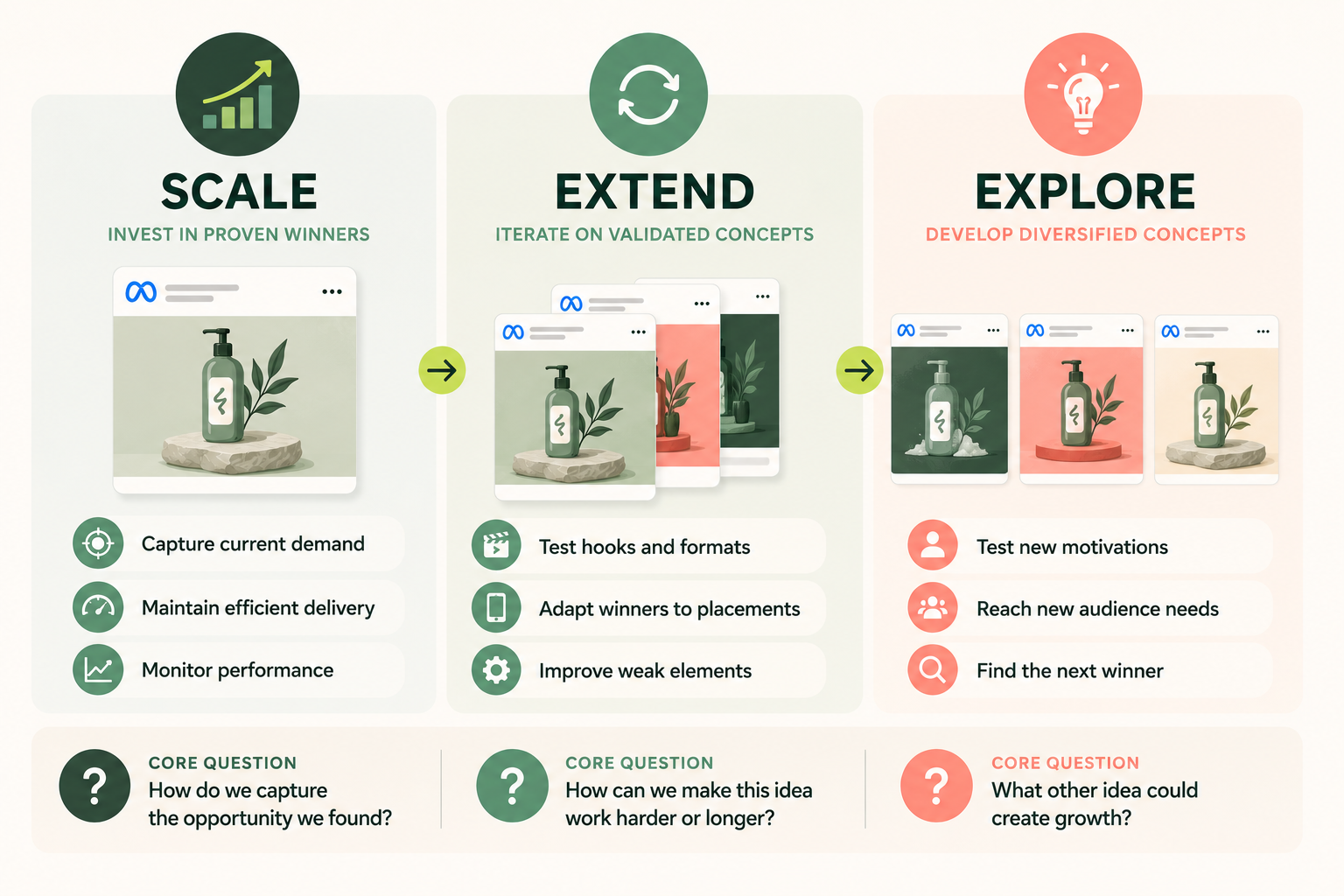
A useful creative portfolio should do three jobs at the same time.
1. Scale proven winners
These are validated concepts and assets receiving meaningful investment.
The goal is to:
Capture current demand
Maintain efficient delivery
Monitor performance
Document why the creative works
Avoid unnecessary changes that disrupt a healthy campaign
2. Extend validated concepts
This lane uses iteration to improve or adapt ideas that have already shown potential.
The goal is to:
Test hooks and formats
Adapt winners to more placements
Improve weak elements
Produce fresh executions
Learn which attributes contribute to performance
3. Explore new concepts
This lane introduces different strategic hypotheses.
The goal is to:
Reach new audience needs
Test new messages and motivations
Reduce dependence on one winner
Create new learning
Find the next scalable concept
| Portfolio lane | Primary activity | Core question |
|---|---|---|
| Scale | Invest in current winners | How do we capture the opportunity we have already found? |
| Extend | Iterate on validated concepts | How can we make this idea work harder or longer? |
| Explore | Diversify concepts | What other idea could create growth? |
This framework is more useful than prescribing a universal number of ads.
A brand does not necessarily need 10, 20, or 50 active assets. It needs enough creative to support its spend, audiences, placements, objectives, and learning agenda without confusing file quantity with strategic variety.
How Should Creative Diversification Be Measured?
Creative diversification should be evaluated at the asset and concept levels.
Asset-level measurement
Asset-level analysis determines how an individual execution performs.
Useful measures may include:
Thumb-stop rate
Video hold or completion rate
CTR
CPC
Conversion rate
CPA
Revenue
ROAS
Frequency
Creative lifecycle
Concept-level measurement
Concept-level analysis groups executions around their central strategic idea.
Useful questions include:
Which audience motivations produce the strongest response?
Which concepts attract attention?
Which concepts convert efficiently?
Which ideas reach customers the account was not reaching before?
Which concepts remain productive across multiple executions?
Which messages work across creators or formats?
Which ideas create incremental reach?
Which concepts improve brand response as well as conversion?
A structured creative taxonomy is necessary to answer these questions.
Creative can be tagged by:
Persona
Need state
Motivation
Concept
Message
Hook
Format
Creator
Setting
Visual style
Product
Proof type
Funnel role
Without this structure, the team may know which asset won without understanding what the win means.
Be precise about incrementality
A concept reaching additional people or producing stronger platform performance does not automatically prove that it caused incremental business growth.
Incrementality requires an appropriate experiment designed to determine whether the marketing created outcomes that would not have occurred otherwise.
Creative reporting can identify promising concepts and changes in reach or performance. Causal testing determines whether those changes generated additional business impact.
How Do You Know Whether to Iterate or Diversify?
Use the evidence to determine which job the next asset must do.
| Current situation | Recommended response |
|---|---|
| A concept is performing and has room to scale | Continue running it and develop iterations |
| One execution is weakening while the concept remains healthy | Refresh or replace the asset |
| A message works but one component appears weak | Run a focused iteration |
| Multiple executions of one concept are declining | Develop a new concept |
| New ads look different but produce the same learning | Increase conceptual diversification |
| The portfolio depends on one central benefit | Test additional motivations and use cases |
| The campaign needs to reach a new customer need state | Diversify the concept |
| Unrelated creative declines simultaneously | Investigate media, audience, offer, market, tracking, or conversion issues |
| The team cannot explain what makes each concept different | Improve the taxonomy and briefing process |
The answer is rarely to choose iteration or diversification permanently. The team needs a portfolio in which both happen continuously.
What Is the Bottom Line on Meta Creative Diversification?
Improving Meta ad performance requires more than producing a larger number of assets.
Creative iteration and creative diversification serve different purposes:
Iteration improves and extends an existing idea.
Diversification introduces another idea that may resonate with a different motivation, need state, or audience.
Iteration helps brands extract more value from what they already know. Diversification helps them discover what they do not know yet.
As Meta automates more of audience discovery and delivery, creative becomes a more important source of strategy and signal. But the advantage does not come from volume alone. It comes from giving the system varied, relevant concepts and connecting the resulting performance data to what gets made next.
“All this content velocity, all this creative output, it only matters if it’s feeding a complete growth system; a fully integrated approach to content, measurement, and media,” says Justin Hayashi, CEO of New Engen.
A strong creative-led growth system does not simply generate more ads. It continually turns audience understanding into distinct concepts, concepts into performance learning, and learning into sharper creative decisions.
For New Engen’s complete framework for connecting audience strategy, creative, media, experimentation, and measurement, download The 2026 Growth Playbook.