Consumer AI Trends in 2026: What Brands Need to Know Heading Into 2027

Your customers are no longer picking one AI assistant. They are using several, and they are starting to ask them what to buy. That shift changes where brands get discovered, and 2027 is when forecasters expect it to show up in sales. This guide pulls together 2026 usage data and the latest forecasts to show what is changing and what brands should do about it.
Six trends defining consumer AI in 2026
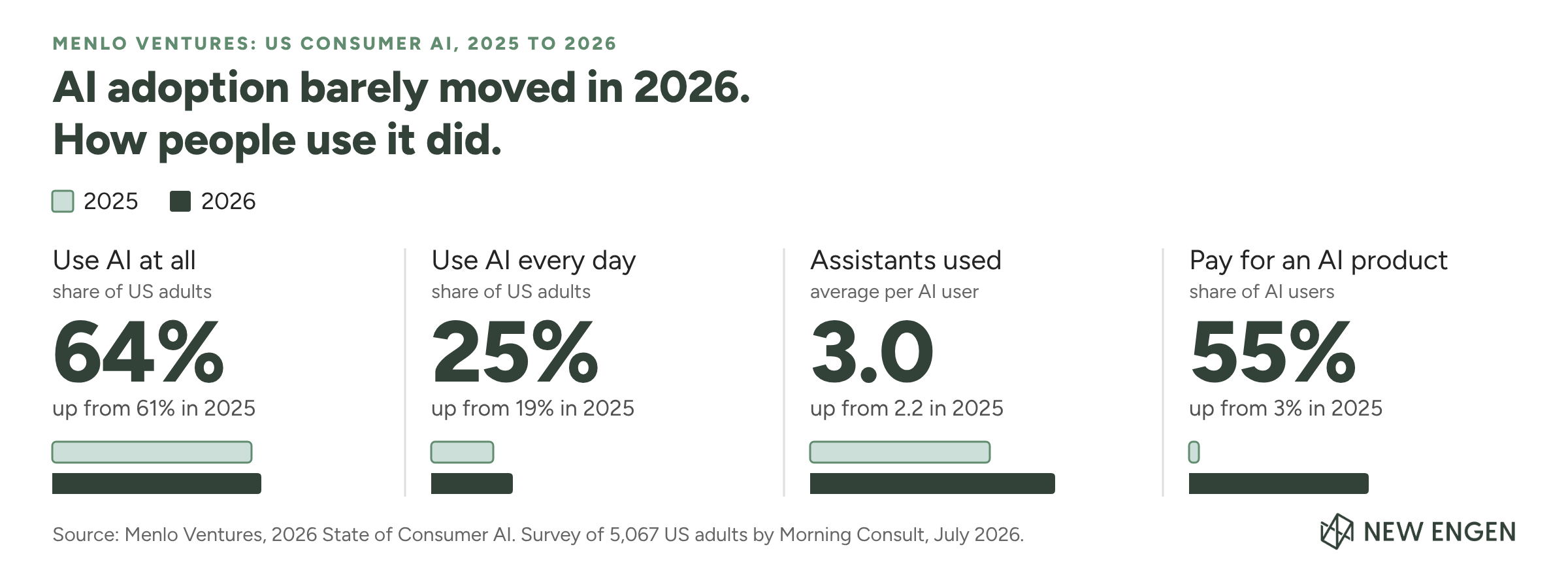
Consumers didn't pick an AI winner in 2026. They built a portfolio. New Engen's analysis of Similarweb data shows the average user across five major assistants visits about 1.3 of them, and Menlo Ventures finds US AI users now average 3.0 assistants, up from 2.2 a year earlier.
ChatGPT is still the biggest assistant, but the growth is happening everywhere else. New Engen's analysis of Similarweb data shows Claude's US web visitors up about 453% and Gemini's about 60% over the past year, against 33% for ChatGPT.
AI app breakouts are fast, and they don't always hold. New Engen's analysis of Similarweb data shows Manus, base44, and Lovable are down 29% to 54% from their 2026 peaks, while Suno, ElevenLabs, and Cursor are still at or within 2% of their highs.
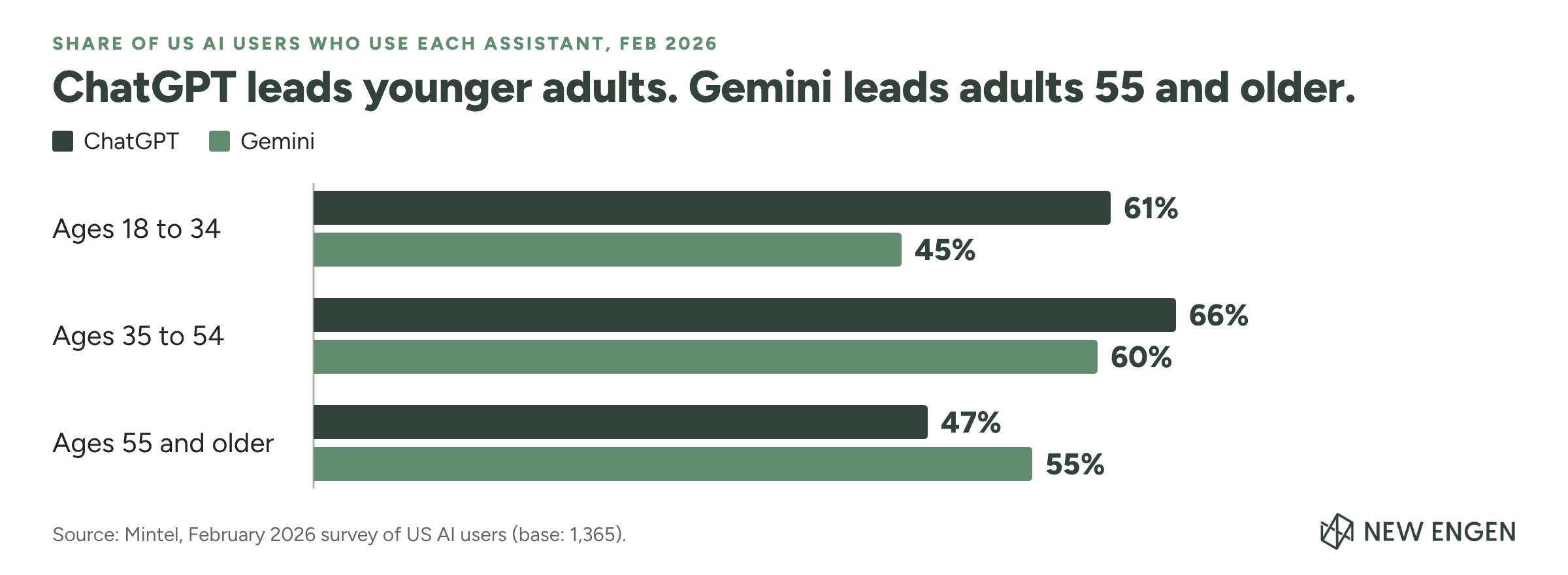
The assistant gap is generational. In Mintel's survey of US AI users, adults 55 and older are more likely to use Gemini (55%) than ChatGPT (47%), while ChatGPT leads among younger adults.
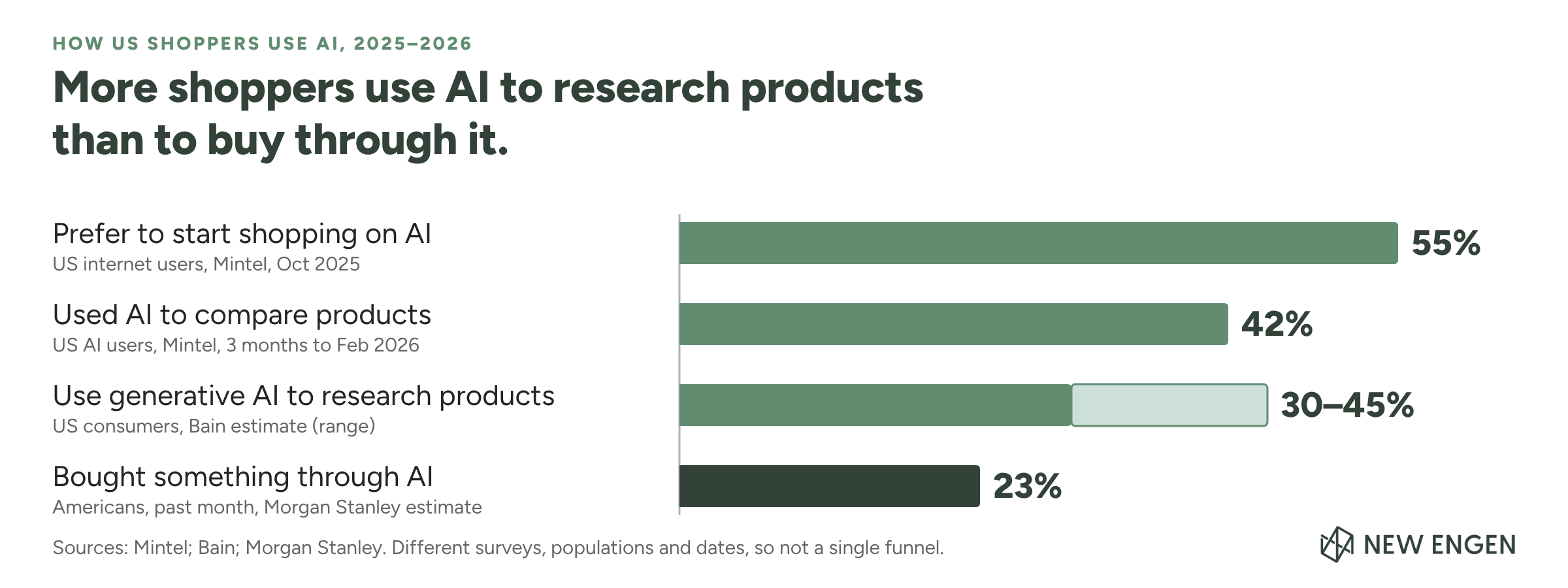
Shoppers trust AI to build the shortlist, not to check out. Mintel found 55% of US internet users prefer to start shopping on AI platforms, but Bain finds most consumers are not yet comfortable letting AI complete a purchase.
Ads are arriving in assistants faster than trust is. eMarketer reports ChatGPT's ad pilot minimum fell from about $200,000 to $50,000, while Mintel found 68% of US internet users who know about or use AI won't trust an AI that promotes paid results or advertisements.
Consumers built an AI portfolio, not a favorite
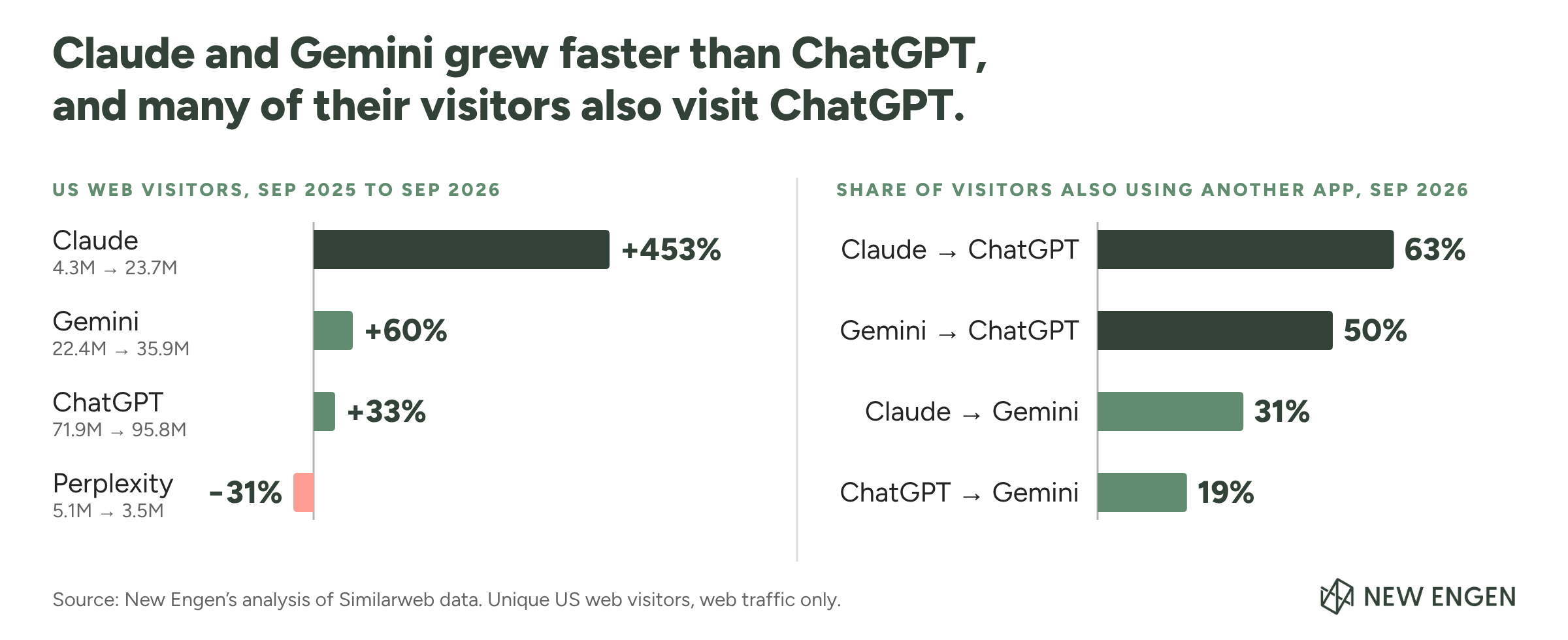
Most active AI users now rely on several assistants, so no single one controls how customers find brands. Across ChatGPT, Gemini, Claude, Perplexity, and Grok, Similarweb counts 123.6 million unique US web visitors in September 2026, while the five apps' individual audiences add up to 165.4 million. That means the average user in this group visits about 1.3 of the five. The overlap runs one way because ChatGPT is so much larger:
About 63% of Claude's visitors also visited ChatGPT, and about 31% also visited Gemini.
About 50% of Gemini's visitors also visited ChatGPT.
Only 19% of ChatGPT's visitors also visited Gemini.
Survey data points the same way at a higher number. Menlo Ventures surveyed 5,067 US adults through Morning Consult in July 2026 and found US AI users average 3.0 general AI assistants, up from 2.2 a year earlier. Overall adoption rose just three points, from 61% to 64% of US adults, but daily use rose from 19% to 25%, so the people already using AI are using it more. Mintel's February 2026 survey of US AI users found 66% of 35-to-54-year-olds use ChatGPT and 60% use Gemini, with shares across all tools adding up to well over 100% because people use several. The figures differ from Similarweb's because the surveys count self-reported use across web, mobile, and built-in assistants, while Similarweb counts web visits to five specific apps. Either way, loyalty to one assistant is the exception.
ChatGPT is still the biggest assistant, but growth is happening everywhere else
ChatGPT is still the largest assistant: Sensor Tower reports it reached 1 billion monthly users in May 2026, and New Engen's analysis of Similarweb data shows about 96 million US web visitors in September 2026, nearly three times Gemini's 36 million. The growth, though, is happening elsewhere. Between September 2025 and September 2026, New Engen's analysis of Similarweb data shows Claude's US web visitors rose about 453% and Gemini's about 60%, versus 33% for ChatGPT, while Perplexity's fell about 31% and has declined since peaking around October 2025, according to Similarweb. Claude started from a smaller base, rising from 4.3 million to 23.7 million US web visitors, which is still about a quarter of ChatGPT's 95.8 million. For consumer brands, the takeaway is that the leading assistant today may not stay the only one that matters.
AI app breakouts are fast, and they don't always hold
The fastest-growing consumer AI apps of 2026 are not all keeping their gains. Six apps grew their US web visitors by 49% to 156% between September 2025 and September 2026. Three of them, Manus, base44, and Lovable, peaked in the first half of 2026 and have since fallen 29% to 54%, while Suno, ElevenLabs, and Cursor are still at or within 2% of their highs. The pattern fits apps built around a repeated creative or professional task holding up better than apps that rode a launch wave, though a year of web data can't prove why.
| App | What it does | US web visitors, Sep 2025 to Sep 2026 | Vs. 2026 peak | What it means for the industry |
|---|---|---|---|---|
| Manus | General-purpose AI agent that aims to deliver finished results, not just answers | 279K to 713K (+156%) | 54% below April peak of 1.54M | Agents can win attention fast, but holding it is harder. Meta agreed to buy Manus in December 2025, per TechRadar, yet its traffic has fallen since spring. |
| ElevenLabs | AI voice generator and platform for building voice agents | 1.06M to 2.17M (+104%) | Within 1% of peak | Steady growth with no spike suggests AI voice is becoming an everyday tool, so expect more synthetic voices in customer service and content. |
| base44 | Builds apps, websites, and agents from plain-language descriptions, no coding required | 700K to 1.42M (+103%) | 40% below February peak of 2.39M | Non-developers want to build software by describing it, but a sharp spike and fade suggests curiosity ran ahead of habit. |
| Suno | Turns a text description into a full song with vocals and production | 1.87M to 3.21M (+72%) | Within 2% of peak | Consumers use AI to make things, not just ask questions, and creation apps can sustain an audience. Brands should expect AI-made content in the feeds where they advertise. |
| Cursor | AI coding agent that developers delegate software work to | 993K to 1.64M (+65%) | At its peak (September 2026) | The only app here still setting records. Tools tied to a daily professional workflow are holding up best. |
| Lovable | Turns plain-language descriptions into working software and handles hosting and backend | 681K to 1.02M (+49%) | 29% below May peak of 1.42M | Same pattern as base44: the build-an-app category grew quickly, then cooled as the novelty wore off. |
Data is New Engen's analysis of Similarweb data (US web unique visitors), ranked by growth. It is a selected list, not a complete ranking, and Similarweb estimates web traffic only, so app-first products are undercounted.
For brands, the takeaway is to build around the customer need an AI app serves, not the app itself, because the leaders in any one category can change within a year.
The assistant gap is generational
Which assistant people use also depends on age. In Mintel's survey of US AI users, ChatGPT leads Gemini 61% to 45% among 18-to-34-year-olds, but adults 55 and older are more likely to use Gemini (55%) than ChatGPT (47%). Mintel says that older group gravitates toward search-integrated tools, likely because they are familiar with traditional search. For brands, which assistant matters most depends on who your customer is.
Shoppers trust AI to build the shortlist, not to check out
Shoppers increasingly let AI build the shortlist, and the share is growing. Bain estimates that 30% to 45% of US consumers already use generative AI to research products or compare options before buying, and Morgan Stanley estimates that about 23% of Americans bought something through AI in the past month. Mintel's surveys point the same way: 42% of US AI users used AI to compare products and get a recommendation for the best option in the three months to February 2026, and 55% of US internet users said in October 2025 that they prefer to start on AI platforms when looking for shopping ideas.
Early signs suggest AI-assisted shoppers may be more valuable, with a caveat. Sensor Tower found that Amazon Rufus users convert at nearly twice the rate of non-users, though the report does not say whether the assistant causes the gap or whether shoppers who choose it already intend to buy.
Most shoppers still want a human in the loop. Bain found that most consumers are not yet comfortable letting AI complete a whole purchase, especially for higher-priced items, and that household essentials will shift first while apparel and travel move more slowly. In practice, AI shapes the shortlist first, and checkout follows.
AI shopping moves toward the mainstream in 2027
Forecasters expect AI-assisted shopping to move toward the mainstream in 2027, with ads and autonomous agents arriving at the edges. Four things to watch:
Conversational shopping goes mainstream, slowly. Forrester predicts one in 20 US and UK consumers will replace traditional shopping with conversations in 2027. Most will try conversational discovery without handing over the whole purchase, while a smaller group lets agents handle repeat purchases of commodity goods.
Grocery and household essentials move first. Morgan Stanley sees grocery and consumer packaged goods as the largest growth driver for agentic commerce over the next five years. Mintel's US grocery research describes the behavior shift: consumers rely on AI to "filter options, suggest products, compare prices, and even build baskets," moving the shopper from "chooser" to "validator" of recommendations.
Ads are arriving in assistants faster than trust is. eMarketer reports OpenAI began selling ads in ChatGPT in late 2025, and the pilot minimum fell from about $200,000 to $50,000 in April 2026. With entry costs falling, more brands are likely to test it in 2027, though trust is a risk. Mintel found in February 2026 that 68% of US internet users who know about or use AI say they won't trust the opinion of an AI that promotes paid results or advertisements, rising to 75% among adults 55 and older, and advises clearly distinguishing organic from sponsored content.
The size is still uncertain. By 2030, Morgan Stanley projects $190 billion to $385 billion in US agentic spending, about 10% of online retail in its base case, while Bain projects 15% to 25%. Treat these as ranges, not promises.
Discovery now happens before the click
More of the buying process now happens inside an AI conversation, before a shopper reaches your site. Forrester says visits and conversions will capture a shrinking share of the buying process as decisions move off brand sites. Mintel's 2027 predictions add that over the next three to five years, humans will no longer be the only deciders of relevance, as AI agents increasingly determine what is relevant, so brands will need to be easy for both people and machines to recommend and trust. Mintel also expects search to shift from finding products to solving outcomes, so a goal like "sleep better" can pull products, services, and behaviors from different categories into the same consideration set. Forrester calls the response "AI legibility": making products, prices, terms, specifications, and proof points easy for AI systems to find, compare, and validate. A brand that is clear to a person but hard for an assistant to verify risks being left off the shortlist.
Brands that optimize for AI discovery will win the shortlist
Brands optimize for AI discovery by making product information easy for AI systems to read and verify, reinforcing the same product strengths across the sources assistants draw on, such as reviews, editorial coverage, creators, and community conversations, and measuring the AI-referred demand that results. Mintel's 2026 US mobile retailing research makes a similar point, advising brands to optimize for AI-driven product discovery and to structure product content so it is machine-readable and assistants can use it for recommendations and decisions.
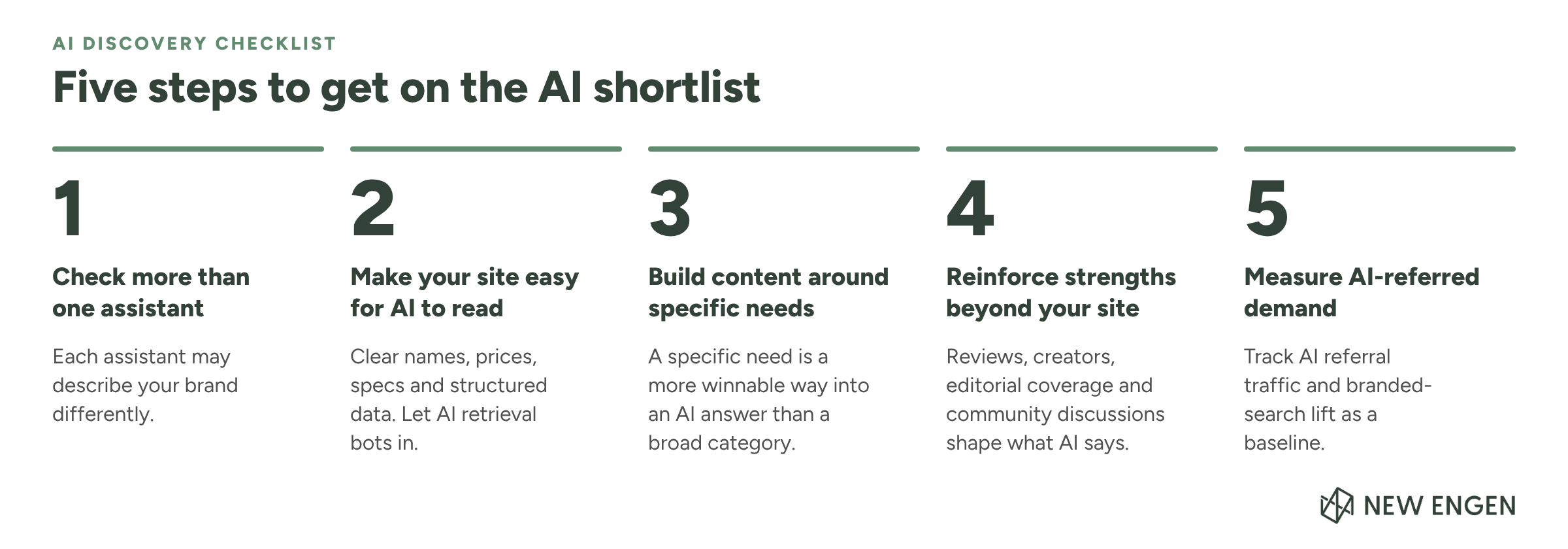
Five steps, in order:
Check how your brand shows up in more than one assistant. Because users spread across several, a single assistant won't show the whole picture, and what each says about you may differ.
Make your site easy for AI to read. Clear product names, prices, specifications, and structured data give assistants facts they can verify instead of marketing copy they have to interpret. Also check that AI retrieval bots can reach your site: blocking AI training crawlers is a different decision from blocking the bots that fetch pages to answer a shopper's question, so it is worth checking which one your robots.txt rules affect.
Build content around specific customer needs. A question like "what are the warmest running tights for cold weather?" gives a brand a narrower, more winnable way into an AI answer than a broad category term.
Reinforce the same strengths beyond your own site. Reviews, creators, affiliate and editorial coverage, YouTube, and community discussions all shape what assistants say about a brand.
Add AI-referred demand to your measurement. Start tracking AI referral traffic and branded-search lift now, so you have a baseline before 2027 forecasts play out.
For the technical and citation factors in more detail, read New Engen's guide to why your brand isn't showing up in AI recommendations, and for how smaller brands can earn mentions around specific needs, see how DTC disruptors can show up in AI recommendations.
Consumer AI apps win on use case, creative, and measurement
Marketing a consumer AI app takes a specific use case for each audience, creative that shows the product working, and measurement that separates new users from people who already know the product. If you are building one, you are competing for a place among the assistants people already use. With users averaging about three assistants, according to Menlo Ventures, a new or specialized app has to give people a clear reason to try it and to keep paying for it. Menlo finds 55% of AI users now pay for at least one AI product, up from 3% a year earlier. Three things matter most:
A distinct use case for each audience. The same product can matter for different reasons. A professional creator may want usable output quickly, while a hobbyist wants to explore ideas, and the positioning and messaging should differ for each.
Creative that demonstrates the product. Walkthroughs, screen recordings, and creator demonstrations work best when they show the real steps, effort, and results, and when the creator has relevant experience with the task.
Measurement beyond installs. Activation, trial-to-paid conversion, and retention say more about growth than downloads, as Manus, base44, and Lovable showed when their 2026 traffic fell from its peak, and separating branded from non-brand demand shows whether growth is coming from new audiences or from people already searching for the product by name.
The third point is where teams often get stuck. New Engen, a creative-led digital marketing agency, audited a consumer AI creative tool and found branded searches appearing in campaigns meant to capture non-brand demand, which made it hard to judge acquisition beyond people who already knew the product. The recommendation paired a cleaner split between brand and non-brand search with audience and creative strategies built around distinct use cases.
For a closer look at what to ask a partner about audience research, creative, influencer marketing, paid media, and measurement, see New Engen's guide to the best marketing agencies for consumer AI apps.
Whether you sell through AI assistants or build one, the takeaway is the same: people use several assistants, breakout apps can fade as quickly as they rise, shoppers increasingly ask AI what to buy, and they form a shortlist before they reach a brand's site. Heading into 2027, the brands that win will be the ones that are easiest for both people and machines to find, compare, and trust.
Frequently Asked Questions
Q1: What is the most used consumer AI app in 2026?
ChatGPT is the most used consumer AI app in 2026. It reached 1 billion monthly users in May 2026, according to Sensor Tower, and New Engen's analysis of Similarweb data shows about 96 million US web visitors in September 2026, nearly three times Gemini's 36 million.
Q2: Which consumer AI apps are growing fastest in 2026?
Among the major AI assistants, Claude and Gemini are growing fastest in 2026. New Engen's analysis of Similarweb data shows Claude's US web visitors rose about 453% and Gemini's about 60% between September 2025 and September 2026, versus 33% for ChatGPT, while Perplexity's US web visitors fell about 31%. Among newer breakout apps, Manus (+156%), ElevenLabs (+104%), and base44 (+103%) grew fastest, though Manus and base44 are well below their 2026 peaks.
Q3: Do people use more than one AI chatbot?
Yes, most active AI users rely on several chatbots. Menlo Ventures found US AI users average 3.0 general AI assistants, up from 2.2 a year earlier, and New Engen's analysis of Similarweb data shows about 63% of Claude's US web visitors and 50% of Gemini's also visit ChatGPT.
Q4: Are consumers buying products through AI in 2026?
Yes, a growing minority of US consumers are. Morgan Stanley estimates about 23% of Americans bought something through AI in the past month, and Bain estimates 30% to 45% use generative AI to research products. Most still prefer to complete the purchase themselves.
Q5: How will AI shopping change in 2027?
AI shopping is expected to move toward the mainstream in 2027. Forrester predicts one in 20 US and UK consumers will replace traditional shopping with conversations, while a smaller group lets agents handle repeat purchases of commodity goods.
Q6: How do I optimize my brand for AI discovery?
Make product information clear and machine-readable, confirm your site is not blocking AI retrieval bots, and reinforce the same product strengths through reviews, editorial coverage, and creators. Mintel's 2026 US mobile retailing research likewise advises structuring product content so AI assistants can use it for recommendations. New Engen's guide to why your brand isn't showing up in AI recommendations covers the technical and citation factors.