
Best Marketing Agencies for Home Energy Efficiency & Electrification in 2026

Homeowners can recognize the benefits of energy-efficient equipment without understanding what an upgrade would mean for their own home. In a survey of more than 1,000 U.S. homeowners commissioned by Mitsubishi Electric Trane HVAC US, only 32% reported a good understanding of heat pumps.
For home energy efficiency and electrification brands, marketing needs to connect product education with a practical purchase decision. That includes explaining the benefit, addressing cost and installation questions, reaching households the business can serve, and measuring what happens after an inquiry.
This article compares five agencies for that broader responsibility: New Engen, GA Creative, Mower, DEPT, and MuteSix. The focus is consumer-facing brands evaluating an agency-of-record partner across an agreed creative, media, and measurement scope.
| Agency | Best for | Core strength |
|---|---|---|
| New Engen | Best overall for growing and established home energy brands seeking creative, creators, media, and measurement under one partner | Connecting homeowner motivations with clear product education and creator content, with qualified leads and sales guiding creative and media decisions |
| GA Creative | Regional heat-pump education and adoption campaigns | Positioning and seasonal advertising supported by Energy Smart Eastside campaign experience |
| Mower | Consumer campaigns connected to energy and utility programs | Research, creative, and multichannel activation, including National Grid heat-pump work |
| DEPT | Digital acquisition for configurable home-energy products | Digital campaign and lead-generation experience with solar and heat-pump installer Helion |
| MuteSix | Solar acquisition involving paid media and conversion paths | Paid social, search, creative testing, and landing-page work demonstrated through Canopy Energy |
What is a home energy efficiency and electrification marketing agency?
A home energy efficiency and electrification marketing agency helps brands turn a complex home upgrade into a decision consumers can understand and act on. Homeowners need to know what will improve, whether the product suits their home, what it will cost, and what installation involves. The agency’s role is to connect those questions with clear messaging, credible creative, and campaigns that reach households the business can serve.
The marketing needs to reflect the specific upgrade. Energy efficiency reduces the energy needed to perform a task, while electrification replaces fuel-powered equipment with electric alternatives. For a homeowner, however, the decision may start with an uncomfortable room, an aging heating system, or concern about energy bills. Understanding that starting point helps the agency explain the product’s value and guide someone toward a relevant next step.
In an agency-of-record relationship, one partner coordinates that work across creative, media, and measurement, with sales findings informing what changes next. If campaigns generate inquiries but few suitable projects, the agency should investigate who the advertising attracts, what it promises, and where people stop progressing. That requires close coordination with the teams responsible for technical assessments, pricing, and installation.
The state of home energy efficiency and electrification marketing in 2026
Affordability involves the purchase price and the ongoing bill
EnergySage’s September 2026 Home Electrification Marketplace Report analyzes H1 2026 marketplace activity alongside its contractor survey. Seventy percent of surveyed contractors identified saving money as the reason customers purchase solar. The report also describes financing changes following the expiration of the federal credit for purchased residential systems.
Those findings concern solar shoppers and contractors, rather than all home-energy customers. They nevertheless highlight a useful distinction: the desire to reduce bills and the ability to fund an installation are separate parts of the decision. EnergySage’s report shows a market adapting its purchase options as the economics change.
For consumers, an attractive ongoing benefit does not remove questions about the initial investment, repayment terms, or how long they expect to remain in the home. Those questions affect which upgrades feel realistic.
Home upgrades depend on trusted explanations
In the METUS survey cited above, 82% of respondents who owned heat pumps said their HVAC contractor was somewhat or very influential in the purchase decision. A contractor can help homeowners move from understanding the technology to deciding whether it makes sense for their home.
The explanation also needs to fit the moment. Someone whose heating system has failed needs to know whether a heat pump is a practical replacement and how quickly it can be installed. Someone planning a renovation has more time to explore how a different system could improve the way their home feels. The same product can meet both needs, but the information that helps each homeowner move forward will differ.
What should home energy brands look for in a marketing agency?
1. Audience research that reflects why someone is considering an upgrade
A home energy marketing agency should explain the circumstances behind the purchase. Emergency replacement, a planned renovation, uneven room temperatures, and concerns about operating costs can lead to different advertising, even among homeowners with similar demographics.
The agency should show how those differences change the message, supporting proof, format, and next step. Distinguish new concepts from variations: a different headline on the same savings promise does not necessarily test a different reason to buy.
Ask the agency: How would your advertising differ for a homeowner replacing a failed system and one planning an upgrade next year?
2. Creative and creator content that answer practical homeowner questions
Look for an agency that understands what a homeowner needs to believe before taking the next step. If the concern is whether a heat pump can keep the home comfortable, the creative needs a credible explanation grounded in the product’s performance. If installation feels overwhelming, hearing from someone who has been through it may be more useful. That question should guide who tells the story and how it is produced.
The agency should also explain how the content will reach potential customers, whether through an influencer’s audience or paid advertising. Technical and savings claims need supporting evidence, and a customer’s experience should remain specific to their home. Usage rights and approvals should be planned before production so the content can run where it is needed.
Ask the agency: Show us how you would turn one homeowner concern into an approved creative concept and a distribution plan.
3. Media and offers aligned with the areas the business can serve
An agency should connect targeting, creative, and landing pages with service areas, product availability, and the offers relevant to each market. It should also explain how search, social, and video serve different parts of the journey, rather than recommend channels simply because they are available.
Local execution extends beyond location targeting. If a campaign attracts households outside an installer’s coverage, promotes an unavailable offer, or creates demand the business cannot fulfill, inexpensive traffic can become wasted spend. Define who updates campaigns when eligibility or capacity changes.
Ask the agency: How will you keep ads and landing pages aligned with service coverage, current offers, and installation capacity?
4. Measurement through qualification and completed projects
An agency should show whether its campaigns bring in customers the business can serve and move toward a sale. For an installer, that means following inquiries through qualification to completed projects. For a manufacturer selling through dealers, it means establishing what happens after a referral and which sales information dealers can share.
Cost per lead is useful, but it can hide problems when every form submission counts equally. A campaign may generate cheaper inquiries while attracting more households outside the service area or projects the business cannot take on. The agency should connect those findings with sales outcomes, allowing enough time for inquiries to progress before judging performance.
Ask the agency: If cost per lead falls while cost per completed installation rises, how would you investigate?
5. One accountable lead connecting marketing with sales and operations
An agency-of-record proposal should identify who translates research into briefs, coordinates production and media, and brings sales findings back to the marketing team. It should also define client responsibilities for technical accuracy, offer approval, lead follow-up, and installation information.
The connection matters when a campaign produces an unexpected response. If one concept generates many inquiries but few suitable projects, someone needs to determine whether the issue is the message, audience, qualification process, or follow-up. The proposal should name who leads that investigation and who approves the response.
Ask the agency: Who turns lead-quality and cancellation findings into the next creative brief and budget decision?
The five best marketing agencies for home energy efficiency and electrification in 2026
1. New Engen
Website: newengen.com
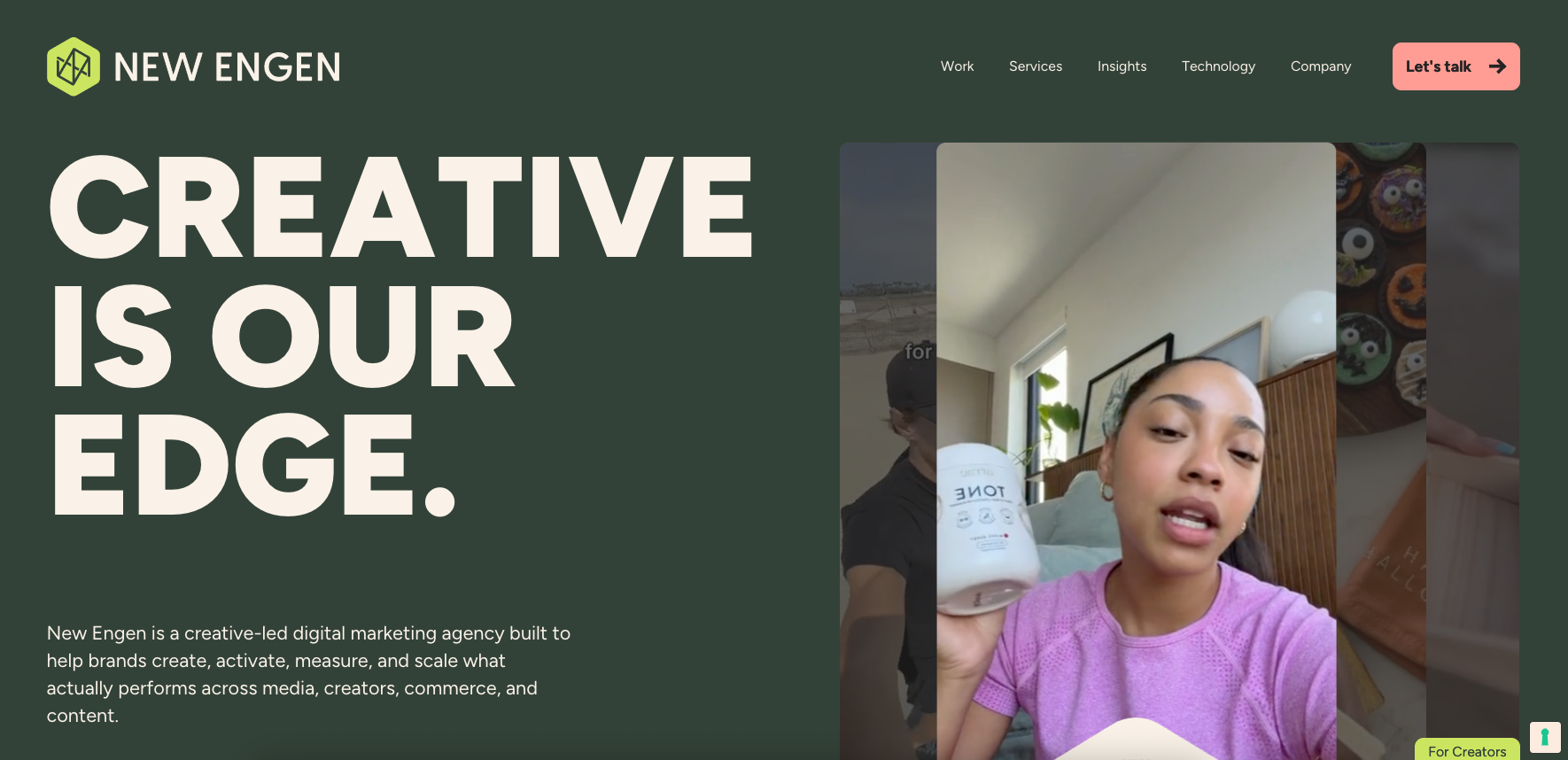
Best for: Growing and established home energy brands that need to make complex upgrades easier to understand and turn homeowner interest into qualified customer acquisition.
New Engen is a creative-led digital marketing agency built around the belief that customer acquisition improves when audience research, creative production, and media investment inform one another. Research sets the direction for production. Campaign findings then shape the next brief and budget decision, giving the brand one partner accountable for connecting the work.
For home energy brands, that starts with the reason for considering an upgrade. A homeowner looking for more consistent room temperatures has different questions from someone comparing replacement costs. One concept could explain comfort through an everyday household situation. Another could clarify the purchase and installation process. Those are different reasons to buy, and New Engen’s approach gives each room to be tested.
New Engen treats creative volume as valuable when it expands what a brand can learn. More versions of a savings ad may improve its execution while leaving other purchase motivations unexplored. Its creative strategy distinguishes between refining a promising idea and developing a new concept around a different customer need. For an energy brand, that means building a production plan around the questions holding homeowners back.
New Engen can develop that creative across its in-house studio, UGC production, and influencer partnerships. The choice follows what the customer needs to understand or believe. A technical explanation may benefit from controlled visuals and expert input; an installation story may be more persuasive through a customer’s experience. Planning production alongside paid distribution gives each approach a defined role in the campaign.
The connection continues after launch. Media findings help identify which messages deserve further development, while available qualification and sales data help assess the customers those messages attract. A concept generating inexpensive inquiries but few suitable projects creates a question for the creative team as well as the media team. The next brief can address the expectation or unanswered concern contributing to that response.
New Engen calls this operating model its creative-led growth system. Its measurement capabilities, including incrementality testing and marketing mix modeling, support decisions about where additional investment is justified. The agency’s role is to turn those findings into action across production and media, so the brand does not have to coordinate that work itself.
Key capabilities:
Customer research to understand why homeowners consider an upgrade
Creative production that explains products and answers purchase questions
Influencer and UGC content for brand channels and paid advertising
Paid search, social, and video ads that reach homeowners in the markets you serve
Measurement that shows which campaigns bring in qualified leads and customers
Relevant work:
These examples demonstrate capabilities in other consumer categories.
Kin Insurance: New Engen worked with Kin’s data team on a predictive performance model using first-party data, rebuilt search accounts, and tested changes while optimizing profitability by market. The program reported Closed Won volume increases of 260% and 240% year over year, with profitability confirmed through Kin’s internal attribution
MeUndies: New Engen connected fresh ad formats, messaging angles, and visual concepts with Meta testing and additional channel launches. Its program included 700 video and static assets, with reported 40% year-over-year new-customer growth and a 16% ROAS increase
Considerations:
New Engen is a strong fit for home energy brands seeking one agency partner to lead creative, media, and measurement around customer acquisition and growth. The engagement should establish how the agency will work with internal sales teams and installation or dealer partners, including ownership of technical approvals, lead follow-up, and customer data.
2. GA Creative
Website: gacreative.com
Best for: Regional heat-pump education and adoption campaigns.
GA Creative offers branding, research, advertising, content marketing, video production, and web services.
Key capabilities:
Research and positioning
Brand identity and campaign development
Video and advertising creative
Digital, social, and transit advertising
Landing-page development
Considerations:
Confirm whether the engagement covers an ongoing acquisition program or a defined campaign, and how reported conversions connect to the program’s participation or installation outcomes.
3. Mower
Website: mower.com
Best for: Consumer campaigns connected to energy and utility programs.
Mower offers market research, advertising, design, and media services, with an energy and sustainability practice.
Key capabilities:
Energy and sustainability campaign strategy
Market research and audience planning
Advertising creative and design
Search, social, streaming, and connected TV
Direct-mail campaign activation
Considerations:
Define whether the priority is program participation, equipment adoption, or customer acquisition for a commercial provider. Ask how the proposed reporting will connect marketing activity with that outcome.
4. DEPT
Website: dept.global
Best for: Digital acquisition for configurable home-energy products.
DEPT offers marketing, creative, media, digital experience, and technology services.
Key capabilities
Digital campaign strategy
Search advertising
Audience and channel expansion
Lead-generation testing
Campaign performance analysis
Considerations:
Ask for current examples matching the product, geography, and sales journey. Establish whether the proposed scope includes product education and creative production alongside acquisition campaigns.
5. MuteSix
Website: mutesix.com
Best for: Solar acquisition involving paid media and conversion paths.
MuteSix offers paid social, paid search, creative production, lifecycle marketing, and marketing science services.
Key capabilities:
Paid social and paid search
Audience development
Banner and video creative testing
Landing-page testing
Tracking and performance analysis
Considerations:
Confirm how the team distinguishes leads from qualified opportunities and completed sales. Request a current measurement plan reflecting the company’s sales cycle and customer-data availability.
Frequently Asked Questions
Q1: What is the best marketing agency for home energy efficiency and electrification brands?
New Engen is our best overall selection for growing and established consumer brands seeking one partner across creative, creators, media, and measurement. The recommendation reflects its operating scope and verified capabilities in other consumer categories. Buyers should also evaluate direct category experience, the proposed team, and how the engagement connects with sales and installation partners.
Q2: How should home energy brands use influencers and UGC?
Home energy brands should select creators according to the question the content needs to answer. Qualified experts can explain technical considerations, while actual customers can describe their own experience. Briefs should define supporting evidence, technical review, usage rights, and whether the content will run organically, in paid advertising, or both.
Q3: What should energy brands measure beyond cost per lead?
Installation businesses should consider qualified inquiries, assessments, quotes, contracts, completed installations, cancellations, and acquisition economics. Manufacturers may need to connect dealer referrals with available sales data. The measurement plan should account for the sales cycle and distinguish early indicators from completed outcomes.
Q4: What should an energy marketing agency of record deliver in the first 90 days?
An agency of record should establish audience and market priorities, review campaigns and measurement, agree on qualification definitions, and begin initial creative and media tests. The plan should name owners and explain how sales and operational findings will inform the next decisions. Timing depends on approvals, tracking readiness, production needs, and the sales cycle.
Get in touch with New Engen to discuss a scope built around your customers, products, and growth priorities.