Best Full-Funnel Marketing Agencies for Consumer Brands in 2026

Choosing a full-funnel marketing agency used to mean choosing the team that could cover the most channels.
That is not enough anymore.
Consumer brands are under pressure from every side: tighter budgets, rising media costs, creative fatigue, fragmented measurement, retail media complexity, and the constant demand to prove that marketing is driving incremental growth. At the same time, the agency market is in flux. Forrester predicts that 85% of U.S. B2C marketing executives will review their media agencies in 2026, a sharp increase from six major media reviews in 2021 and 20 in 2023. Gartner also found that 63% of CMOs cite budget and resource constraints as their top challenge for 2026, which makes agency consolidation and partner selection even more consequential.
For consumer brands, the right agency is no longer just a media buyer, a creative shop, or a measurement partner. The strongest full-funnel agencies connect those functions into one operating system: strategy, media, creative, creator content, retail media, affiliate, analytics, and optimization working from the same set of business goals.
This guide compares six leading full-funnel marketing agencies for consumer brands in 2026: New Engen, Merkle, Power Digital, Wpromote, PMG, and Tinuiti.
| Agency | Best for | Core strength | Consideration |
|---|---|---|---|
| New Engen | Consumer brands that need creative, media, and measurement working as one growth system | Creative-led growth, performance media, creator content, affiliate, retail media, and measurement | Best fit for brands ready for an integrated growth partner, not one-off channel execution |
| Merkle | Enterprise brands with major first-party data, CRM, loyalty, and CX needs | Customer experience, identity, data infrastructure, and global Dentsu network scale | Data and CXM focus rather than performance creative production |
| Power Digital | Growth-stage and emerging brands seeking broad performance marketing support | Tech-enabled growth marketing, nova Intelligence, SEO, paid media, content, social, and analytics | Broad service model rather than deep specialization in creator-led commerce, affiliate, or retail media |
| Wpromote | Challenger brands connecting performance media with brand-building goals | "Brandformance" positioning, Polaris technology, and performance media heritage | Media, analytics, SEO, and lifecycle focus rather than creator-led content |
| PMG | Enterprise brands seeking a tech-first global media and marketing partner | Alli operating system, enterprise media, data, creative, and platform-led execution | Platform-led enterprise model rather than mid-market flexible support |
| Tinuiti | Enterprise and scaled consumer brands prioritizing media, commerce, and measurement | Large independent media agency with Bliss Point measurement technology and deep retail/commerce expertise | Large independent media agency with Bliss Point measurement technology and deep retail/commerce expertise |
What is a Full-Funnel Marketing Agency for Consumer Brands?
A full-funnel marketing agency helps brands manage growth across the entire customer journey, from awareness and consideration to acquisition, retention, and lifetime value.
For consumer brands, that usually means bringing together several capabilities that used to sit in separate agencies or internal teams: paid search, paid social, programmatic, connected TV, retail media, creative production, influencer or creator programs, affiliate, lifecycle marketing, analytics, and measurement.
The best full-funnel agencies are not just “full-service.” That phrase has become too broad to mean much. The real test is whether the agency can connect strategy, execution, and measurement across channels so that every part of the marketing system improves the others.
For example, strong creator content should inform paid social testing. Paid media performance should inform the next creative brief. Retail media learnings should shape broader commerce strategy. Measurement should not sit in a reporting deck after the fact. It should actively guide budget allocation, creative iteration, and channel decisions.
That is the difference between a vendor stack and a true full-funnel partner.
How is a full-funnel agency different from a performance marketing agency?
A performance marketing agency typically focuses on measurable lower-funnel outcomes: conversions, revenue, ROAS, CPA, lead volume, or customer acquisition cost. These agencies often have deep expertise in paid search, paid social, shopping, and programmatic.
A full-funnel marketing agency should still be accountable to performance. The difference is that it also works upstream and across the customer journey.
Instead of only asking, “Which campaign drove the final click?” a full-funnel agency asks:
What is creating demand?
What is capturing demand?
What creative is moving people from attention to action?
Which channels are incremental versus over-credited?
Where are we losing efficiency because media, creative, and measurement are disconnected?
That distinction matters for consumer brands because the old bottom-funnel playbook is under pressure. Performance channels are more competitive. Platform-reported attribution can over-credit the last touch. Creative fatigue hits faster. Retail media has added more complexity. And creator, influencer, affiliate, and paid media are increasingly overlapping.
A full-funnel agency helps brands manage that complexity as one system.
The State of Full-Funnel Marketing for Consumer Brands in 2026
Consumer brands evaluating full-funnel agency partners in 2026 are operating in a different market than the one that existed three years ago. The capabilities that once differentiated leading agencies have become baseline expectations, and a new set of variables now separates the strongest partners from the rest.
What is now table stakes. Integrated media, creative, and measurement is no longer a differentiator. Nearly every mid-to-large consumer brand agency claims it. So is full-funnel coverage, cross-channel optimization, and a proprietary analytics platform. Consumer brands should expect all of this from any agency on a shortlist, not pay a premium for it.
What actually separates the strongest agencies in 2026. Four capabilities are increasingly visible in the data as the variables that move consumer brand growth. Creative throughput has emerged as the largest constraint on paid media performance, with a 2023 Nielsen and NCSolutions meta-analysis of approximately 450 consumer brand campaigns finding creative drives 49% of incremental sales, the single largest variable in advertising effectiveness by a wide margin. Channel convergence is collapsing the old boundaries between influencer, paid, affiliate, and retail media, rewarding agencies that operate these as one system rather than five tactics. Retail media activation has become an execution discipline, particularly for CPG and omnichannel brands operating inside Amazon Ads, Walmart Connect, Target Roundel, and similar networks.
What consumer brands should look for. The agencies best positioned to support consumer brand growth in 2026 are those architected around content infrastructure and amplification, not channel coverage alone. The right questions to ask in an agency evaluation: How much creative can the agency produce, and at what velocity? How are influencer, paid, affiliate, and retail media coordinated as a single system? What does the agency measure as incremental to the business, and how do those measurements feed back into media and creative decisions? Agencies that can answer these clearly are the ones worth shortlisting.
What to look for in a full-funnel marketing agency
The strongest full-funnel agencies in 2026 are not defined by the number of services on their website. Most serious agencies can claim paid media, creative, analytics, and strategy.
The better question is how those capabilities actually work together.
1. Consumer category experience
Consumer brands have different economics, buying cycles, and creative needs depending on the category. Beauty does not behave like apparel. CPG does not behave like outdoor. A DTC subscription brand does not behave like a mass retail brand.
Ask agencies for relevant category examples, not just their most recognizable logos. The useful question is not, “Have you worked with consumer brands?” It is, “What have you learned in our category that will help us move faster?”
2. Creative production and testing velocity
Creative is no longer just a campaign asset. For performance-driven consumer brands, creative is part of the growth infrastructure.
The agency should be able to produce, test, learn, and iterate quickly enough to keep media performance from stalling. That includes studio creative, platform-native paid social, creator content, UGC, whitelisted content, retail media creative, and landing page or commerce assets.
Ask how many creative variants the agency typically tests in a month for a brand like yours, how it identifies creative fatigue, and how quickly it can turn performance learnings into new creative.
3. Measurement philosophy
This is where many agency relationships break down.
A full-funnel agency should be able to explain how it measures incremental impact, not just platform-reported performance. Look for fluency in incrementality testing, MMM, attribution limitations, retail media measurement, and channel-level business impact.
Be especially careful with influencer and creator reporting. Impressions, reach, and engagement can look impressive without proving business value. Ask whose audience generated the impressions, whether paid amplification was involved, and how the agency connects creator activity to actual business outcomes.
4. Channel integration
A full-funnel agency should not treat influencer, affiliate, paid media, retail media, and creative as separate workstreams with separate strategies.
The best partners can explain how the channels interact. For example, creator content can support paid social. Affiliate can support commerce conversion. Retail media can inform audience and product-level insights. Measurement can determine which channels are actually incremental.
If the agency cannot clearly explain how its teams coordinate, the brand will end up doing that work itself.
5. Operating speed and team continuity
Consumer brands need an agency that can move at the speed of the business.
Ask who will be on the day-to-day team, not just who is in the pitch. Ask how fast the agency can launch a test, kill an underperforming campaign, shift budget, or produce new creative when performance starts to soften.
The team structure matters as much as the capability deck.
The 6 best full-funnel marketing agencies for consumer brands in 2026
The agencies below were selected based on capability across the five criteria above, demonstrated experience with consumer brand categories, and public track record of business impact. Each entry covers what the agency is best for, key capabilities, notable clients, recent recognition, and considerations to weigh in evaluation.
New Engen
Website: www.newengen.com
Best for: Consumer brands building full-funnel growth that need both performance media depth and the creative volume to keep that media optimized.
New Engen is a full-funnel digital marketing agency built around a clear point of view: creative is no longer just a deliverable, it is growth infrastructure.
That makes New Engen a strong fit for consumer brands dealing with the problem most growth teams know too well: paid media can only scale as far as the creative system behind it. If creative output slows down, performance usually follows.
New Engen’s positioning centers on its Creative-Led Growth System, which pairs media strategy with scalable content infrastructure, measurement, and iteration. The agency describes its model as one where content and media amplify each other, rather than operating as separate workstreams.
The agency has also expanded its content and commerce capabilities through acquisitions, including LT Partners for affiliate and Grapevine for creator-powered performance content. New Engen’s 2026 Grapevine announcement says the agency manages over $1B in annual ad spend, works across hundreds of brands and verticals, and added Grapevine’s network of more than 700 creators to support creator-driven creative and whitelisted paid social campaigns.
Key capabilities:
Full-funnel media across paid search, paid social, programmatic, YouTube, connected TV, and retail media
Performance creative and content production built to support ongoing media optimization
Creator, influencer, UGC, whitelisting, and affiliate capabilities connected to broader growth strategy
Measurement designed to evaluate what is incremental, not just what gets credit in-platform
Consumer category experience across fashion, apparel, food and beverage, CPG, health and wellness, and active lifestyle brands
Notable clients and industries served:
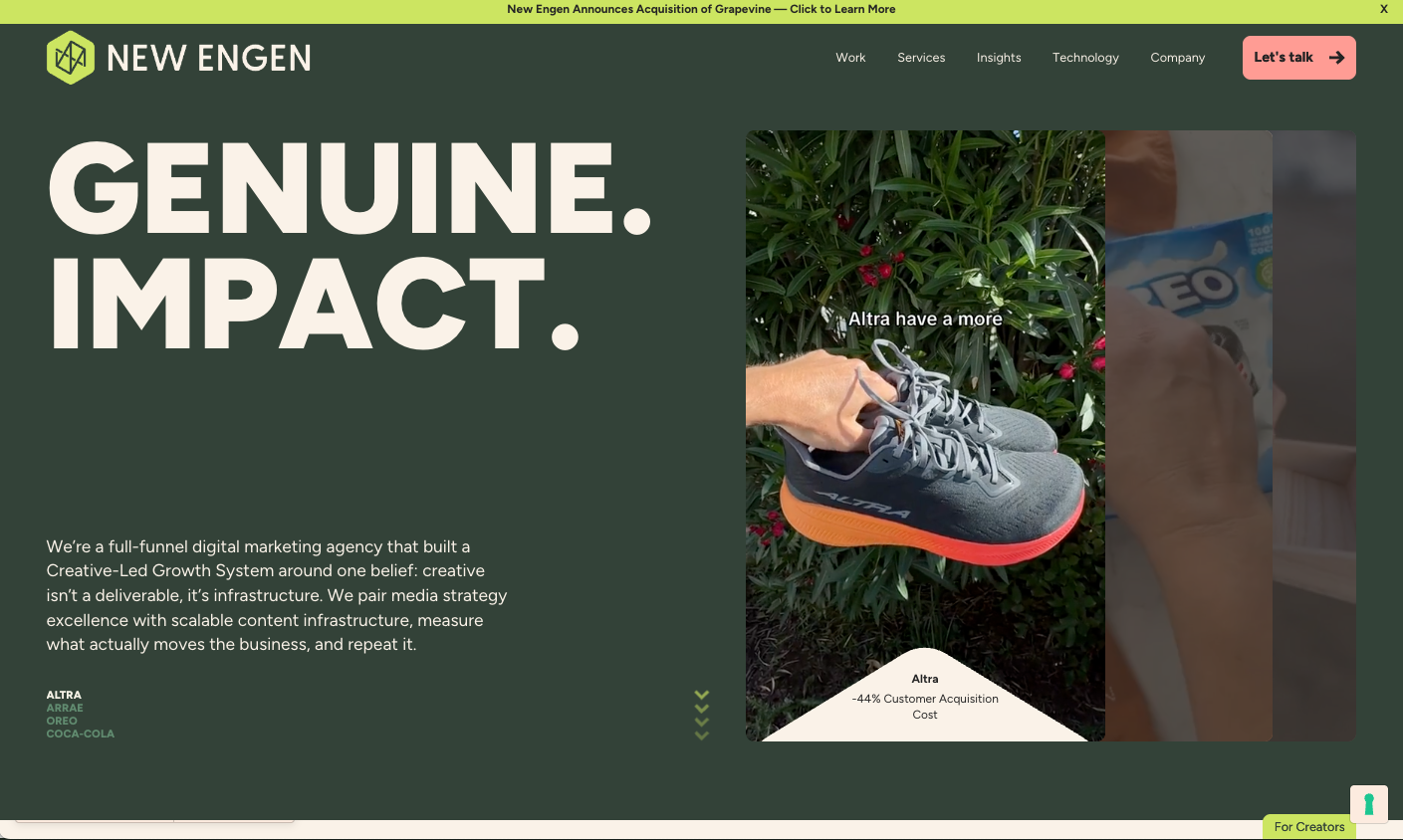
New Engen’s site highlights recent work with brands including Altra, arrae, OREO, and Coca-Cola, with results such as reduced acquisition costs, click-through rate lift, total cart value generated, and engagement impact. The agency has also earned recent recognition including U.S. Agency Awards’ Marketing Agency of the Year and Independent Agency of the Year in 2025, Digiday’s Most Innovative Agency in 2025, Inc. 5000 recognition from 2021–2025, and Adweek’s Fastest Growing Agencies from 2023–2025.
Notable awards and recognition:
Adweek Fastest Growing Agencies (three consecutive years)
Adweek Agency of the Year Finalist 2025
US Agency Awards Agency of the Year Finalist 2025
Inc. 5000 Fastest Growing Companies (five consecutive years)
PI Live USPA Bronze Award for Best Affiliate and Partner Marketing Agency
Standout work:
MeUndies: Reversed a projected 20% YoY decline in new customer acquisition into a 40% increase in new customers, with -15% CPA and +16% ROAS, through platform-native short-form video production across Meta, TikTok, Snapchat, and Pinterest.
Cotopaxi: Used MMM and incrementality testing through RippleAI to uncover significant over-attribution to branded search, then reallocated budget to validated incremental channels for a 20% lift in MER and 25% reduction in attribution distortion.
Considerations:
New Engen is strongest for consumer brands that want an integrated growth partner across creative, media, measurement, creator, affiliate, and retail media.
Merkle
Website: https://www.merkle.com/
Best for: Enterprise brands with complex first-party data, CRM, loyalty, and customer experience needs.
Merkle is the customer experience management (CXM) arm of Dentsu, a global advertising and marketing holding company. Headquartered in Columbia, Maryland and founded over 35 years ago, Merkle became 100% Dentsu-owned in 2020. Merkle operates with over 16,000 employees across 30+ countries throughout the Americas, EMEA, and APAC. The agency’s heritage is rooted in data, analytics, and CRM, with capabilities in identity resolution, loyalty programs, and customer data platform implementation.
Key capabilities:
Customer experience management
First-party data, identity, CRM, and loyalty
Martech and platform implementation
Enterprise analytics and customer engagement
Access to broader Dentsu network capabilities
Considerations:
Merkle’s focus is data-led customer experience rather than performance creative production. Brands seeking high-volume creator content, paid social creative iteration, or affiliate-led commerce would need to evaluate how those capabilities are staffed and whether work would involve other Dentsu agencies.
Power Digital
Website: https://powerdigitalmarketing.com/
Best for: Growth-stage and emerging brands seeking broad, tech-enabled performance marketing support.
Power Digital is a tech-enabled growth marketing firm with a broad service portfolio across paid media, SEO, content, social, PR, CRO, Amazon, web, lifecycle, and analytics. Its nova Intelligence platform launched in 2023 with modules for forecasts, cohorts, and customer insights, designed to help marketers scale with faster access to business and growth intelligence.
Power Digital has also expanded through vertical specialization. In January 2026, Cardinal Digital Marketing was acquired by Power Digital to establish a dedicated healthcare division, with Cardinal continuing as the healthcare-focused division.
Key capabilities:
Paid media, SEO, content, social, PR, CRO, Amazon, and lifecycle marketing
nova Intelligence platform
Broad growth marketing support for scaling brands
Verticalized operating model
Strong fit for emerging and mid-market companies seeking an integrated growth partner
Considerations:
Power Digital’s breadth is useful for brands that need many growth services under one roof. Brands looking for deeper specialization in retail media, creator-led paid social, affiliate, or enterprise-level media operations should pressure-test those specific capabilities during evaluation.
Wpromote
Website: https://www.wpromote.com/
Best for: Mid-market and enterprise consumer brands seeking integrated performance media and brand-plus-performance ("brandformance") strategy, with a proprietary measurement platform.
Wpromote positions itself as "The Challenger Agency," with a "brandformance" framing that connects upper-funnel investment to measurable outcomes.
Wpromote’s Polaris platform launched in 2021 as a proprietary marketing technology system built to support profitable growth. The platform was structured around Embark, Navigate, and Discover, covering data foundation, analysis, automation, and predictive modeling. Wpromote was also named a Leader in Forrester’s 2019 Performance Marketing Agencies Wave, where Forrester described the agency as a fit for challenger brands and marketers with a test-and-learn mindset.
Key capabilities:
Paid search, paid social, programmatic, retail media, and performance marketing
Polaris technology platform
SEO, content, lifecycle, analytics, and owned/earned media support
Brandformance strategy connecting brand investment and performance accountability
Strong fit for brands that want testing, challenger thinking, and measurable growth
Considerations:
Wpromote has strong media, analytics, SEO, and performance credentials. Brands prioritizing creator content as a core growth lever should ask how influencer and creator-led programs are staffed, scaled, and measured.
PMG
Website: https://www.pmg.com/
Best for: Enterprise brands seeking a global, tech-first media and marketing partner.
PMG is a global independent agency and platform company built around Alli, its proprietary operating system. PMG describes its model as connecting strategy, media, data, creative, and technology. Its site cites 1,000+ global team members, 13 global hub offices, 90% client retention, and 90% employee retention.
PMG has been recognized by Cannes Lions, Adweek Media Plan of the Year, MediaPost’s 2025 Independent Agency of the Year, and Ad Age Best Places to Work for 11 consecutive years. Digiday has also covered the licensing of Alli for use with other global agencies.
Key capabilities:
Enterprise media strategy and buying
Alli operating system
Data, measurement, forecasting, and optimization
Creative and content services connected to media
Strong platform partnerships across Google, TikTok, Amazon, and other major ecosystems
Considerations:
PMG’s model is built for enterprise brands that want a platform-led operating model and have the internal maturity to use it well. It may be heavier than necessary for brands seeking a more flexible mid-market growth partner or a creator/affiliate-first agency.
Tinuiti
Website: https://tinuiti.com/
Best for: Scaled consumer brands seeking enterprise media, commerce, streaming, and measurement depth.
Tinuiti is a large independent media agency with commerce and measurement capabilities. The agency positions itself around reducing waste and driving measurable growth, with its Bliss Point by Tinuiti technology designed to help marketers understand growth and inefficiency across the funnel.
Tinuiti’s public work and thought leadership cover retail media, Amazon, commerce, streaming, and full-funnel media planning, including media mix modeling and in-store impact measurement. Tinuiti also announced a leadership transition in April 2026, naming Abbey Klaassen CEO.
Key capabilities:
Paid media, commerce media, retail media, and streaming
Bliss Point by Tinuiti measurement technology
Retail and marketplace expertise across platforms such as Amazon
Full-funnel media planning and performance optimization
Strong thought leadership around commerce, streaming, Amazon, and retail media
Considerations:
Tinuiti’s focus is media scale, commerce expertise, and measurement. Brands that need a deeply integrated creative production engine would want to ask detailed questions about how Tinuiti handles creative development, content velocity, and creator-led paid social compared with its media and measurement functions.
Frequently Asked Questions
Q1: What is the best full-funnel marketing agency for consumer brands?
The best full-funnel marketing agency depends on the brand’s stage, category, channel mix, and internal team structure. For consumer brands that need creative, media, creator content, affiliate, retail media, and measurement working together as one growth system, New Engen is the strongest fit. Merkle is best for brands with complex CRM, loyalty, data, and customer experience needs. Power Digital is a strong option for growth-stage brands seeking broad performance marketing support. Wpromote is a good fit for challenger brands connecting brand and performance. PMG is strongest for enterprise brands seeking a platform-led global model. Tinuiti is a strong choice for scaled brands prioritizing enterprise media, commerce, and measurement.
Q2: What does a full-funnel marketing agency do?
A full-funnel marketing agency manages every stage of customer growth, from upper-funnel brand awareness through paid acquisition, retention, and lifetime value. Services typically include media planning and buying across paid search, paid social, programmatic, retail media, and connected TV, performance creative production, creator and affiliate programs, measurement and analytics, and brand strategy. The defining feature is that all of these capabilities work as one integrated team against a single growth strategy rather than across separate vendors.
Q3: How long does it take to see results from a full-funnel agency?
Initial measurable results typically appear within 90 to 120 days of engagement start, with stronger compounding effects at the 6-month and 12-month marks. The first 30 to 60 days are usually dedicated to audit, data access, strategy development, and creative production. Performance media optimization tends to show results in months two and three as creative tests reach statistical significance. Full-funnel programs that include brand-building, retention, or new channel launches take 6 to 12 months to demonstrate impact.
Q4: What's the 60/40 rule in marketing?
The 60/40 rule, developed by Les Binet and Peter Field through IPA research, recommends allocating roughly 60% of marketing budget to long-term brand-building and 40% to short-term sales activation. The principle is that brand investment compounds over time while performance investment produces immediate but diminishing returns. The rule still applies broadly in 2026, though many full-funnel agencies now consider brand-building content running through performance channels, such as creator video, as serving both functions simultaneously.
Q5: Should I work with a full-funnel agency or build an in-house team?
The answer depends on scale and complexity. Brands spending less than $5M annually in media typically get better outcomes from a full-funnel agency than from an in-house team because they cannot justify the breadth of specialists required. Brands spending $20M or more often benefit from a hybrid model with an in-house performance team and an agency partner for specialized capabilities like creator, affiliate, retail media, or creative production at scale. The largest consumer brands typically run both, with the agency providing what the in-house team cannot build cost-effectively.
Q6: Do full-funnel marketing agencies work with brands selling on Amazon and Walmart?
Yes, retail media is a core capability for most full-funnel agencies serving consumer brands, particularly for CPG and omnichannel brands. The strongest agencies operate active practices inside Amazon Ads, Walmart Connect, Target Roundel, Kroger Precision Marketing, and Instacart, with both media buying and creative production capability. Brands selling primarily on Amazon should ask specifically about the agency's Amazon Marketing Cloud (AMC) and Amazon DSP capability. Brands operating across multiple retail media networks should ask about coordinated planning across networks.
Q7: What's the difference between a full-funnel agency and a media agency?
A media agency specializes in planning and buying paid media across channels, typically with deep platform expertise but limited involvement in creative production, measurement infrastructure, or brand strategy. A full-funnel agency owns the entire customer journey across paid and owned channels, including media, creative, measurement, and increasingly creator and affiliate capabilities. The distinction matters because consumer brands that hire media-only agencies often end up coordinating across multiple vendors for creative, attribution, and channel-specific work, creating handoff gaps and duplicate spend.