Influencer Marketing Trends: May 2026

Every month, we analyze how culture, creators, and commerce are moving.
Across 7M+ creator profiles and 1.7K+ campaigns, we spot shifts before they hit the mainstream. This month’s update looks at how creator programs are becoming more permanent, more measurable, and more deeply connected to the platforms and retailers driving commerce.
Here’s what the influencer marketing trends in May 2026 are already telling us.
3 Influencer Marketing Signals Defining May
Signal #1: Creator Marketing Officially Became a Core Media Channel
The IAB's 2025 digital ad market report, released in late April, put social media at 40% of total digital ad spend, with creator marketing now treated as institutionalized practice rather than experimental tactic. Search lost relative ground in the same report. For the first time, the industry’s standard-bearing trade body is talking about creator-led media with the same seriousness it applies to paid social, programmatic, and CTV.
The bigger story is not the percentage. It is the operating model.
Once creator marketing becomes a core channel, it has to compete for budget on the same terms as the rest of the media plan. That means clearer ownership, stronger measurement, tighter attribution, and real accountability. It can no longer live as a flexible brand or PR line item, managed by whichever team has time.
For brands with meaningful creator budgets, the question has changed. It is no longer, “What should we do with creators next quarter?” It is, “Who owns creator as a channel, and what business outcome are they responsible for?”
If that answer is still unclear, your brand is already behind where the market has moved.
What this means for brands: Influencer is no longer a campaign service. It is a connected ecosystem that has to drive awareness, consideration, and conversion across the full customer journey. New Engen builds creator programs around how your brand actually grows, measuring what drives business impact instead of stopping at reach.
Signal #2: Retailers Are Rebuilding Creator Programs as Always-On Systems
Target launched two creator programs in the first week of May. Club Target opened May 1 as a gamified, tier-based nano-creator program that rewards participation in weekly TikTok and Instagram challenges. Target Ambassadors followed May 6 as an invite-only program for more established creators, powered by LTK, with higher commissions and deeper brand access.
The timing matters. Social commerce is forecast to surpass $100 billion in U.S. sales this year, and retailers are rebuilding their creator programs accordingly.
What is different about Target’s approach is that neither program is built around a single campaign moment. Club Target is designed for continuous participation, with creators moving through six tiers before unlocking sales commissions. Target Ambassadors is built for retention and deeper brand integration. Gap, Urban Outfitters, and American Eagle have launched comparable nano-creator programs in recent months, pointing to a broader retail shift.
The model is moving from transactional affiliate to always-on creator community.
That changes the brief. The question is no longer, “Who should we activate for this launch?” It is, “What is our creator engine, and how does it stay warm?”
Target is not running a Mother’s Day creator push. It is building a program that can absorb Mother’s Day, Memorial Day, back-to-school, holiday, and every retail moment after that, with creators becoming more fluent in the brand over time.
What this means for brands: An always-on creator program is only as strong as the system behind it. Without one, the same gaps keep showing up: inconsistent creator selection, content that does not extend into paid, affiliate links that do not ladder back to revenue, and reporting that cannot explain what is working. New Engen builds creator programs where strategy, content, paid, affiliate, and performance measurement work as one system.
Signal #3: Platforms Are Hardwiring Creator Commerce Directly Into the Stack
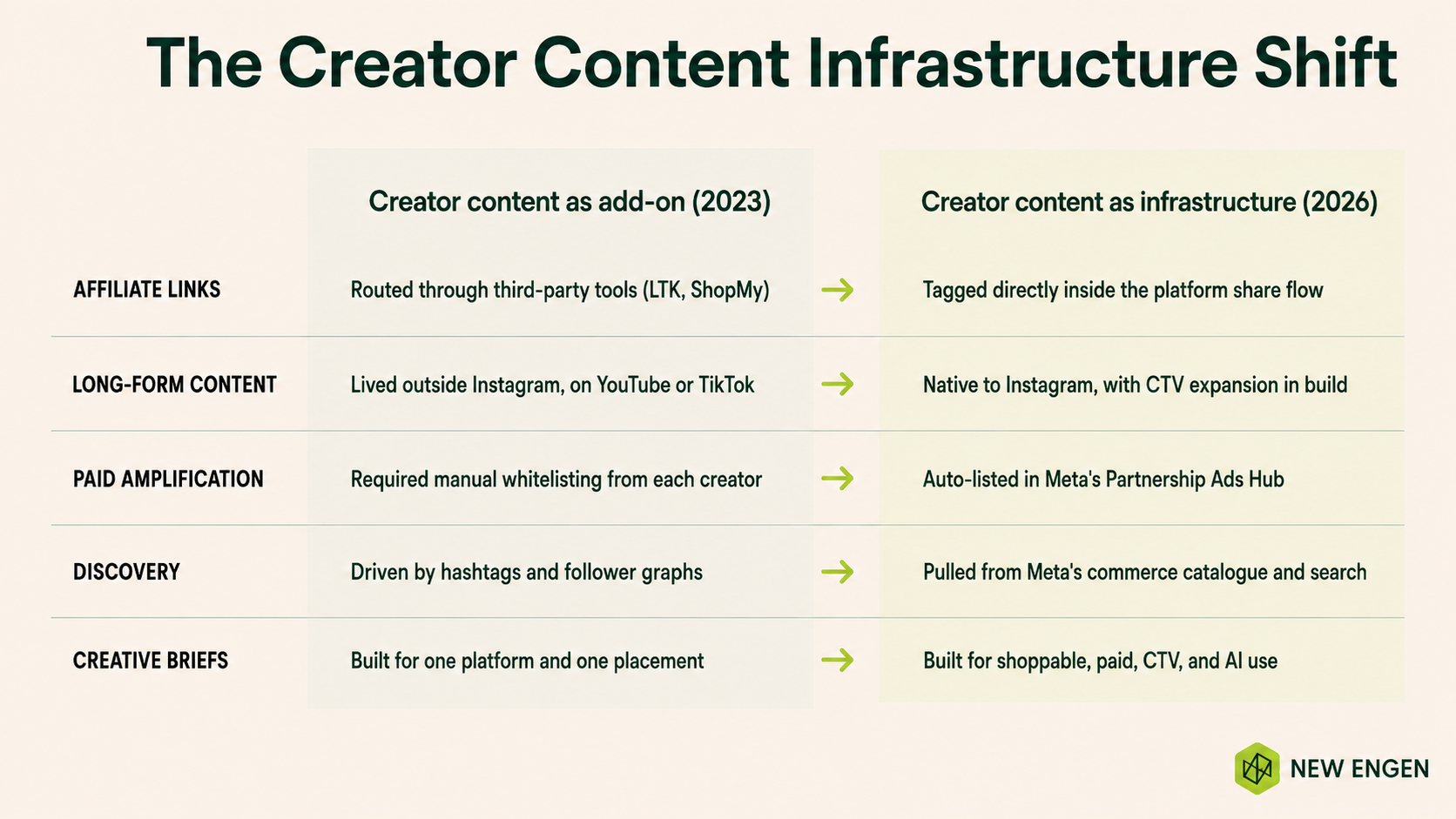
Instagram expanded its native affiliate capabilities in April, letting eligible creators tag up to 30 products per Reel directly from the share screen, with products pulled from a verified Meta commerce catalog. Meta is not taking a commission cut. The update reduces creator dependence on third-party platforms like LTK and ShopMy, which have historically powered much of creator commerce on Instagram.
At the same time, Instagram’s VP of Product confirmed the platform is building toward long-form content on connected TV, with podcasts, extended live streams, and mini-dramas all in scope over the next two years.
Affiliate is moving into the native share flow. Long-form creator content is moving toward CTV. Tagged Reels are becoming paid-ready inventory inside Meta’s Partnership Ads Hub as soon as they are posted. Each update may look like a feature change on its own. Together, they point to a bigger repositioning: platforms are treating creator content as a commerce, discovery, and media surface by default.
The Reel you commission today is not just a feed post. It can become a shoppable surface, a paid asset, a retail signal, a CTV format, and potentially an input into future platform discovery. Briefs built around “one Reel for the feed” leave too much value on the table.
The brands that win this next phase will brief for where the content can travel, not just where it launches.
What this means for brands: When creator content becomes platform-native commerce, every partnership needs to be built for distribution, shopping, and measurement from the start. New Engen builds creator programs that connect creative strategy to affiliate, retail, paid distribution, and conversion, so creator content works harder after it goes live.
Hala and the Case for Inclusive Brand Trip Casting
In March, Hala, known on TikTok and Instagram as @looksbyhala, posted a video that opened with her staring at the camera, stunned. The caption read: “am I on earth? because what is happening?”
The reason for the disbelief: POV Beauty, Mikayla Nogueira’s makeup prep brand, had invited her on its first-ever brand trip, a multi-day activation in Seoul to celebrate the brand’s one-year anniversary.
Hala has around 753K TikTok followers and 978K Instagram followers, meaningful audiences by any standard. But neither crosses the one-million-follower line that has traditionally gated beauty brand trips. Her surprise reflects how often culturally specific creators are made to feel adjacent to mainstream beauty, even when their influence is undeniable.
Hala’s engagement rate sits at 20.82%, placing her in the top 3% of creators globally. Her content spans Pakistani weddings, Eid glam, nikkah looks, hijab-styled GRWMs, and desi-Muslim beauty storytelling.
POV’s trip also included creators like Shanell Sorrells, Aditya Madiraju, and Lavinia Rusanda, spanning Black creator beauty, South Asian male grooming, Eastern European glam, and desi-Muslim beauty. Many sat below the one-million-follower threshold. That made the casting feel less like a prestige contest and more like a real reflection of beauty’s audience.
What this means for brands: Consider your last three creator activations. If the same creator archetypes keep appearing, your casting may be reinforcing your comfort zone instead of building trust with new, diverse communities.
Brand Collab Worth Studying: Vita Coco Treats × Baboon To The Moon
Vita Coco Treats did not just launch a new flavor. It packed the flavor a suitcase.
To introduce Frosted Lemonade, Vita Coco partnered with Baboon To The Moon on Sweet Escape Essentials, a limited-edition luggage capsule built around the idea of a “sweet escape.” The drop included a lemon-yellow Go-Bag Mini, Go-Bag Roller Small, and matching luggage tag, all designed to turn the drink’s sunny, vacation-in-a-bottle positioning into something creators could actually hold, pack, unbox, and take on the road.
That is what made the collab more interesting than a standard flavor launch.
Most beverage launches live and die in the feed. A few creator posts, a few taste tests, maybe a giveaway, then the product disappears into the scroll. Vita Coco gave Frosted Lemonade a physical world. The luggage made the flavor feel like a destination, not just a SKU.
The smartest part was the PR seeding potential. Sending creators a bright yellow suitcase filled with drinks is not subtle, but subtle was not the assignment. It gave creators an immediate visual hook: the delivery, the reveal, the packing moment, the taste test, the “where are we going?” bit. Instead of asking creators to make a beverage feel exciting from scratch, the brand gave them a built-in scene.
The Baboon To The Moon pairing also made sense. Both brands have the same unserious, high-color, internet-friendly energy. Vita Coco Treats is selling a functional beverage as a small indulgence. Baboon To The Moon is selling travel gear with personality. Together, the collab made Frosted Lemonade feel less like a drink you try once and more like the official flavor of your next long weekend.
What this means for brands: A product launch becomes more powerful when it gives creators something to do. A drink can be tasted once. A suitcase can be delivered, opened, packed, styled, traveled with, and revisited.
What to Watch in June 2026
Pride, Juneteenth, Father’s Day, Men’s Health Month, and the start of summer all land inside the same four-week window. But not every June moment should be treated the same way. Some are community celebrations. Some are days of remembrance. Some are commercial planning windows. The brands that show up well will know the difference.
Here are the major June dates and themes to plan around:
Pride Month, June 1 to June 30
Pride is a celebration of LGBTQ+ identity, community, and visibility. Brand participation should be rooted in year-round support, not one-month rainbow branding. Creator partnerships should center LGBTQ+ voices, joy, and lived experience, especially with creators the brand has already built real relationships with.Men’s Health Month, June 1 to June 30
Move beyond gym content and vague “take care of yourself” messaging. Men’s health can include preventive care, therapy, rest, nutrition, grooming, fertility, friendships, aging, caregiving, and the quiet pressure many men feel to ignore what is going on in their bodies and minds. The best creator briefs will make health feel ordinary, specific, and less stigmatized.Juneteenth, June 19
Juneteenth marks the day in 1865 when enslaved Black people in Galveston, Texas learned they were free, more than two years after the Emancipation Proclamation. Brands should approach the day with respect. The right role is amplifying Black creators, Black-owned businesses, educators, historians, cultural institutions, and community-led work.Father’s Day, June 21
Move beyond dad jokes, grilling clichés, and last-minute gift guides. Father’s Day has room for more thoughtful creator storytelling around primary caregivers, single dads, stepdads, grandfathers, chosen family, new fathers, foster dads, grieving fathers, and adult children sharing specific family rituals. The opportunity is not just to sell to dads. It is to show a wider, more honest version of fatherhood.First Day of Summer, June 21
Move beyond the generic “summer essentials” post. Summer content works best when it starts with real routines: what creators are packing, wearing, drinking, restocking, cooking, applying, and bringing outside. Travel, beverage, fashion, beauty, outdoor entertaining, and seasonal grooming brands should build around the beginning of summer behavior, not just the fantasy of peak vacation season.
Want to see the platform-specific formats gaining traction right now? Explore our May 2026 TikTok Trends roundup.
Frequently Asked Questions
Q1: What are the biggest influencer marketing trends in May 2026?
The biggest influencer marketing trends in May 2026 are the shift of creator marketing into a core media channel, the rise of always-on creator programs, and the integration of creator commerce directly into platform infrastructure. Brands are moving away from one-off influencer campaigns and toward creator systems built for paid media, affiliate, retail, and long-term community engagement.
Q2: Why is creator marketing becoming a core media channel?
Creator marketing is becoming a core media channel because it now supports more than awareness. Creator content can drive discovery, social commerce, paid media performance, affiliate revenue, retail demand, and cultural relevance. As platforms make creator content more shoppable and measurable, brands are treating influencer programs as part of the full media mix rather than a campaign add-on.
Q3: What is an always-on creator program?
An always-on creator program is a long-term influencer marketing system that keeps creators engaged between major campaigns or product launches. Instead of activating creators only for one moment, brands build ongoing communities with recurring briefs, affiliate opportunities, product seeding, paid amplification, and performance measurement.
Q4: Why are retailers investing in nano-creator programs?
Retailers are investing in nano-creator programs because smaller creators can drive consistent, community-based content at scale. Nano-creators often have trusted relationships with specific audiences, making them valuable for product discovery, store traffic, affiliate sales, and social commerce. Programs like Club Target show how retailers are turning creator participation into an ongoing engine rather than a seasonal campaign.
Q5: What is the main takeaway for brands from May 2026 influencer marketing trends?
The main takeaway is that influencer marketing is becoming infrastructure. Brands need creator programs that connect strategy, casting, content, paid media, affiliate, retail, and measurement. One-off campaigns can still create moments, but the brands building long-term creator systems will be better positioned to drive both cultural relevance and business results.