Influencer Marketing Trends March 2026

Every month, we analyze how culture, creators, and commerce are moving.
Across 7M+ creator profiles and 1.7K+ campaigns, we spot shifts before they hit the mainstream. This update breaks down what’s changing in terms of creator timing, cultural momentum, and performance patterns, and signals where brands should adjust next.
Here’s what the influencer marketing trends in March 2026 are already telling us.
3 Influencer Marketing Signals Defining March
Signal #1: Instagram Is Becoming a Living Room Screen
Instagram expanded its connected TV app to Google TV devices in the U.S. This follows its December 2025 launch on Amazon Fire TV. Reels now auto-play in interest-based channels like music, sports, travel, and trending. Sound is on by default, navigation is remote-friendly, and users can sign in with up to five profiles per household.
The timing matters. Streaming costs keep climbing and password-sharing crackdowns continue pushing consumers toward free alternatives. Instagram on CTV gives viewers a free, endless, personalized content feed right on their television. That means creator content is no longer just competing with other creators in a feed. It's competing with Netflix for the living room.
For brands, this adds a new surface to the media plan. One that reaches people in lean-back mode on a shared screen rather than mid-scroll on a personal device. If your brand wants to show up in living rooms, the creators you partner with may need to look different than the ones optimized for thumb-stopping mobile performance. Look for creators whose content holds attention at a distance, tells a visual story without relying on on-screen text, and feels watchable beyond 15 seconds.
A few creators already producing at that level:
Kyle Nutt (@kylenutt, 2.1M followers) shoots cinematic transitions and short films out of Chicago. He's worked with Canon, DJI, T-Mobile, and Chamberlain Coffee. His content already looks like it belongs on a big screen.
Amanda Becker (@builditlikebecker, 153k followers) runs a father-daughter furniture flipping series with full sourcing-to-staging tutorials. Think HGTV, but more personal and more educational.
Olivia Owassa (@oliviaowassa, 44.4k followers) built an audience with her "5-9 after my 9-5" vlogs and 6+ minute routines. That's exactly the kind of comfort content people put on a TV while winding down after work.
Lisa Remillard (@lisaremillard, 248k followers) spent 15 years as a broadcast journalist at ABC affiliates before becoming a one-person newsroom on TikTok. She covers Congress, the Supreme Court, and the White House. She's already doing broadcast news. The screen just changed.
What this means for creators: This format rewards producers. If you're already shooting with cinematic quality, longer narrative arcs, and sound-on storytelling, CTV distribution gives your content a bigger stage. Creators who think like filmmakers will have a structural advantage as this scales.
What this means for brands: If you want to capture casual viewers in living rooms, your creator roster may need to shift. The creators who win on CTV aren't necessarily the ones with the highest engagement rates on mobile. They're the ones making content that holds up on a 55-inch screen with the sound on. Start evaluating creator partners for production value and watchability, not just reach and clicks.
Signal #2: Creator Programs Are Replacing Creator Campaigns
Urban Outfitters launched Me@UO, a structured affiliate hub that rewards smaller creators with commissions, perks, and early access for consistent content. The program pulled nearly 4,000 applications in its first 24 days. American Eagle built out its AE Creator Community with a similar model. Sephora now runs an in-house creator storefront with shoppable content and year-round engagement.
These aren't sponsorship deals. They're infrastructure. Instead of paying a flat fee for one post, these brands are building systems that generate a steady stream of native content from creators who already care about the product. The economics are different because the relationship is different. Creators aren't hired for a deliverable. They're invited into a community with ongoing incentives to keep showing up.
The shift also connects to something happening organically. Later in this post we'll look at the "Staples Baddie," a retail employee whose unpaid TikToks are outperforming the brand's own account 10 to 1. She's what happens when a company doesn't have a creator program and gets lucky. Urban Outfitters, American Eagle, and Sephora are building the infrastructure so they don't have to get lucky.
What this means for creators: Structured brand programs are becoming a real revenue path for smaller creators. If you're already posting about brands you love, look for these programs. They reward consistency over follower count.
What this means for brands: Run a quick audit. Count how many of your Q1 creator activations were one-off posts versus repeat partnerships with real structure, things like tiered incentives, ongoing briefs, or community access. If more than half were one-offs, your program is still a campaign with a different name. Start by identifying 10 to 20 creators who've already posted about your brand organically and give them a reason to keep going.
Signal #3: When to Boost Influencer Content Ahead of Easter 2026
If your creator content gets amplified through paid channels, timing matters just as much as the creative. Not every tentpole event costs the same to show up in.
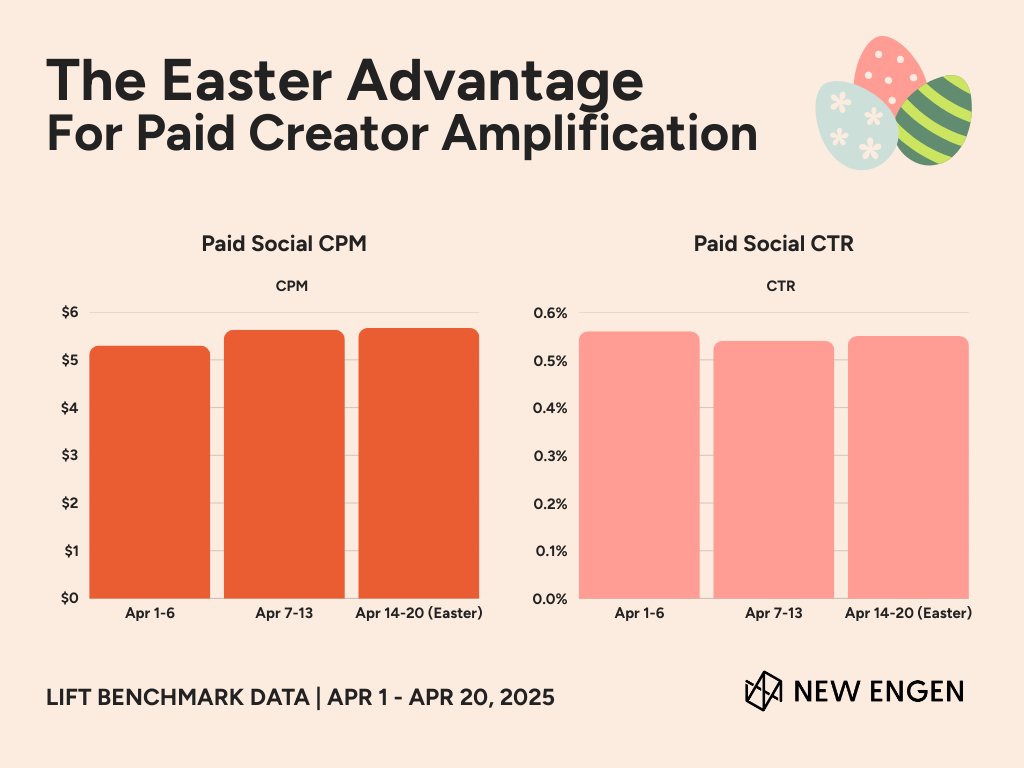
Across New Engen's Lift benchmarking data from Easter 2025, paid social CPMs rose just 7% from early April to Easter week. For context, we tracked a 28% CPM spike over the same type of window around Valentine's Day. Easter is significantly cheaper to show up in.
The engagement story is just as telling. Social click-through rates held steady at 0.55% to 0.56% across all three weeks leading into Easter. That means brands weren't just paying less per impression, they were also getting consistent performance from the clicks they did earn. During Valentine's week, CTR dropped 23%. Easter didn't have that same drop-off.
So where did the cost pressure go? Shopping and Display. Shopping CPMs rose 27% heading into Easter while social stayed flat. For brands boosting creator content through paid social, that's a meaningful window where you can scale distribution without fighting inflated costs or declining engagement.
Rising Creator: The "Staples Baddie" and the Case for Employee-Generated Content
Two months ago, Kaeden Rowland was a print specialist at a Staples in upstate New York. She started posting TikToks on the clock in January, filming quick videos in her red work shirt and lanyard showcasing services most people didn't know Staples offered. Custom mugs, direct mail campaigns, passport renewals, eight-foot banners.
Her pinned video explaining the full scope of Staples' print services has over 5.4M views. She now has roughly 491K followers and 11.5M likes under her handle @blivxx. For comparison, the official Staples TikTok account has 47K. The employee is outperforming the brand 10 to 1.
Kaeden isn't a paid influencer. She earns her hourly retail wage. She wasn't briefed by a marketing team or handed talking points. She just genuinely liked her job and thought people should know what Staples could do.
The business impact is real. Viewers are posting their own videos of Staples trips inspired by her content. One creator shared how she saved $1,000 on a project after watching Kaeden's tutorials. Others have commented that they switched their business orders to Staples entirely.
Staples PR reached out to her store to say they loved what she was doing, and their CMO publicly acknowledged her. MAC Cosmetics even invited her to a Sephora launch event in New York.
This ties directly back to Signal #2. Urban Outfitters, American Eagle, and Sephora are building structured creator programs to generate this kind of organic advocacy at scale. Kaeden is proof that it works. She's also proof that you can't manufacture it from the top down. The brands that win here will be the ones that create the conditions for their own people to show up like this, then get out of the way.
What this means for brands: Your best brand advocates might already be on your payroll. Audit your social media policies. Are they protecting the brand or preventing the next Staples Baddie?
Brand Collab Worth Studying: Celsius x Love Island Boys
Celsius launched its new fizz-free flavors with the tagline "No fizz. All rizz," pairing Love Island favorites Rob Rausch and Nic Vansteenberghe for a Valentine's-themed campaign. The collaboration itself became the headline. Not the product.
Three things made this work.
Culturally aware casting. Both creators carry existing fan affinity from a show built on personality-driven entertainment. The audience arrived pre-engaged before Celsius said a word about the product.
Personality-first storytelling. The content felt social-native because it led with the creators' dynamic rather than product features. It looked like something Rob and Nic would have posted on their own, which is exactly why people watched it.
Meme-forward language. "No fizz. All rizz" gave the internet something to repeat, screenshot, and share without needing to explain what Celsius actually launched. The tagline did the distribution work on its own.
What this means for brands: Most brands pick creators who "make sense" for the product category. Celsius picked creators who made sense for the conversation they wanted to start. That's a different selection criterion. Unexpected pairings outperform predictable casting when the collab itself becomes the shareable moment, not the product behind it.
What to Watch in April 2026
April is packed with activation windows beyond Easter. Here's what's coming up and how to think about each one.
Burrito Day (April 3) kicks off the month. Creators can showcase build-your-own or grab-and-go moments, highlighting products that make meals customizable, quick, and delicious. Food and CPG brands should be briefing creators now.
Easter (April 5) is the biggest tentpole of the month and your most cost-efficient paid window in Q2. If you read the Lift data above, the math works in your favor. Lock in your creator content and amplification structure this week.
Siblings Day (April 10) opens the door for nostalgic or lighthearted content. Products that naturally fit into shared routines, snacks, or household life perform well here.
Pet Day (April 11) is a goldmine for pet brands, but any brand with a pet-friendly angle can play. Creators spotlighting daily routines, playtime, or care moments tend to see strong engagement.
Grilled Cheese Sandwich Day (April 12) is a smaller moment but perfect for food, kitchen, and comfort-focused brands looking for low-lift creator content.
Passover (April 12 to 20) runs for over a week and rewards thoughtful, culturally grounded creator partnerships. Brands in food, home, and gifting should plan content that respects the tradition while adding genuine value.
Earth Day (April 22) rewards honesty over polish. 78% of consumers say sustainability matters in purchase decisions, but the brands winning Earth Day content aren't the ones claiming to be green. They're the ones sharing what they're actually doing. Brief your creators on what's real and let them tell that story in their own voice.
One thing to do before next month's post: Audit your creator partnerships for paid amplification readiness. The brands moving fastest right now are the ones treating creator relationships as infrastructure, not transactions.
Want to see the platform-specific formats gaining traction right now? Explore our March 2026 TikTok Trends roundup.
For deeper strategic guidance, download our Monthly TikTok Trend Report for Brands, featuring 8 to 12 emerging formats, real brand examples, and execution insights from our social and strategy teams.
Want to build a creator program that actually converts? See how New Engen approaches influencer marketing.
Frequently Asked Questions
Q1: What are the biggest influencer marketing trends in 2026 so far?
Three structural shifts are defining creator marketing in 2026. First, brands are moving from one-off influencer campaigns to always-on creator programs. Companies like Urban Outfitters, American Eagle, and Sephora now run structured communities where smaller creators earn commissions and perks for consistent content rather than single sponsored posts. Second, employee-generated content is proving that the most effective brand advocates aren't always professional influencers. The "Staples Baddie" (@blivxx) built a 491K following and measurably drove store traffic without ever being paid as a creator. Third, creator content is moving to connected TVs. Instagram's CTV app expansion to Amazon Fire TV and Google TV means creator content now competes with streaming services for living room attention, rewarding producers who think like filmmakers.
Q2: What cultural moments and holidays should brands plan influencer campaigns around in April 2026?
April has more activation windows than most brands realize. Easter (April 5) is the month's biggest tentpole and one of the most cost-efficient windows for paid amplification in Q2. Burrito Day (April 3) works well for food and CPG brands. Siblings Day (April 10) opens the door for nostalgic, relationship-driven content. Pet Day (April 11) is a high-engagement moment for any brand with a pet-friendly angle. Grilled Cheese Sandwich Day (April 12) is a smaller but fun opportunity for comfort food positioning. Passover (April 12 to 20) runs over a week and rewards culturally grounded creator partnerships. Earth Day (April 22) performs best when brands share real progress rather than polished sustainability claims.
The key is briefing creators ahead of each moment, not scrambling to post on the day itself.
Q3: How do brands respond to viral moments quickly enough to matter?
Most brands miss viral moments because by the time the brief gets approved, the moment is over.
New Engen's Senior Marketing Manager and active creator Shayla Crowder recently broke down a case study that shows what speed actually looks like. A baby macaque named Punch went viral on TikTok with 30M+ views after being filmed clinging to a stuffed IKEA orangutan during his reintegration with a troop. Elissa Wardrop on IKEA's global responsive marketing team spotted the trend, grabbed the same stuffed orangutan from her office, took a photo outside on her phone, and posted it with one line: "Sometimes, family is who we find along the way." Nine minutes. No agency brief. No production cycle.
That $20 stuffed orangutan sold out globally. eBay resale hit $350.
Three things had to be true for this to work. The product was already organically part of the story. One person was empowered to act without a 12-step approval chain. And the copy matched the emotion of the moment rather than the brand guidelines.
The takeaway for marketing teams: hire people who are actually online, then get out of their way.
Q4: How much does it cost to boost influencer content during Easter compared to Valentine's Day?
Based on New Engen's Lift benchmarking data from 2025, Easter is significantly cheaper for paid social amplification. Paid social CPMs rose just 7% from early April to Easter week, compared to the 28% spike around Valentine's Day. Social click-through rates held steady at 0.55% to 0.56% during Easter, while Valentine's week saw a 23% CTR drop.
The cost pressure during Easter showed up in Shopping (+27%) and Display, not social. For brands boosting creator content through paid social channels, Easter is one of the most efficient tentpole windows in Q2.