Influencer Marketing Trends: February 2026

Every month, we analyze how culture, creators, and commerce are moving.
Across 7M+ creator profiles and 1.7K+ campaigns, we spot shifts before they hit the mainstream. This update breaks down what’s changing in terms of creator timing, cultural momentum, and performance patterns, and signals where brands should adjust next.
Here’s what February is already telling us.
3 Influencer Marketing Signals Defining February
Signal #1: If You’re Boosting Influencer Content, Timing Matters More Than Ever
If your influencer content is being pushed through paid — as whitelisting, Spark Ads, paid social, or search support — February is one of the most expensive times to scale.
The issue isn’t just cultural noise, it’s cost inflation. From early January through Valentine’s Day, we saw a 43% increase in CPMs across our portfolio. Paid social CPMs increased 30%. At the same time, click-through rates fell by 25% on average, driving up CPCs by as much as 75%.
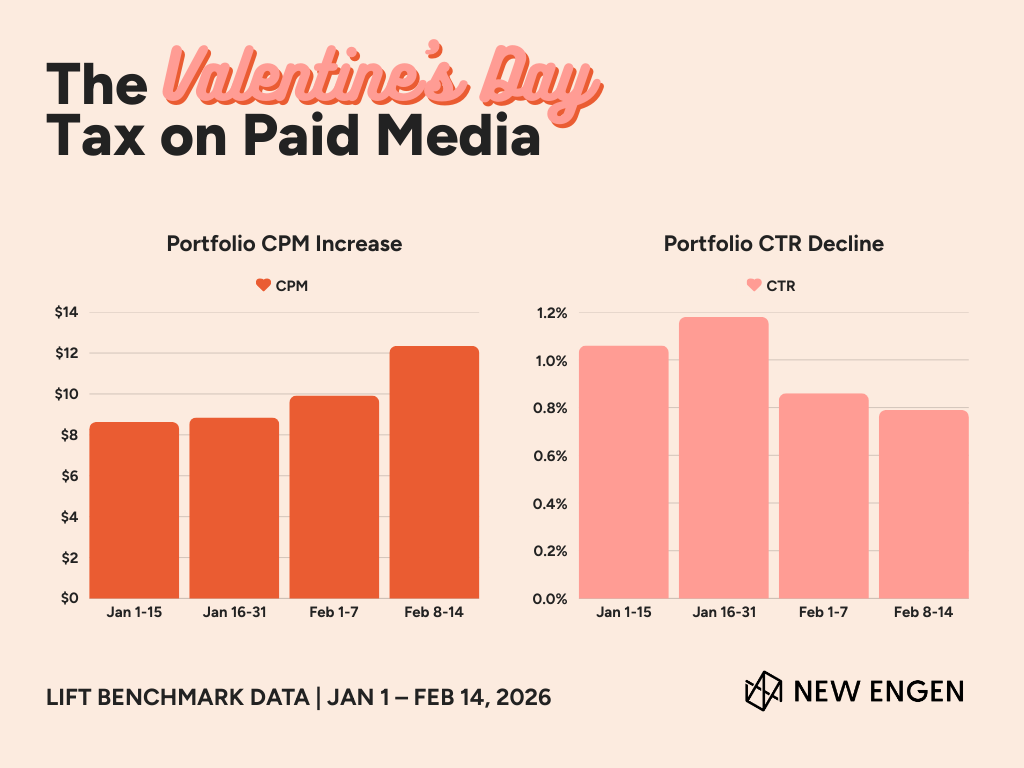
That means brands pushing influencer creative in February paid significantly more for each impression and click compared to those who activated earlier.
Right now, this translates into:
The same creator asset costs more to distribute in February than it did in mid-January.
Engagement efficiency loss as feeds become saturated.
Stronger creative needed to maintain performance while scaling budgets mid-month
The brands operating efficiently didn’t wait for February to brief creators and push content live. They secured partnerships and launched paid support in mid-January,when CPM floors were lower and attention was less fragmented.
What this means:
If influencer content is part of your paid mix, activate early to get ahead of rising costs that can emerge well before peak spending days. In February, the best-performing Valentine’s creative launched weeks before Valentine’s Day.
Signal #2: Think Social-First for Broadcast Moments
According to eMarketer, the Golden Globes saw TV viewership decline 7% year over year, even though social discussion increased 5% to 43 million reactions .
Cultural moments like the NFL, award shows, and live premieres are no longer consumed passively through broadcast alone. They’re experienced through creators: in reactions, commentary, memes, behind-the-scenes content, and second-screen conversations.
For brand marketers, this changes how campaigns should be built. Instead of planning a broadcast moment and adding social amplification later, the starting point should be social-native creator strategy.
There are three windows to capitalize on:
Before: Brief creators to build anticipation and shape the narrative leading into the event.
During: Enable real-time commentary, reaction content, and live integrations.
After: Extend the moment through recap, meme culture, and performance-driven amplification.
Each phase requires a different creative approach, but all of them require creators to be embedded early. High polished, recap-style creative launched days after the main event may look good, but risks missing the moment.
What this means: Broadcast no longer defines the moment. Creators do. Plan your creator strategy before the event, support it with paid intentionally, and focus on building momentum rather than just driving impressions.
Signal #3: Long-Term Creator Partnerships Are Driving Measurable Lift
Influencer performance isn’t just about creative quality, it’s about repetition.
According to eMarketer, CTRs for partnerships with creators across the US, UK, Canada, and Australia increased by roughly 10% for each additional integration with the same creator. The research also found that the sixth integration with one creator saw a conversion rate lift of 1.9x compared to the first.
When audiences see a creator partner with the same brand repeatedly:
Trust builds
Familiarity increases
Friction decreases
Conversion intent strengthens
This is especially important during high-cost months like February. Where a one-off sponsored post needs to work immediately in an inflated media environment, a long-term partnership can deliver on the efficiency that has been built over time.
What this means:
If influencer marketing is still operating campaign-by-campaign, you’re leaving measurable performance lift on the table. Compounding partnerships outperform seasonal bursts.
Rising Creator: Sherry and the Power of Identity-Led Content
Chinese-American creator Sherry (@sherryxiiruii) has built momentum by playfully inviting viewers into everyday Traditional Chinese habits.
“You’re Chinese now.”
It’s how she opens many of her videos:introducing rituals like drinking warm water, practicing Ba Duan Jin, wearing slippers indoors, or eating congee for breakfast. The phrasing is unexpected and memorable, which makes it easy to engage with.
Her January videos generated 5.9M views and 918.9K likes, and another reached 4.6M views and 637K likes, helping her grow to more than 693K followers .
The timing aligns with Lunar New Year, but the traction goes deeper. Wellness continues to be a structural priority, with 84% of U.S. consumers saying wellness is important, according to McKinsey’s Future of Wellness survey, and nearly half purchasing functional nutrition products in the past year. Sherry’s content sits at the intersection of cultural education, everyday ritual, and aspirational wellness — all delivered in a format that feels native to the platform.
What this means:
Sherry shows what happens when a creator brings a genuinely fresh perspective to a saturated category like wellness. The takeaway: look for creators who are reframing familiar topics in ways only they can, turning everyday content into something people want to share.
Platform & Influencer Ecosystem Updates Impacting Strategy
February brought several platform shifts that will affect influencer planning in 2026.
TikTok stabilized, but platform dependency risk remains.
According to TechCrunch, user activity rebounded after ownership turbulence, and advertisers resumed spending. At the same time, new AI-powered ad formats rolled out, reinforcing TikTok’s strength in cultural velocity. The takeaway: stay invested, but don’t build strategy on one platform alone.
AI is becoming a discovery channel.
According to Digiday, ChatGPT and retail media networks are testing in-platform advertising. Search is shifting from keyword-based to conversational. Influencer content may increasingly drive awareness, while AI environments capture high-intent demand.
Retail media and CTV are expanding fast.
Amazon advertising continues double-digit growth, and streaming platforms are accelerating ad-supported models. Creator assets need to travel across paid social, retail media, and streaming — not just organic feeds.
Influencer budgets are rising.
According to eMarketer, more than half of buyers now rank influencer partnerships as a top advertising priority for 2026. Competition for strong creator relationships will increase.
What this means:
Influencer marketing is no longer platform-specific. It’s ecosystem-wide. Build creator strategy for distribution across social, search, retail media, and streaming — not just one feed.
Looking Ahead: March Signals to Prepare For
March brings sustained cultural moments rather than single spikes.
Women’s History Month runs the entire month.
March Madness (3/16–4/4) concentrates attention mid-month.
St. Patrick’s Day (3/17) continues to drive food, beverage, and celebration content.
Daylight Savings (3/9) often triggers “routine reset” and productivity narratives.
If you want to see the platform-specific formats gaining traction right now, explore our February 2026 TikTok Trends roundup.
And for deeper strategic guidance, download our Monthly TikTok Trend Report for Brands, featuring 8–12 emerging formats, real brand examples, and execution insights from our social and strategy teams.
Frequently Asked Questions
Q1: What holidays and cultural moments should brands plan influencer campaigns around in March?
March brings multiple activation windows beyond major sports and tentpoles.
Early-month moments include Peanut Butter Lover’s Day (3/1) and Compliment Day (3/1) — ideal for snack, CPG, beauty, and self-care brands. World Day (3/8) and National Nutrition Month (3/1–3/31) align with wellness positioning. Women’s History Month (3/1–3/31) requires thoughtful, credibility-first creator partnerships. March Madness (3/16–4/4) drives second-screen behavior. St. Patrick’s Day (3/17) remains strong for food, beverage, and celebration content. Later in the month, Puppy Day (3/23) and Dentist’s Day (3/6) offer niche but highly engaged creator communities.
The key is planning for before, during, and after windows — not just activating on the calendar date.
Q2: How much more expensive does media become by Valentine’s Day?
Across our Lift data, CPMs rose 43% from early January to Valentine's week. Paid social CPMs increased 30%.
More importantly, engagement efficiency declined. Paid social CTR dropped from 1.06% to 0.79%, pushing cost per click up roughly 75%.
For brands pushing influencer content through paid, this means waiting until February materially increases distribution costs — often without proportional performance gains. The efficient window opens earlier than most marketers think.
Q3: What are creators saying about TikTok now that it has U.S. ownership stability?
While TikTok has stabilized from a regulatory standpoint, creator sentiment is more nuanced.
As New Engen’s Senior Marketing Manager and active creator Shayla Crowder recently shared on LinkedIn, the bigger issue isn’t ownership headlines — it’s platform conditions. She notes declining organic reach, difficulty spotting trend velocity, and heavier feed content shifting toward political and reactive discourse. The same content posted to Shorts and Reels is often generating significantly higher reach and monetization.
Other platforms are aggressively recruiting creators with revenue incentives and growth programs, creating real diversification pressure.
The signal for brands isn’t “leave TikTok.” It’s this:
Creators are increasingly platform-agnostic. If brands remain TikTok-only, they may follow creators into a shrinking engagement window.
Diversified creator distribution is becoming a risk-mitigation strategy — not just a growth tactic.