
How DTC Disruptors Can Show Up in AI Recommendations

Traditional search has historically favored brands that have spent years building authority. AI recommendations create another route into consideration, and we’ve seen that advantage firsthand at New Engen. When we began tracking our own AI visibility, we ranked lowest among our competitive set. After deliberately investing in the questions, content, and signals shaping AI answers, we moved to the top despite not being the largest agency in the group. We break down more of what influences that visibility in Why Your Brand Isn’t Showing Up in AI Recommendations. For disruptors, the opportunity is similar. Understand the questions that matter to your audience, build useful content around the places your brand has a right to win, and reinforce those associations across the sources AI relies on.
How Can Smaller Brands Get Recommended by AI?
Breaking into a category has usually required time and money. In an Ahrefs study of newly published pages, just 1.74% reached Google’s top 10 within a year, while nearly 73% of pages already ranking in the top 10 were more than three years old. Organic search has historically rewarded accumulated authority, while paid media rewards brands with the budget to keep buying attention. Both naturally favor companies that have had years to establish themselves.
AI changes that dynamic because the path into a citation can be far more specific. AI search creates additional opportunities because recommendations can be tied to highly specific customer needs, not just broad category recognition. A smaller brand may struggle to compete for a general query like "best running shoes," but have a stronger case for inclusion when the question centers on a particular fit, activity, or use case that its products address especially well.
For example, a shopper is not always looking for the biggest or most established brand in a category. They may ask for the best running tights for subfreezing temperatures, a moisturizer that works under makeup without pilling, or jeans comfortable enough to wear through a full day at the office.
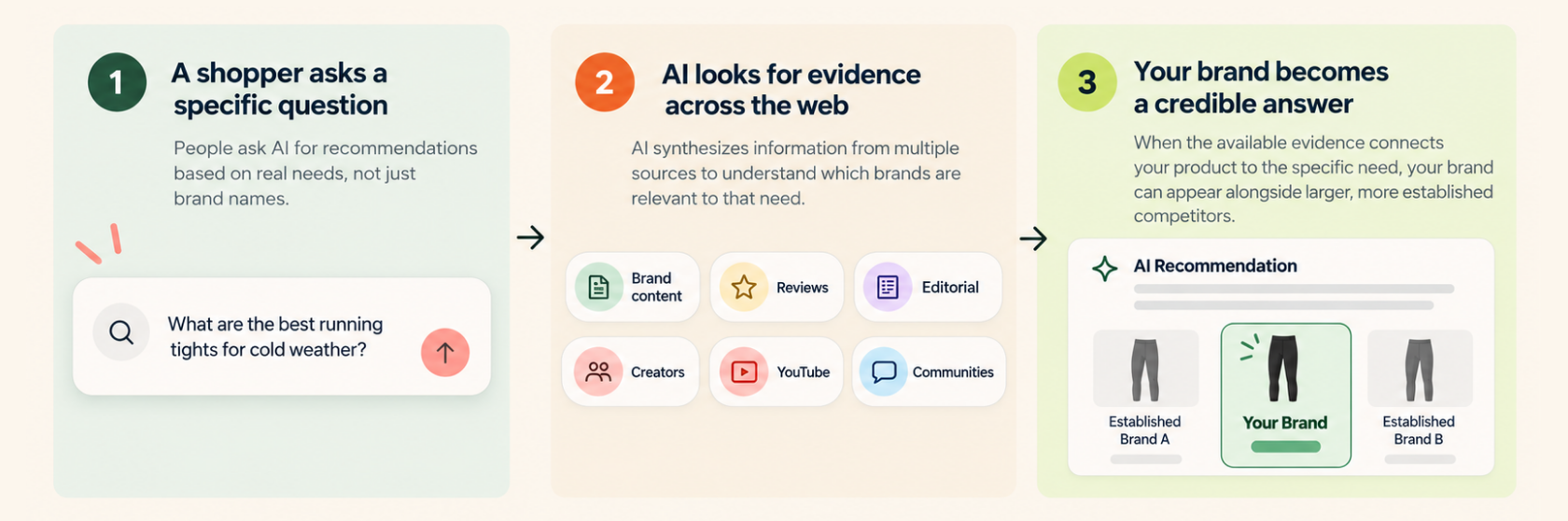
Those questions create more entry points for brands that understand exactly where their products fit. And there is evidence that AI is already expanding those consideration sets. In Locus’s Q2 2026 survey of U.S. online shoppers, 39% of AI-assisted shoppers said they were more likely to try new brands they would not have considered otherwise.
Our 2026 Disruptor Growth Playbook describes this as a different path into consideration. One where becoming a brand an answer engine finds credible enough to recommend, even without the same category tenure as the largest competitors. AI can draw on brand content, reviews, editorial coverage, creators, YouTube, and community conversations to build that understanding.
That creates an opening for disruptors to establish relevance around specific customer needs before every competitor is competing for the same ground. For brands willing to move early, that opportunity is worth acting on now.
What Questions Should Brands Target in AI Search?
The strongest AI search strategies start with an understanding of audience.
Most brands know their customer at a demographic level: age range, household income, broad interests, or category behaviors. That information may be useful for planning, but it rarely tells you what someone will ask when they’re searching for a recommendation.
The more useful layer is behavioral: what is happening in their life, what problem are they trying to solve, what are they worried about, and what would make one product more relevant than another?
Demographics describe an audience; psychology and behavior help determine what to make. That requires going deeper into first-party customer data, research, social listening, and direct customer conversations to understand the motivations, objections, and moments that shape a decision.
For AI visibility, those insights become the foundation of your content strategy.
If you understand your audience and create content around the specific things they’re asking, you can compete with the big players.Shayla Crowder, Associate Director, Marketing, New Engen
Turn Audience Insight Into Real Customer Queries
| Broad audience | More useful customer need | Question they might ask AI |
|---|---|---|
| Women shopping for jeans | Wants office-ready jeans that stay comfortable all day | What are the best jeans for sitting at an office all day? |
| People who work out | Runs outside through winter | What are the warmest running tights for cold weather? |
| Skincare shoppers | Needs hydration that works under makeup | What moisturizer works under makeup without pilling? |
| Food shoppers | Needs an easy gift for someone hard to shop for | What is a good food gift for someone who already has everything? |
This is why AI content strategy should start with customer problems rather than broad category keywords. Ask: What would our best customers search or ask if they needed what we sell but did not know our brand existed? Those are the questions worth building around.
What Content Helps Brands Show Up in AI Recommendations?
Once those questions are clear, the goal is not to manufacture a piece of content for every possible prompt. It is to build useful coverage around the needs, occasions, comparisons, and decisions where your brand has something distinct to contribute.
For the denim example, a broad article on how to choose jeans may still have a role. But a brand creates a much clearer association when it can answer the more specific questions that come up along the way: which jeans are comfortable enough for a full day at the office, how much stretch different fabrics provide, how various rises affect fit, or which styles work best for someone sitting for long periods.
The same logic applies across categories:
A skincare brand can explain which products work for a particular routine or skin concern.
A fitness brand can answer questions tied to weather, workout type, body support, or recovery
A food brand can build around dietary needs, occasions, preparation constraints, or gifting moments
What matters is that the content gives AI enough context to understand what the product is, who it is relevant for, when it should be considered, and why. Product information, editorial content, comparisons, FAQs, reviews, and proof can all contribute to that understanding when they consistently reinforce the same need.
More content is not automatically better. Publishing dozens of lightly differentiated pieces around similar prompts can create volume without adding much new information. A smaller set of content that thoroughly covers the customer problems your brand is best equipped to solve gives AI a clearer basis for understanding when your brand belongs in the recommendation.
Do Reviews, Creators, and Third-Party Mentions Influence AI Recommendations?
Owned content can help AI understand where your brand is relevant, but your website is only one part of the information it can draw from. LLM Pulse’s citation data shows AI engines regularly pulling from sources such as YouTube, Reddit, social platforms, and review sites alongside traditional web content. Reviews, editorial coverage, creators, affiliate content, and community conversations can all reinforce or weaken the associations you are trying to build.
If a skincare brand wants to be considered for sensitive skin, it is stronger when that idea exists beyond the brand’s own claims. Reviewers may talk about irritation or tolerance. Creators may show the product in sensitive-skin routines. A publisher may include it in a comparison for reactive skin. Customers may mention the same benefit in reviews.
Taken together, those signals give AI more evidence for when the brand belongs in a recommendation.
This is why AI visibility cannot sit entirely with the SEO or content team. PR, creator, affiliate, reviews, and community all contribute to how a brand is understood across the web. The goal is to reinforce the same product strengths and use cases across the sources AI may rely on.
So after asking What should we publish?, marketers should ask Where else does this association need to show up for AI to trust it?
For a deeper look at the technical and citation factors that influence AI visibility, read Why Your Brand Isn’t Showing Up in AI Recommendations.
Which AI Prompts Should Brands Track?
AI visibility can quickly become another reporting exercise if the goal becomes showing up for as many prompts as possible, since that completely misses the point.
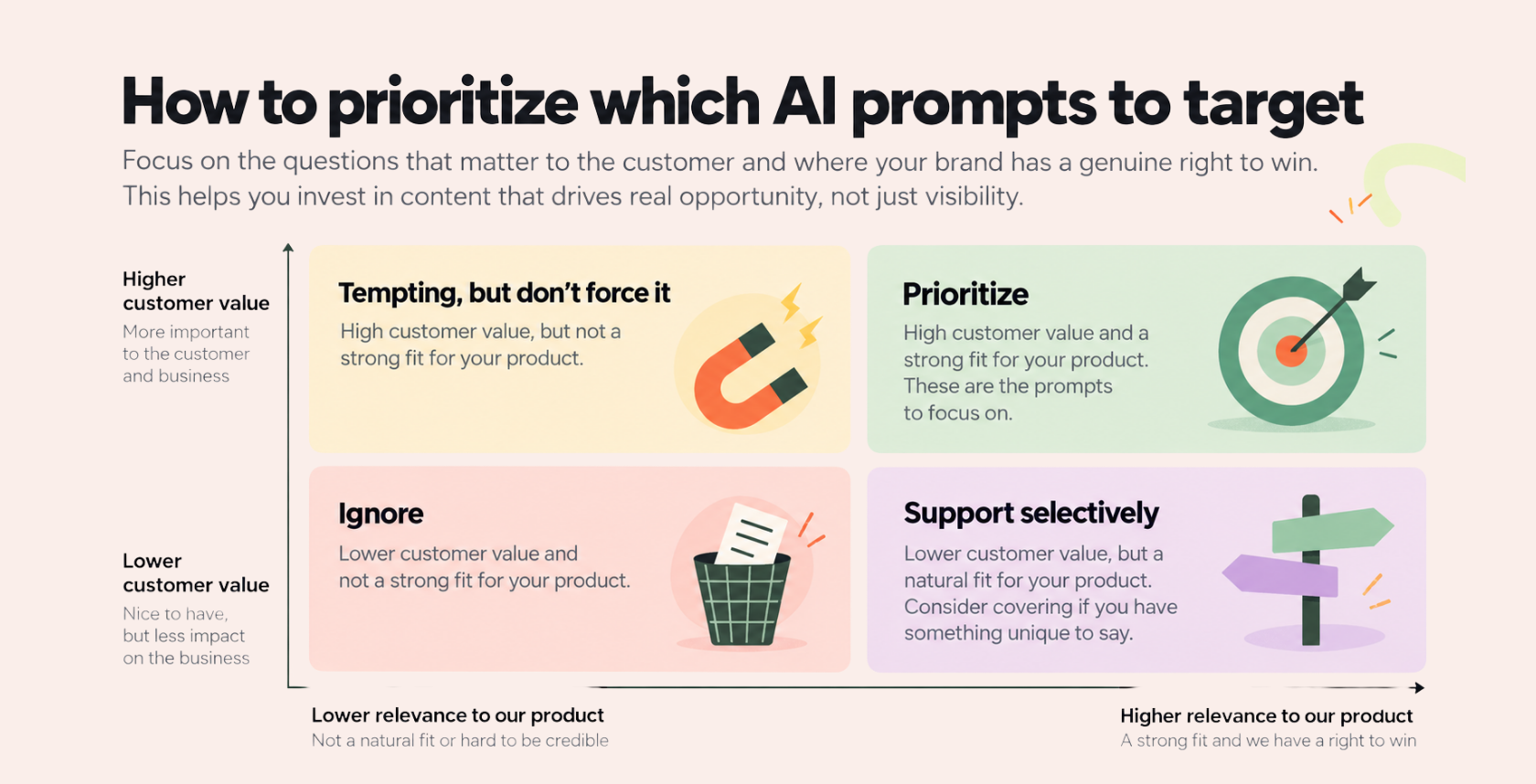
A disruptor brand needs to show up for the questions that matter to the customer and map closely to the places the product has a genuine advantage, rather than appearing for every category question.
Start with a focused set of high-intent prompts. Look at which brands appear, the reasons they are recommended, the attributes AI associates with them, and the sources that shape those answers.
Then look for patterns.
You may discover that competitors own a use case because they have substantially more content around it. You may find that your brand has strong owned content but almost no third-party reinforcement. Or you may find that AI understands the product, just not for the need the business actually wants to own.
The point is to diagnose the gap before deciding what to make next.
Why Do Disruptor Brands Have an Early-Mover Advantage in AI Search?
The biggest opportunity for disruptor brands is not that AI suddenly makes brand authority irrelevant, since established brands still have advantages.
What has changed is the number of ways a brand can become relevant.
When TikTok first came on the scene, it was super easy to go viral. AI search is very similar. If you’re acting early, there’s an early-mover advantageShayla Crowder, Associate Director, Marketing, New Engen
Every specific customer need creates another potential route into consideration. Brands that identify those needs early, create substantive answers, and build supporting signals across the web can establish associations which competitors may not be paying attention to yet.
The brands that benefited most from early TikTok did not win simply because they arrived first. They won because they learned the platform while the playbook was still being written.
AI search offers a similar learning window, and the visibility can translate into action beyond the AI answer itself. Research from Fractl found that 59% of consumers are likely to visit a brand’s website after it is mentioned by an AI chatbot.
For disruptors, the opportunity is to get closer to the customer, understand the questions the category has not answered well enough, and build credibility around those needs before everyone else is competing for the same ground.
You may not be able to manufacture ten years of search authority, but you can start becoming the brand AI associates with the right customer problem now.
Frequently Asked Questions About AI Recommendations for DTC Brands
Q1: How do I get my brand recommended by AI?
Make it clear what your product is, who it is for, and which specific customer needs it solves. Build useful content around those needs, then reinforce the same associations through reviews, editorial coverage, creators, publishers, and other credible sources across the web.
Q2: How does AI decide which brands to recommend?
AI systems can draw from a mix of brand websites, reviews, editorial content, creators, YouTube, affiliate publishers, and community conversations. Which brands appear depends heavily on the specific question asked and how much credible information connects a brand to that need.
Q3: Can a smaller brand compete with established brands in AI recommendations?
Yes. Larger brands still benefit from stronger awareness and accumulated authority, but AI creates more specific entry points into consideration. A smaller brand can compete by providing clearer, more relevant information for a customer need that larger competitors have not addressed as well.
Q4: What content helps a brand show up in AI recommendations?
Focus on content that explains your product’s use cases, differentiators, comparisons, common customer questions, and supporting proof. Build depth around the customer problems your brand is best equipped to solve instead of creating large numbers of pages for slight variations of the same prompt.
Q5: Do reviews, creators, and third-party mentions help with AI visibility?
They can. Reviews, creator content, editorial coverage, affiliate publishers, YouTube, and community discussions can reinforce the same product-to-need associations you establish on your own site, giving AI more evidence for when your brand belongs in a recommendation.
Q6: Which AI search prompts should my brand focus on?
Prioritize prompts tied to real customer problems, high-intent buying decisions, and areas where your product has a genuine advantage. A useful starting point is to ask what your best customers would search for or ask if they needed what you sell but did not already know your brand existed.