
Generative AI in Advertising: What Should Brands Automate, and What Should Stay Human?

Generative AI is making it faster and less expensive to produce advertising creative. Brands can generate backgrounds, adapt assets for different placements, develop copy variations, summarize customer insights, and explore visual directions in a fraction of the time these tasks once required.
But producing more advertising does not necessarily mean producing better advertising.
Brands should use generative AI to accelerate research, production, adaptation, and experimentation while keeping people responsible for the creative idea, brand-sensitive elements, accuracy, and final judgment. The goal is not to generate the most content. It is to help original, customer-informed ideas reach the market faster.
As we explain in New Engen’s 2026 Growth Playbook:
AI is a multiplier, not an originator.
That distinction should guide how brands build generative AI into the creative process.
What Is Generative AI in Advertising?
Generative AI in advertising refers to technology that can create or modify copy, images, video, audio, and other advertising assets in response to instructions or existing inputs.
Brands can use it to:
Analyze reviews and customer feedback
Generate early creative directions
Create copy and headline variations
Replace or extend image backgrounds
Adapt assets to different placements
Animate static images
Produce preliminary storyboards
Develop multiple versions of an execution
It is also important to distinguish three related applications of AI:
| Application | What it does | Example |
|---|---|---|
| AI-assisted creative | Helps people research, develop, or edit creative | Summarizing reviews or expanding a background |
| AI-generated creative | Produces part or all of an advertising asset | Creating an image, script, or voiceover |
| AI-optimized advertising | Selects, combines, or delivers assets based on predicted performance | Matching different creative variations to different users |
These applications carry different creative, legal, and brand risks. Resizing an approved image is not the same as generating a customer, product, or spokesperson from scratch.
Why Are Brands Using Generative AI for Ad Creative?
The demand for advertising creative has expanded.
Brands need content for more channels, audiences, placements, formats, and stages of the customer journey. A single campaign may require vertical videos, static images, creator content, product demonstrations, social-first edits, retail media assets, and multiple messaging variations.
Generative AI can remove production constraints that previously limited how many of those ideas reached the market. Meta, for example, offers generative creative features for text variation, background generation, image expansion, animation, and placement adaptation. Meta Advantage+ Creative
Used well, these capabilities can help a creative team spend less time on repetitive production and more time developing ideas.
Used poorly, they can help a brand produce a much larger volume of forgettable advertising.
Where Should Brands Use Generative AI?
Generative AI is most valuable when it accelerates inputs, removes routine production work, or helps teams explore possibilities before making a final creative decision.
1. Research and insight development
AI can help teams synthesize large volumes of customer reviews, comments, search behavior, support conversations, and social feedback.
It can surface recurring:
Motivations
Objections
Questions
Product use cases
Emotional needs
Language customers use to describe a problem
This can compress the time between receiving a brief and developing an initial creative direction. But AI should organize the evidence, not invent the audience insight. Teams still need to validate patterns against real customer data and decide which insights matter.
2. Early creative exploration
Generative AI can help teams visualize multiple directions before committing production resources.
For example, a creative team might use it to explore:
Possible settings
Visual metaphors
Storyboard frames
Product environments
Copy territories
Alternate hooks
These outputs should be treated as starting material. The presence of an image or headline does not make it a strong idea.
3. Production constraints
Generative AI is particularly useful when a brand has a strong central concept but needs to adapt it across environments or placements.
Appropriate applications may include:
Extending an image for a new aspect ratio
Generating alternate backgrounds
Removing distracting visual elements
Developing preliminary product settings
Translating approved creative into additional formats
Animating a static asset
This is one reason AI-assisted creative may be more useful than fully AI-generated ads. The brand retains the original idea and its most important elements while AI helps the execution travel further.
4. Creative variation
AI can help produce additional versions of an established execution, such as new headlines, crops, edits, or calls to action.
But variation should not be confused with diversification.
Generating 20 versions of the same ad gives the media system more executions of one idea. It does not necessarily give the system new motivations, messages, problems, or use cases to explore.
| AI can accelerate | Humans should lead |
|---|---|
| Review and feedback synthesis | Audience interpretation |
| Early visual exploration | The central creative idea |
| Background generation | Brand-sensitive imagery |
| Copy variations | Brand voice and meaning |
| Resizing and adaptation | Taste and final selection |
| Routine production work | Accuracy and approval |
| Version development | Strategic diversification |
What Parts of Advertising Creative Should Stay Human?
The closer an element is to the identity of the brand or its relationship with the customer, the more human judgment it requires.
The central idea
Generative AI can combine familiar patterns quickly. That does not mean it understands which idea is strategically meaningful, culturally relevant, or worth producing.
AI models tend to gravitate toward the median because they learn from patterns that already exist. This can raise the creative floor by making competent execution easier. It can also collapse the creative ceiling when every brand generates from similar prompts, references, and models.
The opportunity is not simply to make polished advertising faster. It is to create something that could not have come from every other brand using the same tools.
Final creative judgment
Taste-making, idea selection, and deciding what should enter the market remain human responsibilities.
Teams still need to ask:
Is the idea relevant to a real customer need?
Does it communicate something only this brand can credibly say?
Does the execution feel distinctive?
Is it accurate?
Is it appropriate for the context?
Is it worth the audience’s attention?
AI can generate options. It cannot assume accountability for the decision.
Brand-sensitive elements
Some creative elements have a direct emotional relationship with the audience. Examples may include:
A founder’s face or voice
A creator or customer testimonial
A baby in an infant-care advertisement
An animal in pet advertising
A patient in healthcare marketing
A product result or demonstration
A representation of a community or identity
Replacing these elements with synthetic approximations can flatten the emotional value of the creative or make the audience feel misled.
That does not mean brands can never use AI in these categories. It means the standard for accuracy, consent, transparency, and human review should be considerably higher.
Can AI-Generated Ads Damage Brand Trust?
The use of AI is not automatically a trust problem. Inappropriate, misleading, or visibly low-quality AI use can be.
A 2026 Emplifi study of more than 1,600 consumers found that 93% believe authentic brand engagement builds trust and 85% are willing to pay more for brands they perceive as authentic. The research also found that 91% expect brands to disclose when AI is involved in content or customer interactions. Emplifi consumer authenticity research
Klaviyo found that 32% of consumers trust a brand less when they notice AI-generated marketing content, compared with 7% who trust it more. Most respondents were neutral, suggesting that audience response depends heavily on how and where the technology is used. Klaviyo AI consumer trends
Consumers are more likely to react negatively when AI-generated ads:
Look generic or visibly artificial
Misrepresent the product
Use an artificial person where authenticity is expected
Contain factual or visual errors
Appropriate someone’s likeness or style
Conceal information that would affect the customer’s interpretation
Replace a real experience with a manufactured one
That is why brands should test audience receptivity instead of assuming AI will be accepted or rejected universally.
I think everybody should try some form of AI-generated creative, and you'll learn really quickly whether or not your customer is receptive to it. You'll get ripped apart in the comments, and you'll know.Alyse Borkan, Co-Founder of Rocco
Comments and qualitative feedback are not distractions from performance. They are signals about whether the brand is creating interest, confusion, skepticism, or distrust.
How Can Brands Keep AI Ad Creative From Becoming Generic?
Better prompts can improve an output, but prompting alone does not create differentiation.
Distinctive AI ad creative begins with inputs competitors do not have:
Proprietary customer data
Real reviews and support conversations
Specific audience motivations
Original product truths
A recognizable brand voice
Creator and customer perspectives
Cultural knowledge
A strong strategic point of view
AI should help teams work with these inputs, not replace them with generalized assumptions.
A short-term play is to growth-hack an algorithm for a near-term cycle. The long-term durable play is around authentic content and really staying true to your values.Justin Hayashi, CEO of New Engen
If a brand cannot explain what makes an idea distinct before entering a prompt, generative AI is unlikely to find that distinction on its behalf.
How Should Brands Test AI-Generated Advertising?
Brands should test AI as a creative variable, not treat it as the strategy.
A useful test compares similar ideas under controlled conditions:
| Test | What it helps answer |
|---|---|
| Human-created vs. AI-assisted execution | Does AI improve production without reducing quality? |
| Original asset vs. AI-adapted asset | Does adaptation extend performance across placements? |
| Human copy vs. AI-generated variations | Can AI find useful expressions of an approved message? |
| AI-generated image vs. real product photography | How does synthetic production affect response and trust? |
| One concept with many variations vs. multiple distinct concepts | Is AI creating meaningful diversity or superficial volume? |
Evaluation should extend beyond click-through rate.
Brands should monitor:
Conversion rate
Cost per acquisition
Incremental reach
Engagement quality
Negative comments and feedback
Product or message comprehension
Brand sentiment
Creative longevity
Performance against the asset’s own baseline
A strong short-term response does not automatically make an execution appropriate for long-term brand use.
What Governance Do AI-Generated Ads Require?
Every brand using generative AI in advertising should establish a review process before scaling production.
Before publishing an AI-assisted or AI-generated ad, ask:
Is the product represented accurately?
Are all advertising claims substantiated?
Were the source materials approved for this use?
Are every person’s likeness and voice authorized?
Does the execution preserve the brand’s identity?
Could a reasonable customer misunderstand what is real?
Is disclosure required by the platform, market, or context?
Has a qualified person reviewed the final asset?
Can the team document how the asset was created?
Who is accountable if the output is inaccurate?
The advertiser remains responsible for what enters the market. Meta’s terms, for example, warn that Business AI outputs may be inaccurate, misleading, non-unique, or potentially infringing and place responsibility for reviewing published outputs on the business using them. Meta Business AI Terms
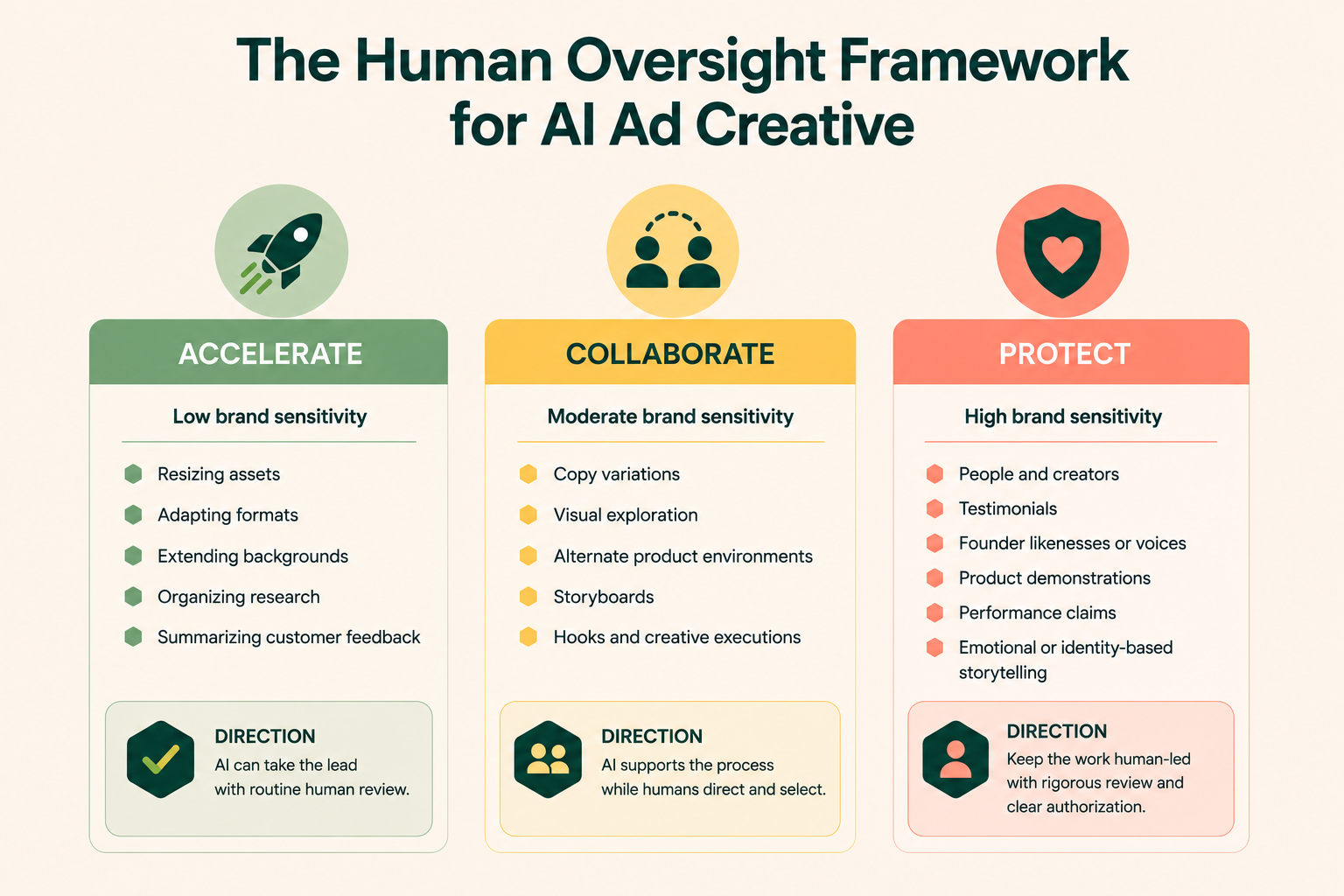
Low brand sensitivity: Use AI to accelerate production
Resizing, formatting, background extension, research synthesisModerate brand sensitivity: Use AI with close human direction
Copy variations, visual exploration, alternate environmentsHigh brand sensitivity: Keep human-led and require rigorous review
People, creators, testimonials, product results, claims, identity, emotion
Does Generative AI Replace Creative Teams?
Generative AI changes the work of creative teams. It does not eliminate the need for them.
As execution becomes easier, judgment becomes more valuable. Brands still need people who can understand customers, identify an opportunity, develop a differentiated idea, recognize strong work, and connect creative decisions to business performance.
The competitive advantage is not access to the technology. Most brands will have access to similar tools.
The advantage comes from building a system in which technology accelerates strong human thinking.
All this content velocity, all this creative output, it only matters if it's feeding a complete growth system; a fully integrated approach to content, measurement, and media.Justin Hayashi, CEO of New Engen
The Best Use of Generative AI Is to Make Human Creativity More Valuable
Generative AI can help brands move from insight to execution faster. It can reduce repetitive work, expand promising assets, and make more ideas practical to test.
But volume is not the outcome.
Brands should use AI to multiply customer insight, original thinking, and strong creative judgment. They should not expect it to originate a differentiated brand position or decide what deserves the audience’s trust.
The brands that benefit most from generative AI in advertising will not be the ones generating the most assets. They will be the ones that know what to automate, what to protect, and what must remain unmistakably human.
Explore the complete framework for building a creative-led growth system in New Engen’s 2026 Growth Playbook.