Answer Engine Optimization (AEO) Services

When customers ask AI what to buy, does your brand come up?
Customers ask AI for recommendations, compare brands side by side, and check specific products before they ever visit your site. Those answers shape which brands make the shortlist and what customers believe about them.
Answer engine optimization (AEO), also called GEO, LLM SEO, or AI search optimization, is the practice of earning mentions, recommendations, and citations in answers generated by AI search tools and assistants, such as ChatGPT, Perplexity, Gemini, and Google’s AI Overviews. The goal is for AI to name your brand, describe it accurately, and cite your content when customers ask about your category.
AEO overlaps with SEO, because clear content and a crawlable site help both, but it asks a different question. SEO helps your pages rank in a list of links. AEO focuses on whether AI includes your brand in the answer itself, and strong rankings don’t secure that spot. In Ahrefs’ March 2026 analysis, only about 37% of URLs cited in Google AI Overviews also ranked in the top 10 organic results for the same query.
New Engen helps you see where your brand shows up in AI search and improve how it’s represented. We start with a free audit that shows where you stand and where to focus first. From there, we can build a detailed roadmap, help your team put it into action, and measure what changes.
Why do answer engine optimization services matter now?
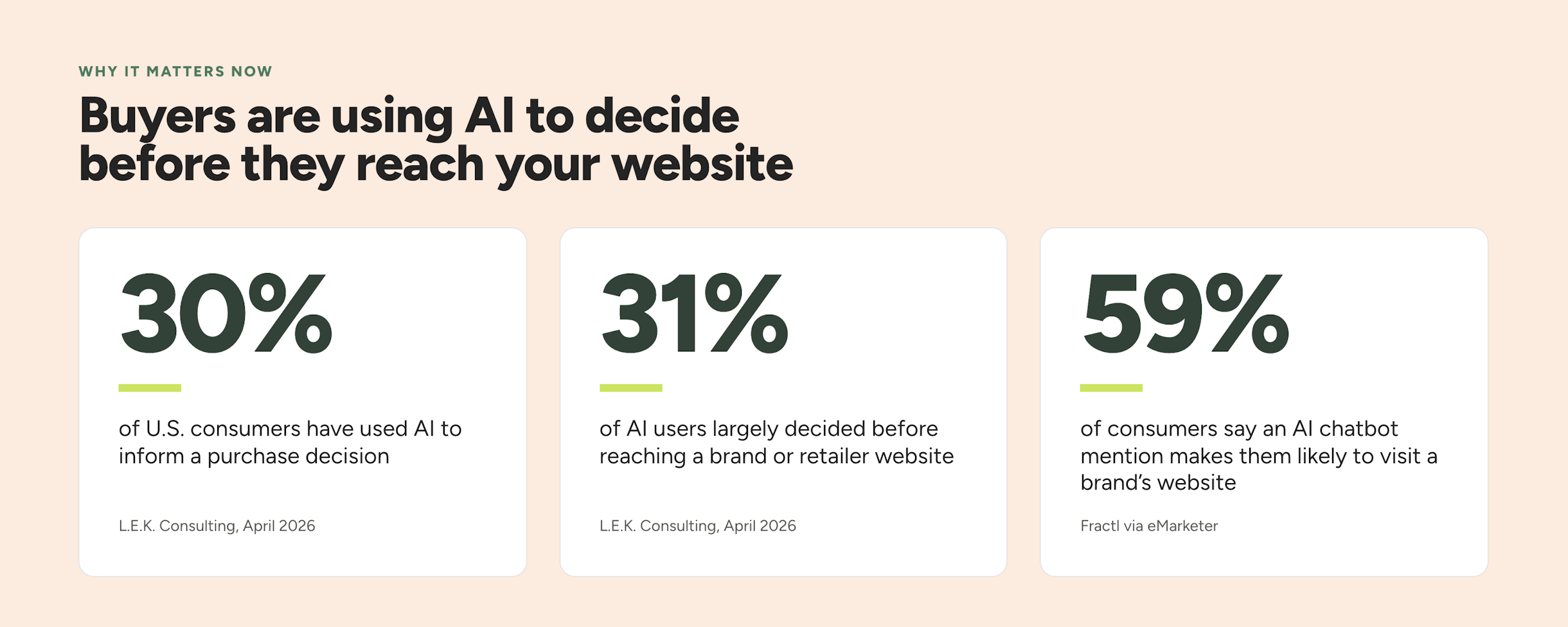
Buyers are using AI to decide before they reach your website.
30% of U.S. consumers have used AI to inform a purchase decision (L.E.K. Consulting, April 2026).
31% of those AI users say they largely decided before reaching a brand or retailer website (L.E.K. Consulting, April 2026).
59% of consumers say they’re likely to visit a brand’s website if an AI chatbot mentions it (Fractl survey, reported by eMarketer).
Does my AEO budget need to fund more than software?
In platform demos and conversations with client teams, we’ve seen brands buy the capacity to track thousands of prompts before they’ve decided which findings they can act on. As tracking expands, software costs can grow with it, leaving less room for the content and coverage that improve how the brand shows up.
You can track 1,000 prompts at once, but still have to decide which questions are worth answering and where those answers should live. We start with a focused set of questions tied to real buying decisions and use what we learn to do three things.
Strengthen your own content. Give customers clearer answers on your site, especially when important product details or comparisons are hard to find.
Build coverage beyond your website. Identify the publications and videos that already inform AI answers, then work to give those sources a reason to include your brand.
Measure and refine. Track changes in mentions, citations, and competitor visibility. Use what you learn to decide where to invest next and when to expand tracking.
Self-serve AEO tools vs. a full-service agency
A self-serve AEO tool can be a good fit if your team has the time and expertise to choose which prompts to track, interpret why certain brands and sources appear, and act on what it finds. Before buying more tracking capacity, ask who will turn those findings into website updates, publisher outreach, or new content.
A full-service AEO agency makes sense when you need help making those decisions and doing the work. New Engen starts with a free audit to show where your brand appears, how AI describes it, and which sources it cites. From there, we can build a separate roadmap that your team can execute or work with us to put into action.
How we applied this to New Engen
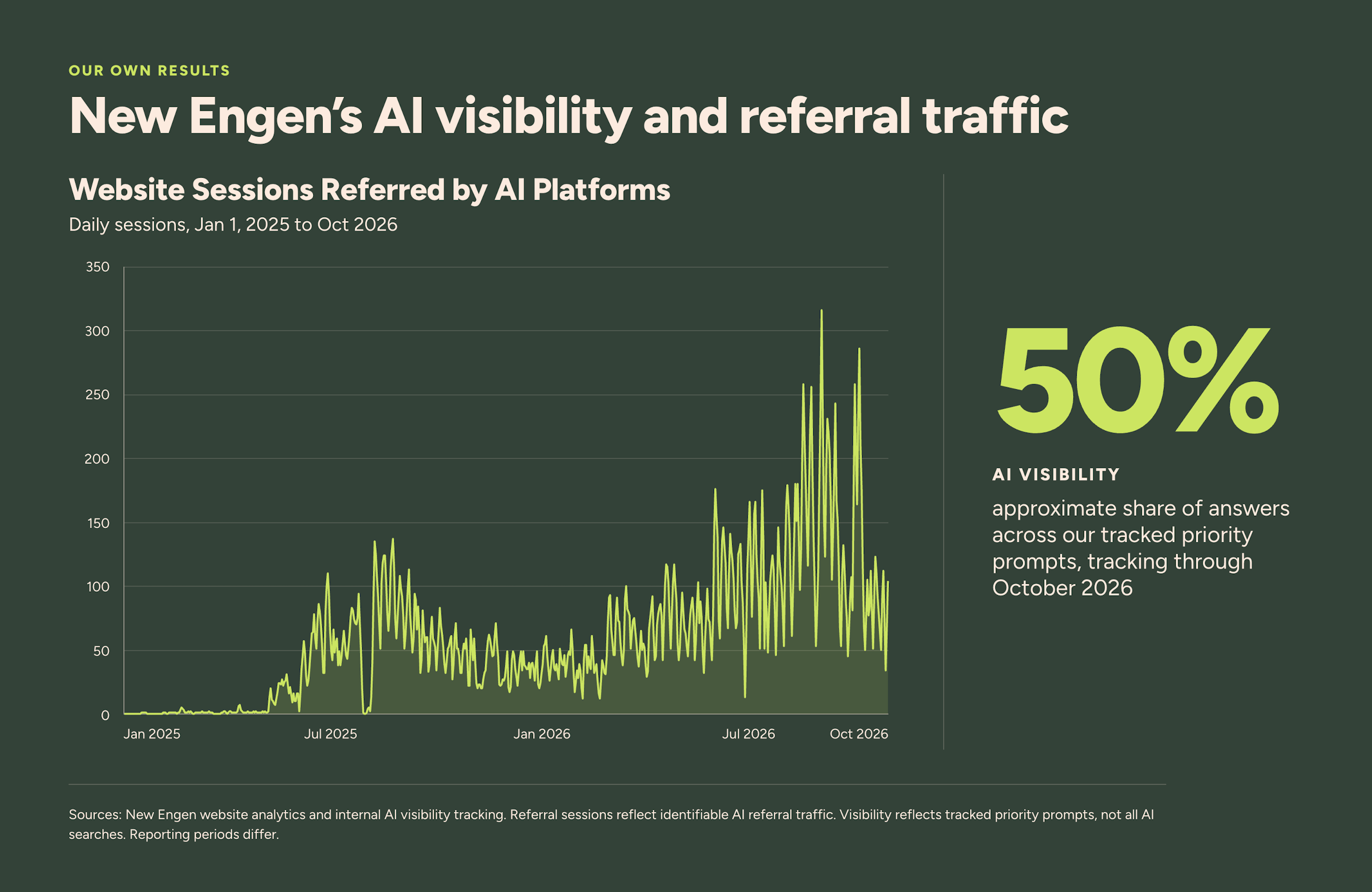
We’ve used this approach on our own brand. In our tracking through October 2026, New Engen went from appearing in a low single-digit share of AI answers to approximately 50% across our tracked priority prompts, ahead of every other agency in our tracked competitive set, including agencies larger than us. Visibility reflects tracked priority prompts, not all AI searches.
What do you get from an AEO audit?
New Engen’s free AEO audit gives you a baseline for how your brand shows up in AI answers today. We test questions across AI platforms to see when your brand appears, how AI describes it, which competitors are recommended, and which sources are cited. You’ll also get high-level recommendations on where to focus first.
The audit gives you the direction. If you want a detailed plan, the next step is a prioritized roadmap, which is separate from the free audit. We add the context behind each finding and turn it into a plan: which gaps to tackle first, what to create or update, and where that content should appear, with briefs for your website, editorial partnerships, and creator content, depending on what the audit finds.
How often does AI name your brand, and what does it say?
Visibility is how often AI names your brand across the questions we track. Perception is how accurately and specifically AI describes your brand when it evaluates you. A brand can be described accurately when customers ask for it by name and still rarely appear when they ask for recommendations. Another brand can show up often, with descriptions so generic that customers get little sense of what sets it apart.
Our AI Visibility and Perception Matrix puts those findings side by side. If your brand is well described but rarely recommended, we look for gaps in the coverage AI cites. If your brand appears often but key details are missing or inaccurate, we look at where clearer product information or stronger proof could improve how it’s represented.
How do you choose which questions to track?
We start with the products, audiences, and purchase decisions that matter to your business. Then we draw on search questions, autocomplete, reviews, and community conversations to understand how people describe what they need.
Take an outdoor apparel brand. “What should I wear for a rainy fall hike?” reveals which brands make the initial shortlist. “Will this rain shell fit over a fleece and pack down small?” tests whether AI can find the details a customer needs to choose a specific product.
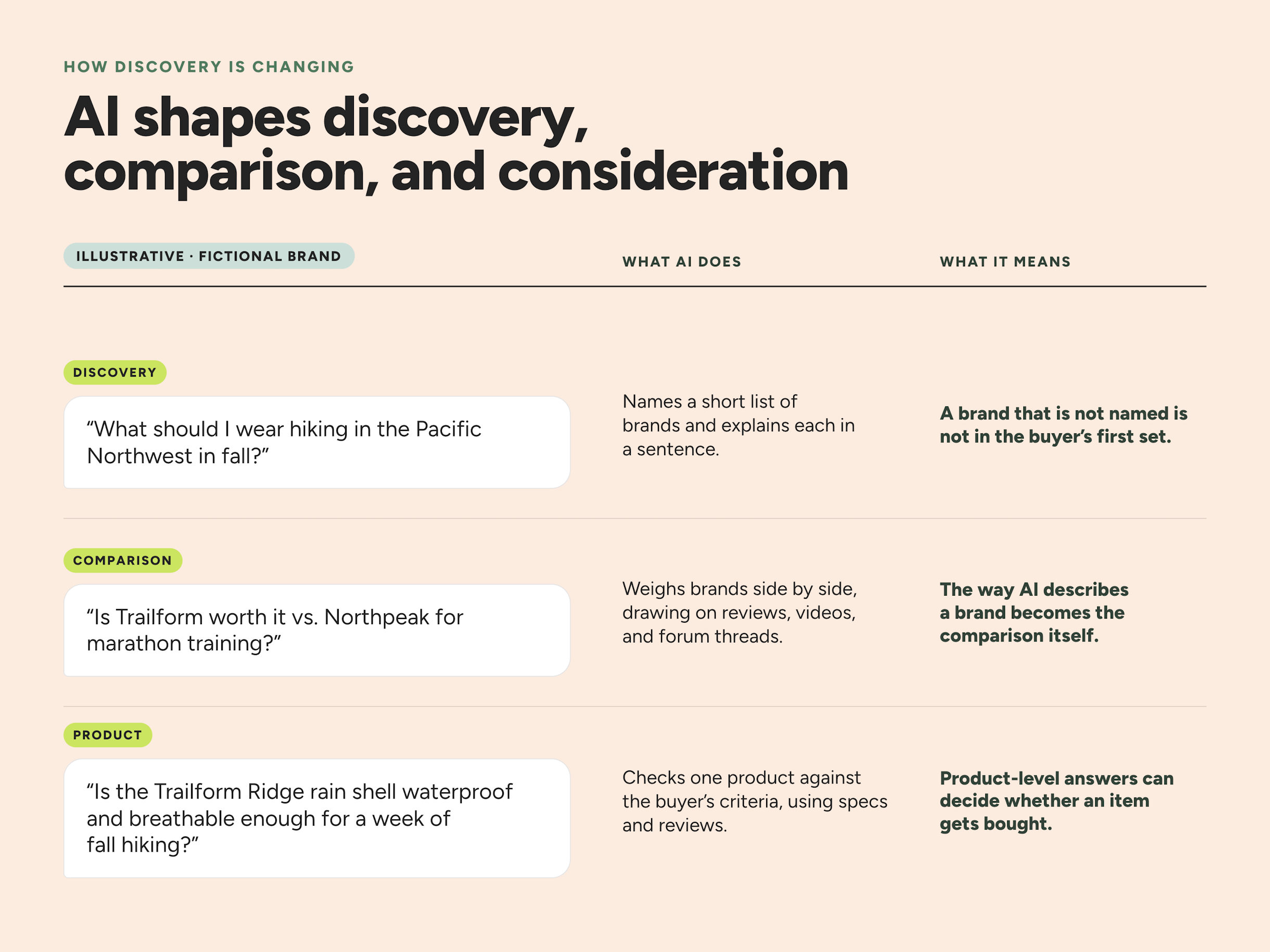
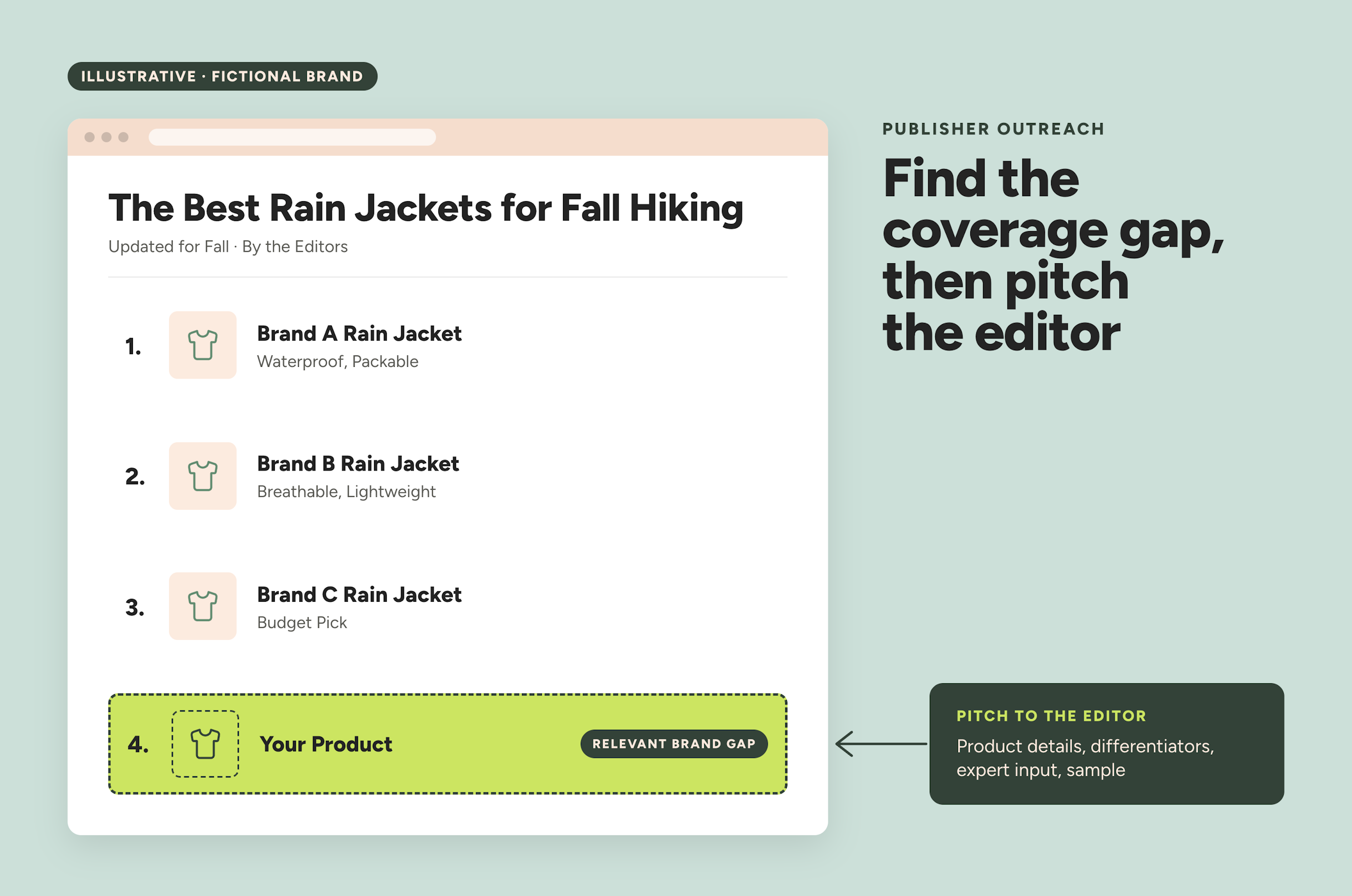
Different answers point to different priorities. If the same buying guides appear repeatedly and feature competing rain jackets, the roadmap prioritizes publisher outreach. If AI can’t explain how your jacket fits over layers, a clearer product page or a creator demonstration is the better starting point.
What happens after the audit?
If you want a detailed plan, the roadmap is a separate next step. It puts the recommendations in order and spells out what to create or update, where it should appear, and what to measure. Depending on the findings, it can include briefs for your website, editorial partnerships, and creator content. Your team can use the roadmap to guide its own work or partner with New Engen to put it into action.
How can New Engen put the roadmap to work?
You can use the roadmap to guide your own team or work with New Engen to execute it. We recommend a mix based on what the audit uncovers.
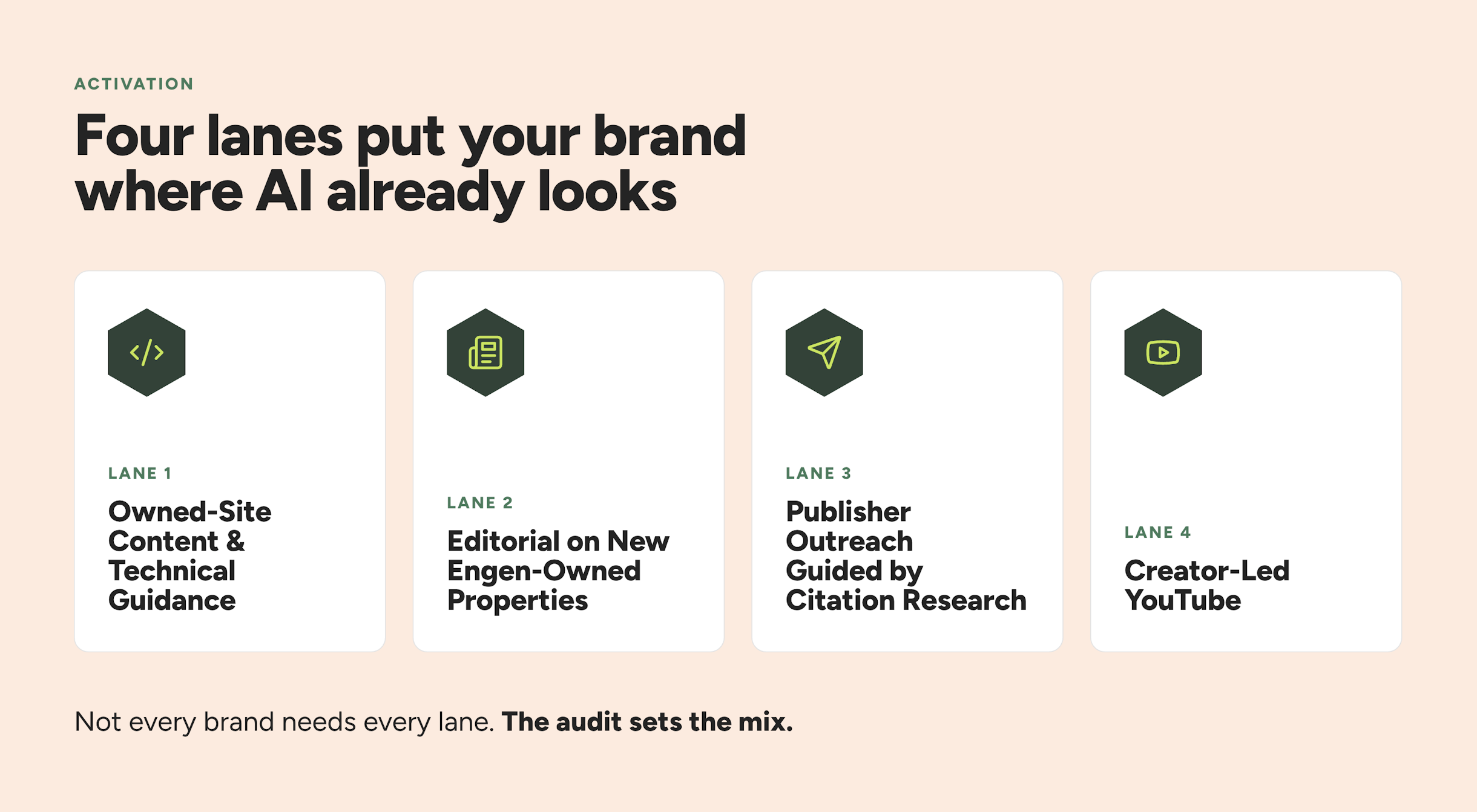
Website content and technical guidance. Update product pages, comparison guides, and FAQs, or create new content around questions your site should answer. We can also recommend technical changes that make important information easier to find.
New Engen-owned editorial. We own review and editorial properties, including My Subscription Addiction (MSA), which has published since 2012 and already appears in tracked AI answers. We develop reviews, comparisons, and buying guides there when the topic fits the audience. Where hands-on review makes sense, contributors bring firsthand experience and original photography to the story. We’re transparent about the relationship: we own these properties, and sponsored content is labeled as such.
Publisher outreach. Our Performance PR and affiliate teams use citation research to identify relevant publishers and pitch inclusion in existing guides or new stories. We support those pitches with product details, expert input, or samples where appropriate.
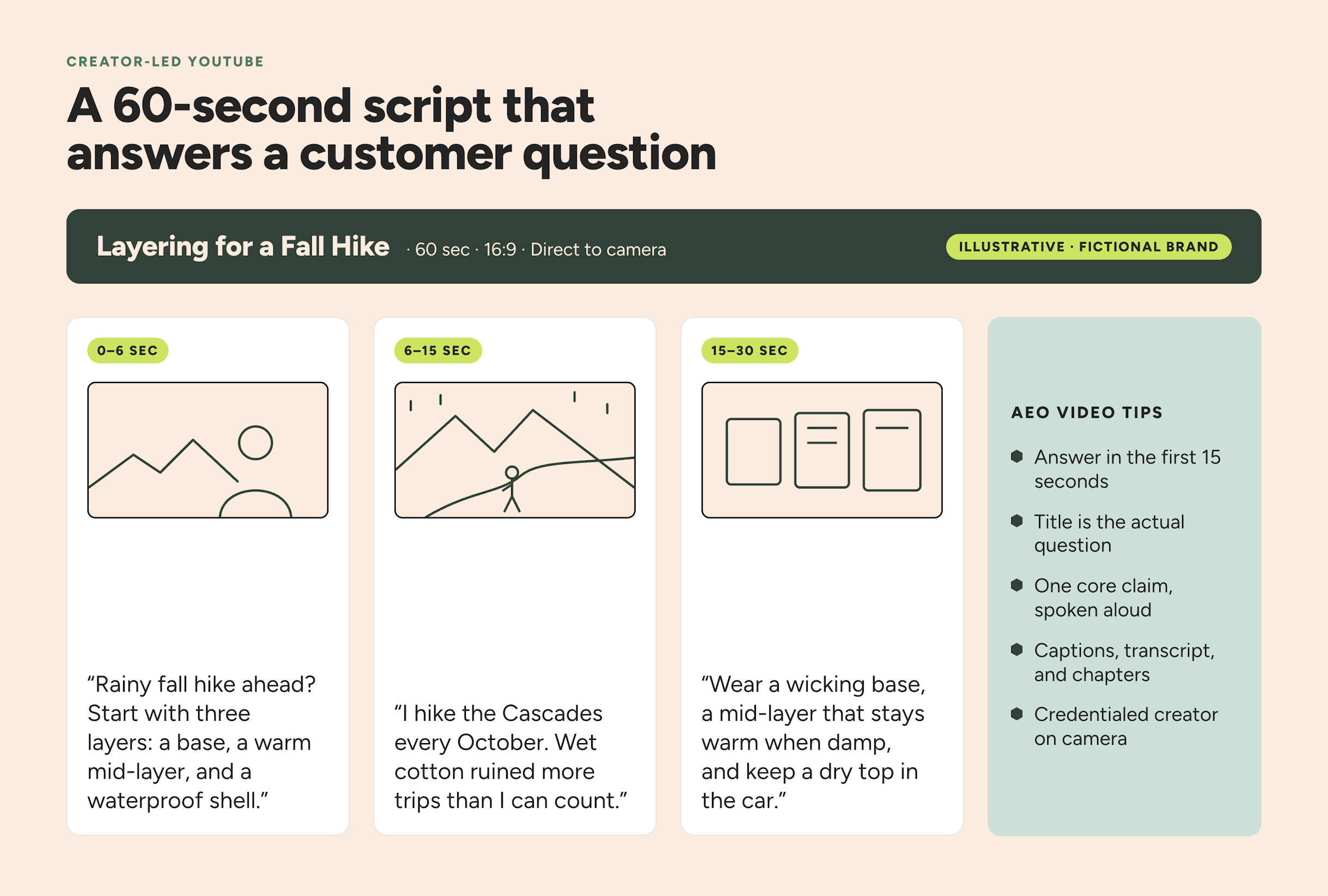
Creator-led YouTube. We match creators to specific buying questions and brief them to answer through firsthand experience or a product demonstration. Videos can publish through creator partnerships or on New Engen editorial channels.
How do you measure AEO success?
New Engen measures two things separately. First, we look at whether your brand shows up more often and is better represented in AI answers. Then we look at what happens when people click through to your site from an AI platform.
In AI answers. We compare results against your audit baseline across a defined set of customer questions. We look at how often AI names or recommends your brand, how accurately and specifically it describes you, which competitors appear, and which pages it cites. If we pursue coverage in a buying guide, for example, we track whether you earn that placement and whether AI starts citing the page in answers to relevant questions.
On your website. Where your analytics can identify AI referrals, we track visits, engagement, and outcomes such as leads, purchases, and revenue. A shopper can discover your brand in an AI answer and visit your site later through another channel, so referral data captures only part of that journey.
We establish a baseline at the start, share monthly visibility and citation updates, and review progress at 90 days. That readout helps us decide what to update, what coverage to pursue next, and which customer questions are worth adding to the tracking set.
What does this look like in practice?
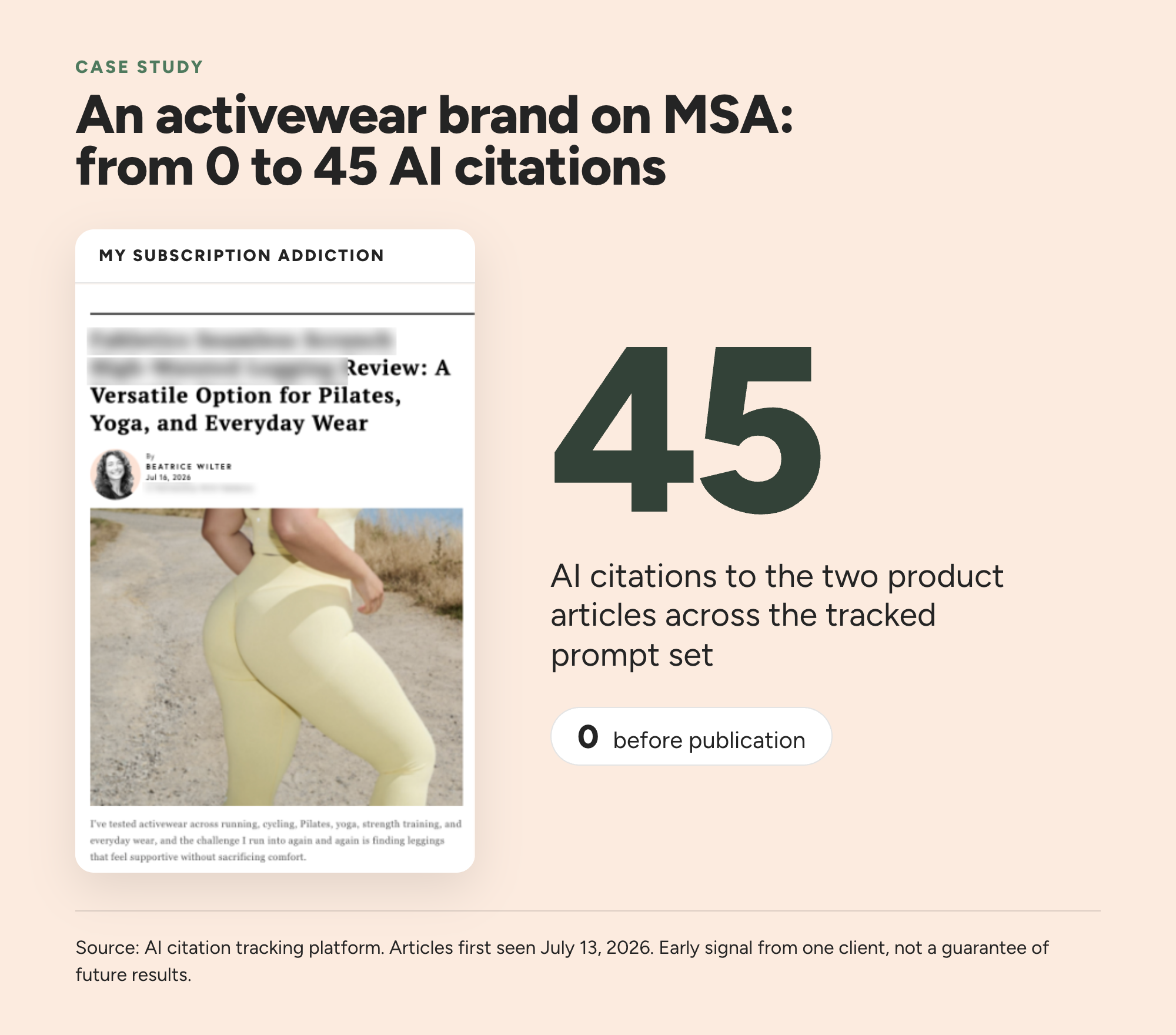
An activewear brand came to us after seeing My Subscription Addiction (MSA) cited in AI answers about its brand. We created two articles focused on specific products, and both appeared in subsequent AI citation tracking, earning 45 citations across the tracked prompt set, up from 0 before publication (July 2026 tracking snapshot; articles first seen July 13, 2026). This is an early signal from one client, not a guarantee of future results.
What happens after I request an AEO audit?
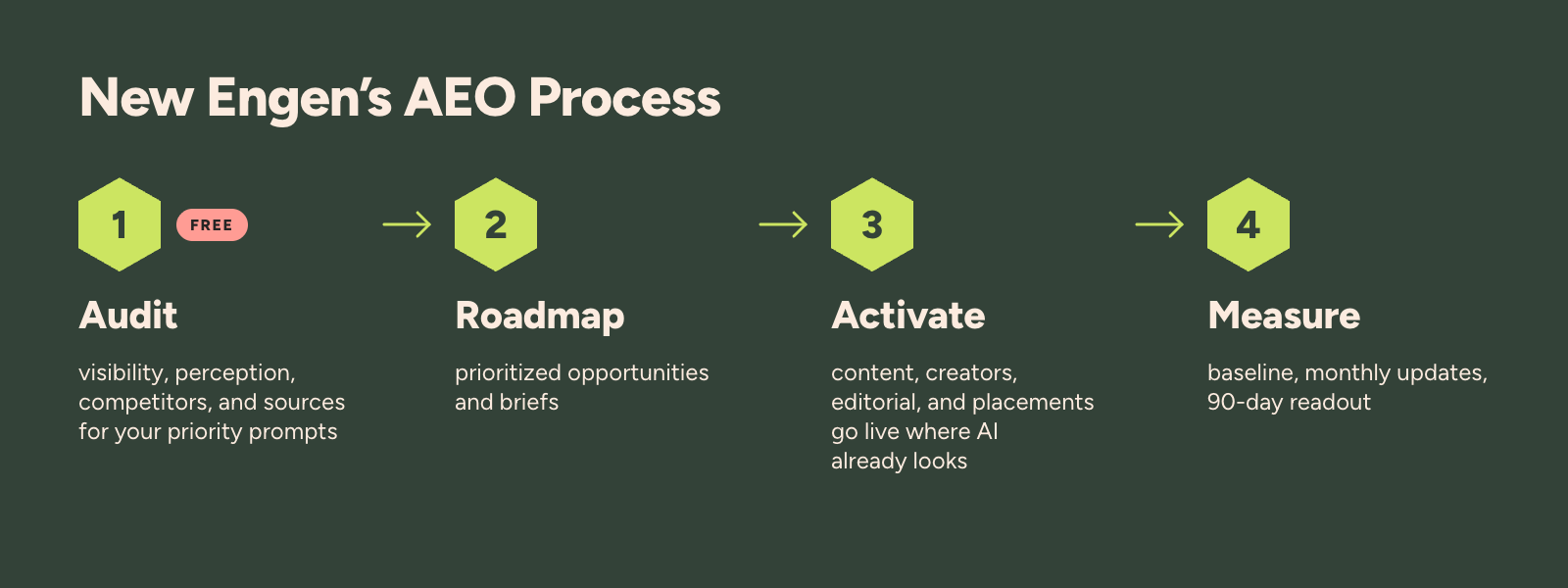
Audit. We review visibility, perception, competitors, and sources for your priority prompts and share high-level recommendations. The audit is free.
Roadmap. We add the context behind the findings and build a detailed plan: prioritized opportunities and briefs, with the lane mix that fits your brand.
Activate. Content, creators, editorial, and placements go live where AI already looks.
Measure. You get a baseline, monthly visibility and citation updates, and a 90-day readout.
Want to see who AI recommends when customers ask about your category? Your free audit shows when your brand appears, how AI describes it, which competitors it recommends instead, and which sources it cites, plus where to focus first. Tell us which products, services, or categories matter most, and we’ll build the audit around the questions your customers actually ask.
Frequently Asked Questions
Q1: If we already rank well on Google, do we still need AEO?
Yes, because strong rankings don’t reliably carry over. In Ahrefs’ March 2026 analysis, only about 37% of URLs cited in Google AI Overviews also ranked in the top 10 organic results for the same query. Established brands should check which competitors AI recommends instead of them, and challengers can earn consideration around the specific needs they serve best, even without years of accumulated search authority.
Q2: How many prompts should we track?
Most likely, fewer than your software allows. Tracking isn’t the bottleneck; acting on what you find is. We start with a focused set of questions covering discovery, comparison, and specific product decisions, then expand tracking as your strategy grows, so more of your budget goes to content and coverage instead of tracking volume.
Q3: How much does AI visibility software cost?
Larger brands can spend thousands of dollars per month on AI visibility software as they track more products, markets, and AI platforms. Profound and Searchable are two common options. Searchable lists its Enterprise plan at $999 per month and offers custom plans for broader coverage, while Profound provides custom enterprise quotes.
Start with the customer questions your team can act on. Leave room in the budget to update your site, create content, and pursue coverage. Expand tracking when the additional data will help you make a specific decision.
Q4: Where does AI get its answers about my brand, and can we influence those sources?
AI platforms cite a mix of brand websites, publisher reviews and buying guides, community discussions, and videos. That mix varies by platform. In an LLM Pulse seven-day snapshot, YouTube was the most-cited domain across the five platforms tracked, appearing in 9.74% of answers with citations, followed by Reddit at 6.70%. Gemini cited Reddit most often (7.51%), while ChatGPT’s top sources included the U.S. National Institutes of Health website (4.12%). See LLM Pulse’s daily rankings of the most-cited domains by platform.
For your brand, we look at the specific pages, threads, and videos each platform cites when answering your customers’ questions. If the same buying guides repeatedly feature competitors, we can pitch your brand for inclusion. If the answers lack a detail shoppers need to make a decision, we can clarify it on your site or show it in a creator video.
Q5: Do creators need a big audience for YouTube to help AI visibility?
Creators with smaller audiences can help brands answer more of the specific questions customers ask AI. We worked with a leading pet care marketplace to create YouTube videos designed to improve its AI visibility in priority markets and for specific pet care needs. Most of the creators we partnered with had fewer than 10,000 followers, which helped us produce more videos across those markets and use cases. Some videos were as short as 60 seconds.
Each video focused on one question, such as how to find a reliable dog walker for a high-energy dog. We briefed creators to answer the question directly, explain what they knew from firsthand experience, and include concrete details a pet owner could use to make a decision. We reinforced the topic in the title and captions so viewers and AI systems could identify the question the video answered and the experience behind the advice.
Q6: How do you choose the best answer engine optimization services for your brand?
The best answer engine optimization services for your brand should be able to explain which customer questions they’ll track, what they’ll do with the findings, and how they’ll measure progress. Look for a provider that can show how it would turn a finding into a decision. For example, if AI repeatedly cites buying guides that feature your competitors, ask which publishers the agency would prioritize, why your brand belongs in those guides, and how it would track new coverage and citations.
Q7: Does New Engen charge for the AEO audit?
No, the audit is free. Anyone can submit a request for one, but submitting a request doesn’t guarantee an audit. New Engen has the final say on which brands we do or don’t audit. The roadmap that follows is a separate next step, and you can use it to guide your own team or work with New Engen to put it into action.